


Traditional Asian Hall Table
These traditional asian hall table pieces bring solid elm, carved hardwood, and lacquered surfaces into an entranceway, offering functional display space rooted in centuries of Chinese provincial and Qing Dynasty design.
Traditional Asian Hall Table
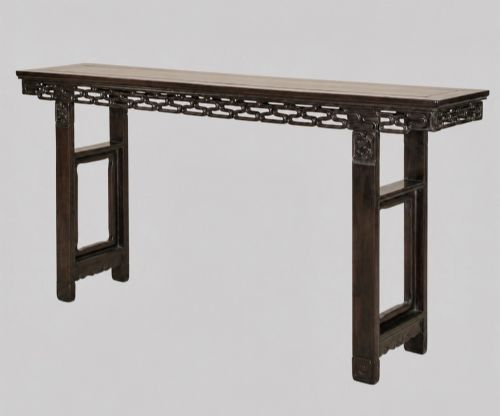
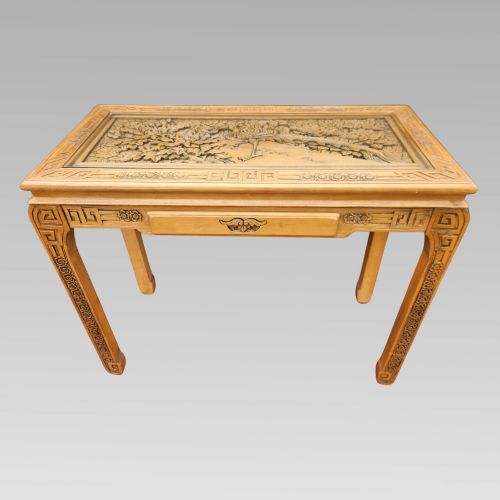
When you search for a traditional asian hall table, you are looking at furniture designed primarily for placement in hallways, reception rooms, and living spaces. The selection includes console tables, altar tables, side tables, and writing desks originating from various Chinese regions.
The pieces you are most likely to meet on this page date from the eighteenth century through to the early twentieth century, spanning the late Qing Dynasty and the 1900s. Elm and various hardwoods dominate the forms, frequently appearing alongside red or black lacquer finishes and marble inserts.
Makers and workshops produced these items to serve practical domestic and ceremonial functions, ranging from simple side tables with drawers to large carved altar tables. Stylistic variations cover Chinese provincial, regional, traditional, and export designs, including occasional demi-lune configurations.
How they were made
Makers relied on durable regional timbers such as elm, camphorwood, and dense hardwoods to construct the frames and surfaces of these tables. These woods provided the structural integrity required for heavy use in domestic settings and ceremonial spaces.
Surface decoration frequently involved layers of red or black lacquer applied to the timber, sometimes accented with brass hardware or inset marble tops. Carving techniques were utilised on specific hardwood and elm examples to add linear detail and floral or geometric motifs.
Listings feature items spanning the eighteenth century to the early twentieth century, constructed from elm, hardwood, camphorwood, and lacquered wood.
What varies in quality
The refinement of the carving work and the crispness of the joinery set higher grade pieces apart from simpler utility furniture. Hardwood and older elm examples with intact lacquer or well-fitted marble tops generally represent the upper tier of construction.
Proportion and the balance of the proportions between the legs and the tabletop influence the visual success of each console or altar table. Tables retaining their original brass hardware and deep patination on the timber command closer attention from collectors.
The Traditional Asian Hall Table Glossary
- Altar Table
- A long, narrow table traditionally used for ancestral worship or ritual display in Chinese homes, characterised by upturned flanges or recessed legs.
- Console Table
- A flat-topped table designed to stand against a wall, frequently utilised in hallways and entrance spaces.
- Elm
- A resilient, figured timber commonly employed by Chinese provincial makers for domestic tables and side furniture.
- Lacquer
- A durable resin finish applied in multiple coats to wood surfaces, yielding a smooth red or black sheen.
- Qing Dynasty
- The final imperial dynasty of China, lasting from 1644 to 1912, associated with substantial output in traditional furniture.
Traditional Asian Hall Table: Frequently Asked Questions
What is an altar table used for?
These tables originally served ceremonial functions in domestic settings, holding ritual objects, incense burners, or ancestral tablets. Today, buyers utilise them in hallways and living areas as striking console tables for display.
The elongated proportions and characteristic upturned ends make them well-suited for narrow spaces where a standard table might feel too deep.
How do I identify elm furniture?
Elm exhibits a distinct, interlocking grain pattern with visible growth rings and a warm tone that deepens with age and handling. It served as a primary material for provincial Chinese cabinetmakers due to its toughness.
Over the centuries, this timber develops a dry, tactile patination that helps distinguish older elm tables from modern reproductions.
Are lacquer finishes original?
Many pieces retain historical red or black lacquer applications, though some surfaces show evidence of later maintenance or re-touching by workshops. The presence of craquelure and minor wear indicates age and long-term use.
Inspecting the layers around joints and corners helps determine whether the finish has survived intact since the nineteenth or early twentieth century.
Where should I place a console table?
These pieces function effectively in entrance halls, against living room walls, or behind sofas to provide surface area for lamps and decorative objects. Their shallow depth allows them to fit into passageways without blocking movement.
Pairing a wooden or lacquered console with appropriate wall art creates a balanced focal point in a room.