
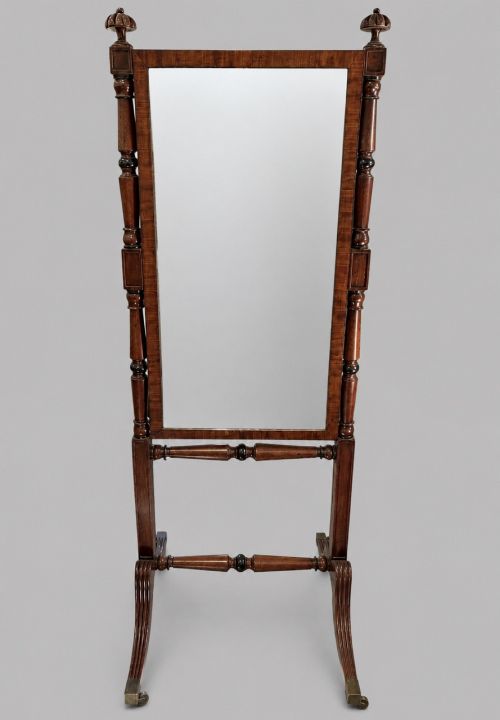


Timber Full Length Mirror
A timber full length mirror gives a room scale and light, bringing together wood frames and tall glass in pieces that span the nineteenth and twentieth centuries.
Timber Full Length Mirror
When you search for a timber full length mirror, you find tall glass held in wooden frames designed to stand on the floor or hang upon a wall. The pieces appearing here range from freestanding cheval mirrors to wall-hung mirrors and dressing tables spanning the nineteenth and twentieth centuries.
Victorian and nineteenth century examples often use mahogany, satinwood, or rosewood, while later items bring in painted finishes and black frames. You encounter French carved wood, Swedish Grace designs, and English country pieces among the selection.
Freestanding cheval mirrors tilt within supporting frames, while pier mirrors and wall mirrors secure directly to vertical surfaces. Dressing tables incorporate mirrors into larger furniture forms intended for bedrooms and dressing rooms.
How they were made
Cabinet makers constructed the frames using solid timbers including mahogany, oak, satinwood, and rosewood, often applying marquetry inlay or paint to the wooden surfaces. Carved wood decoration appears on nineteenth century French examples, alongside brass fittings that secure pivoting cheval mechanisms.
Glass plates rest within rebated wooden frames, sometimes accompanied by mercury backing on twentieth-century pieces. Paint finishes cover carved wooden columns and plain borders, creating solid colour or contrasting tones across the frame.
Some nineteenth-century dressing mirrors tilt so freely they require a velvet wedge to hold still during an energetic morning inspection.
What varies in quality
The sophistication of the timber and the crispness of the carving distinguish finer pieces from simpler domestic items. Marquetry inlay, choice mahogany or satinwood grains, and substantial brass mounts indicate greater workshop investment.
Proportion and scale dictate the visual weight of the mirror, with larger carved frames requiring careful balance to support tall glass plates effectively. The integration of the frame with its support legs or hanging brackets shows the underlying joinery skill.
The Timber Full Length Mirror Glossary
- Cheval mirror
- A freestanding full length mirror mounted on a vertical frame with pivots that allow the glass to tilt. This form became popular during the nineteenth century for bedroom dressing.
- Pier mirror
- A tall mirror designed specifically to hang on the wall between two windows, often placed above a pier table. These pieces reflect additional light into rooms.
- Satinwood
- A hard, durable timber with a golden sheen and fine grain, frequently used for high-quality nineteenth-century cabinet work and inlay. It provides a pale, reflective surface.
- Marquetry
- The art of applying decorative pieces of veneer to a structure to form intricate patterns or pictures. Craftsmen utilise contrasting woods to achieve detailed surface decoration.
- Mercury mirror
- A looking glass produced using a tin and mercury amalgam backing before modern silvering techniques were adopted. This method creates a distinctive mottled reflection over time.
Timber Full Length Mirror: Frequently Asked Questions
What is a cheval mirror?
A cheval mirror is a freestanding full length glass plate supported by a frame with pivot pins, allowing the user to tilt the angle of the glass. These pieces stand directly on the floor without requiring wall fixings.
Originating in the eighteenth century and remaining popular through the Victorian era and beyond, they served as practical dressing room furniture where people could check complete outfits.
Where should I place a pier mirror?
Pier mirrors hang on the wall in narrow wall spaces, traditionally between two windows or above low mantelpieces and side tables. Their tall, narrow proportions draw the eye upward and amplify natural light within a room.
In modern rooms, they work effectively above console tables in hallways or as vertical accents in sitting rooms where floor space is limited.
How do I date a timber mirror?
Dating relies on observing the timber species, construction methods, frame style, and the manufacturing technique of the glass itself. Victorian pieces often feature mahogany or satinwood with hand-finished joints, while later pieces adopt painted finishes or Art Deco geometry.
Checking the reverse of the frame and the mounting hardware also reveals clues about the period of manufacture and whether components have been replaced.
Are painted wooden mirrors original?
Many nineteenth-century French mirrors feature painted wooden frames that were decorated as part of their original design. Craftspeople applied paint over carved wood to match specific interior decorative schemes.
Examining the wear patterns and the relationship between the paint layer and the wood beneath helps confirm whether the surface finish dates to the period of the frame's creation.