

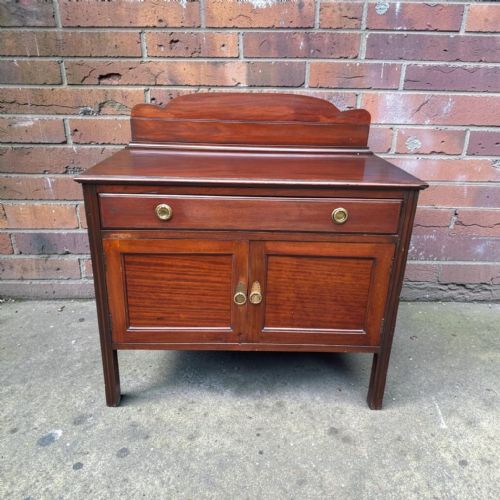
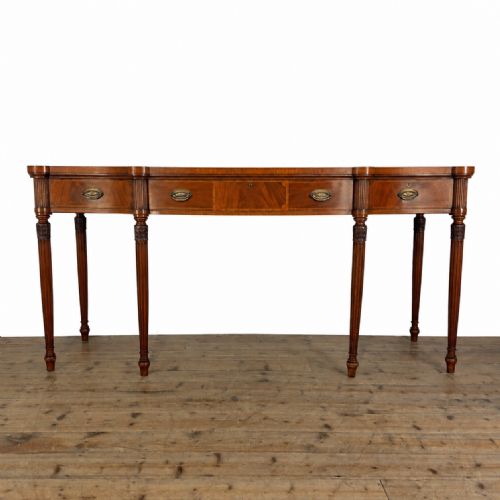
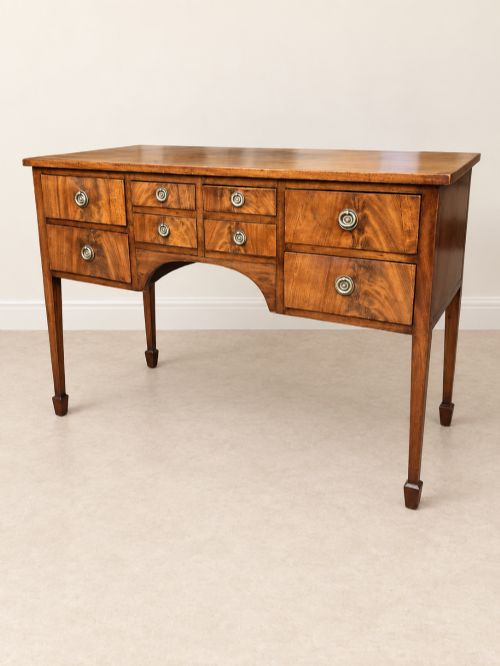
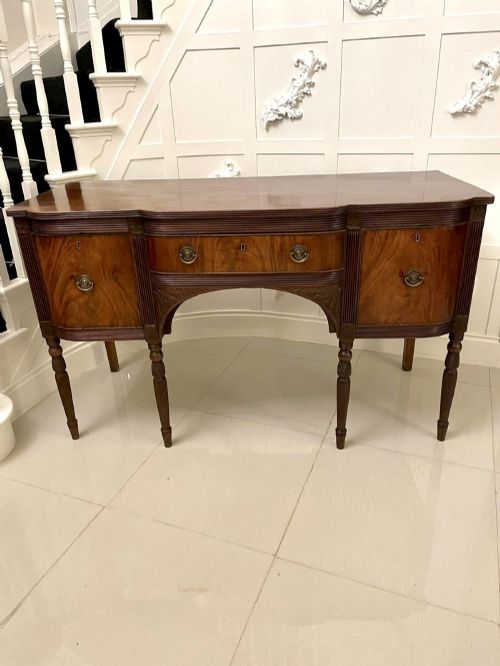
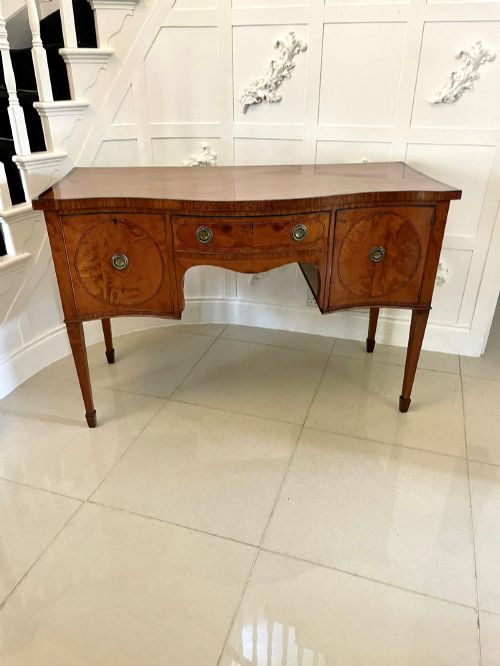
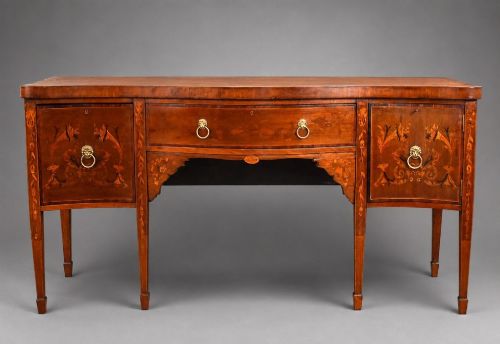
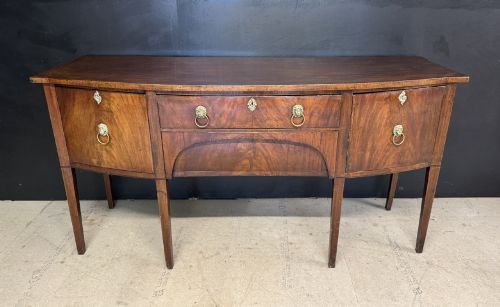
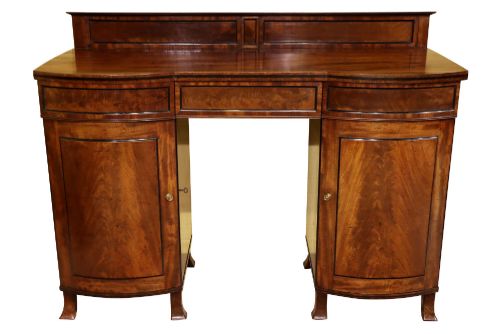
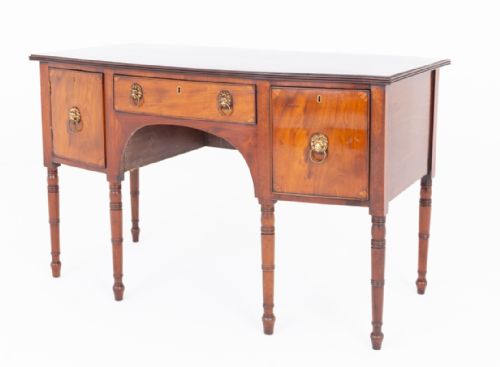
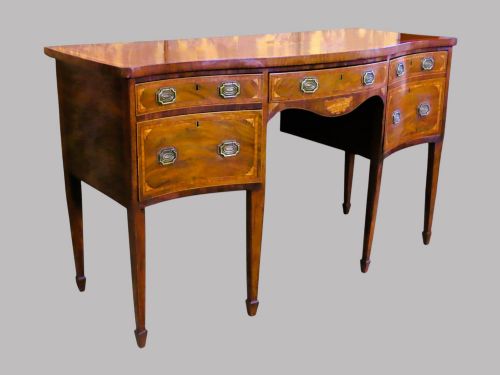


Timber Dining Credenza
A timber dining credenza organises the dining room, uniting solid mahogany and flame veneers with centuries of refined cabinetmaking.
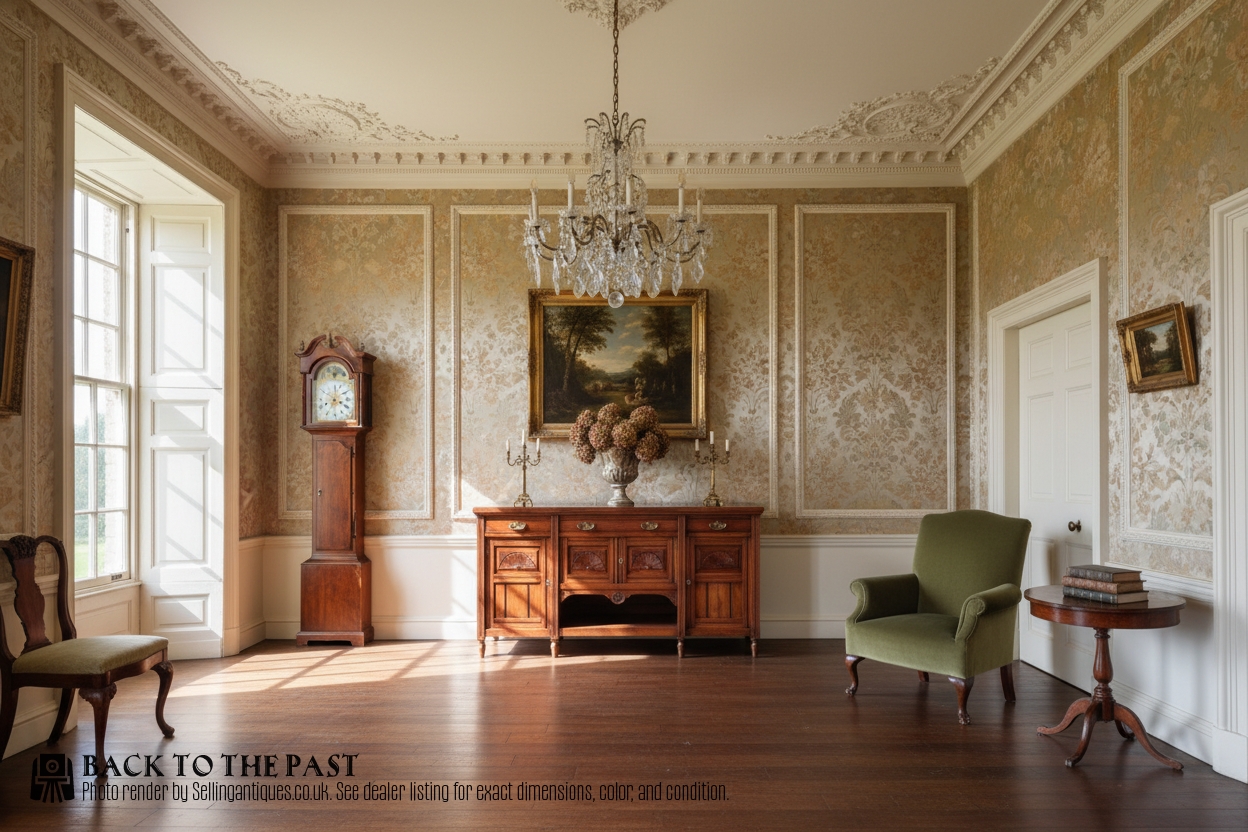
Timber Dining Credenza
When you search for a timber dining credenza, you are looking at substantial serving furniture designed for the dining room. These pieces function as sideboards, buffets, serving tables, and side cabinets.
The pieces on this page span the Georgian, Regency, William IV, Victorian, Edwardian, and Art Deco periods. You are most likely to meet mahogany examples with bow fronts or serpentine shapes, alongside satinwood and walnut variations.
Origins stretch from the eighteenth century through the nineteenth century and into the early twentieth century. Makers and cabinetmakers utilised boxwood inlay, brass fittings, and glass to elevate these dining room pieces.
How they were made
Cabinetmakers constructed these pieces primarily from solid timber and selected veneers, employing mahogany, flame mahogany veneer, burr elm, satinwood, walnut, and rosewood. These woods provided durable structures and rich grain patterns suitable for formal dining rooms.
Surface decoration relied on boxwood inlay, boxwood stringing, and brass hardware to define borders and drawer pulls. Carving and mirror backs appeared on later Victorian and Edwardian examples to add visual weight.
Construction techniques encompassed serpentine, breakfront, and bow front shaping, requiring precise joinery to curve timber and veneer effectively. Glass elements were integrated into display sections where designated as display whatnots.
Timber Dining Credenza Retail Price Guide 2026
Typical asking prices for timber dining credenza among the pieces listed under this phrase on Sellingantiques today, from the lower quarter to the upper quarter. They describe what is for sale here now, not the wider market.
A solitary Kilkenny workshop left its name stamped in nineteenth-century mahogany.
What varies in quality
The selection of timber dictates much of the visual standard, separating standard stock from pieces utilising highly figured flame mahogany, burr elm, or fine satinwood. Grain alignment across drawer fronts shows the tier of craftsmanship involved.
The complexity of the carcass shape separates simpler forms from superior examples. Serpentine fronts and breakfront profiles demand advanced woodworking skill compared to straight or plain bow front designs.
Inlay work and hardware integration reveal the hand of the maker. Fine boxwood stringing and crisp boxwood inlay demonstrate precision, while robust brass fittings complete the construction.
The Woodworkers Ltd Kilkenny
The Timber Dining Credenza Glossary
- Serpentine front
- A furniture front curving outward in the centre and inward at the ends. This shape requires skilled carpentry to execute properly.
- Bow front
- A convex, outwardly curved front profile popular in Georgian and Regency cabinetmaking. It softens the linear appearance of a dining room sideboard.
- Breakfront
- A large piece of furniture where the central section projects forward from the flanking sides. This architectural arrangement creates depth and shadow.
- Boxwood inlay
- Light-coloured boxwood set flush into dark timber surfaces to create contrasting geometric or floral patterns. It highlights drawer borders and tabletops.
- Flame mahogany veneer
- Timber sliced from the fork of a mahogany tree to produce a flickering, flame-like grain pattern. Cabinetmakers prized this for central drawer and door panels.
Timber Dining Credenza: Frequently Asked Questions
What is a timber dining credenza?
A timber dining credenza is a large serving piece placed in a dining room to hold tableware, linen, and food during meals. These items encompass sideboards, buffets, and serving tables.
They evolved through various periods from Georgian times to Art Deco, utilising woods like mahogany, walnut, and satinwood.
How do I date a timber sideboard?
Dating relies on observing the combination of wood species, hardware, and structural style. Georgian pieces often feature simple elegance with boxwood inlay, while Victorian examples introduce heavy carving and mirror backs.
Period markers such as Regency curves or Edwardian proportions help narrow down the decade of manufacture.
Where were these pieces used?
These cabinets belonged in formal dining rooms of houses and estates. Servants used the tops to present dishes before serving while storing cutlery and glassware within.
Today they serve similar organizational and decorative functions in modern dining spaces.
What is the difference between a sideboard and a buffet?
Sideboards and buffets both provide storage and surface area in the dining room, though terminology shifted across centuries. Sideboards often include pedestals or tapering legs, whereas buffets frequently emphasise lower cabinet space.
Both categories appear across the Georgian and Victorian eras.
How do I care for antique mahogany?
Antique mahogany requires stable indoor humidity away from direct heat sources to prevent timber splitting. Regular dusting with a soft, dry cloth preserves the polished surface.
Avoid silicone-based polishes and apply traditional wax sparingly when the wood appears dry.