
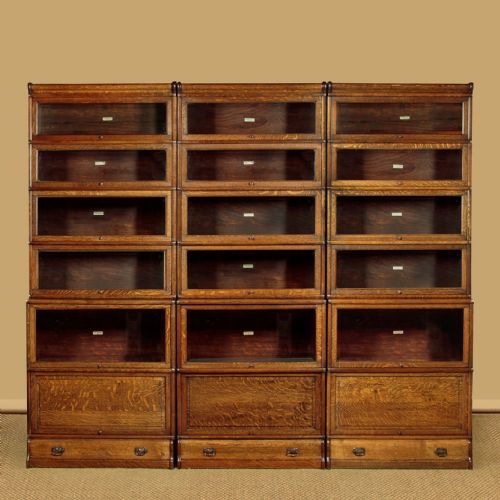


Three Section Bookcase
A three section bookcase offers substantial proportions and versatile compartmentalised storage, making it a practical anchor for extensive home libraries.
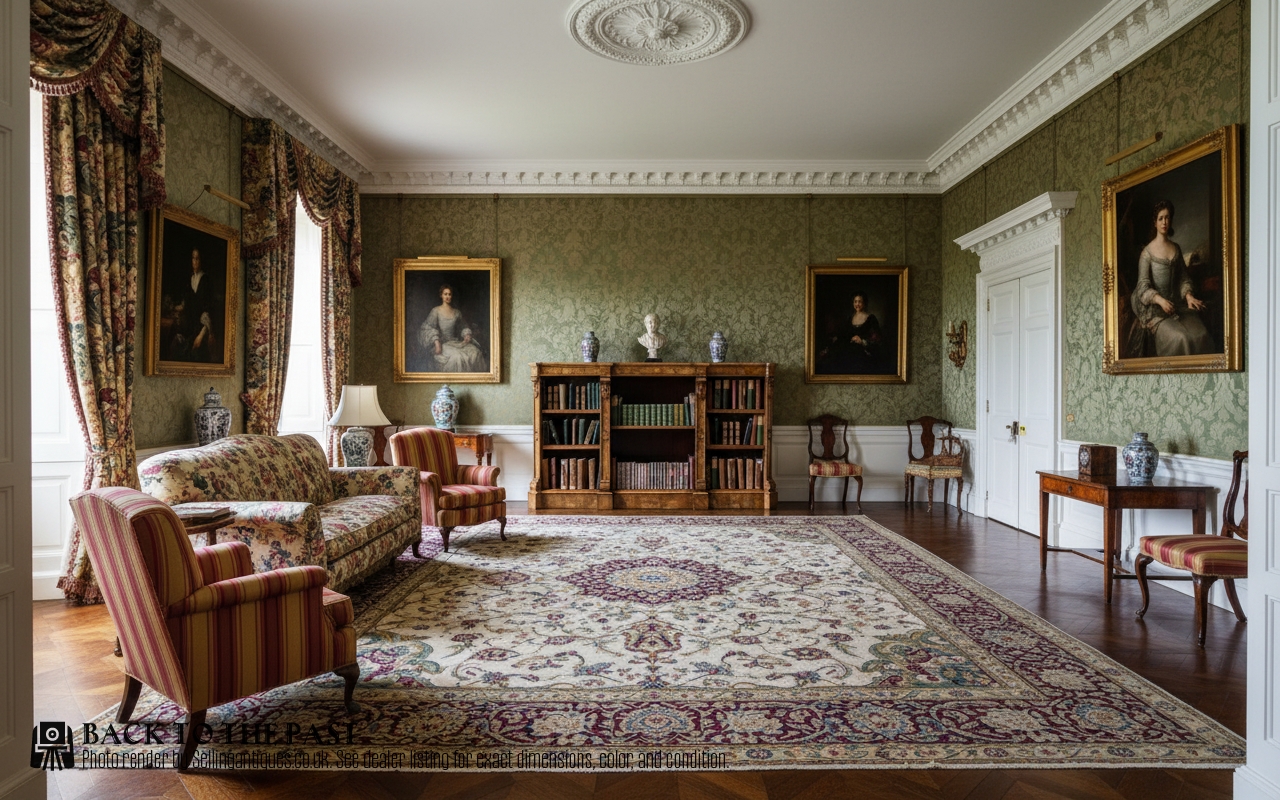
Three Section Bookcase
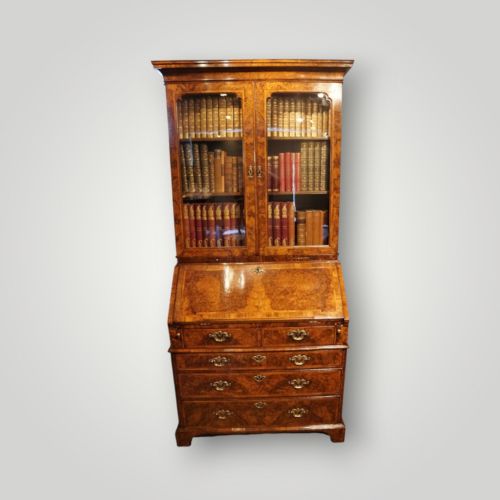
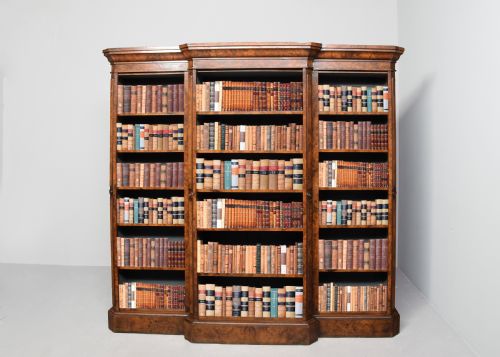
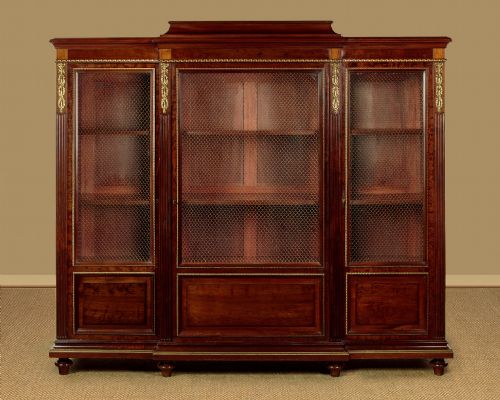
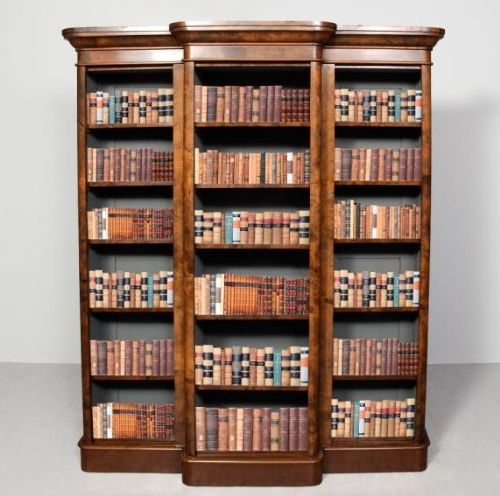
A three section bookcase splits into three distinct vertical bays or horizontal modular tiers, providing an organised structure for large collections of volumes. The evidence shows these pieces appearing primarily in Victorian, Edwardian, and later twentieth-century periods, spanning open breakfront formats and glazed stacking lawyer styles.
Makers such as Minty, Gunn, and Wm Baker Oxford represent the stacking office tradition, whereas the breakfront open bookcases showcase nineteenth-century cabinet-making. Buyers encounter everything from elaborate neoclassical mahogany to utilitarian arts and crafts elm.
How they were made
Makers utilised solid timbers alongside carefully selected veneers, applying burr walnut, pollard oak, and figured mahogany to display rich natural grain patterns across the primary facades. Carcasses often incorporate softwood or elm for internal shelving and secondary framing.
Glazing takes the form of fitted wire mesh or glass panes set within timber doors, whilst stacking modular versions employ internal brass mechanisms and lift-and-slide panel hardware. Inlaid details, brass mounts, and adjustable shelf brackets complete the structural execution.
Retail Price Guide 2026
Typical UK retail prices for three section bookcase, calculated from the Sellingantiques database of over a million retail prices indexed since 2003. This retail price guide relies exclusively on Sellingantiques data; no external sources or auction records are used, so the figures do not describe the wider market.
Listings span 1850 to 1930, featuring burr walnut, mahogany, oak, elm, and brass fittings across Victorian, Edwardian, and Arts and Crafts styles.
What varies in quality
Excellence in these pieces rests upon the choice of timber veneer and the precision of the breakfront alignment, where continuous grain patterns across all three sections mark superior craftsmanship. Lesser examples rely on plain timber stock with minimal figure and heavier secondary woods.
Hardware integration and shelf adaptability also separate the workshop tiers, distinguishing purpose-built library furniture from modular office stacking units. The execution of inlaid decorative bands and the integrity of brass mounts further indicate the maker's original investment of time.
Minty Library Specialist·E.S.A London·Wm Baker Oxford·Gunn
The Three Section Bookcase Glossary
- Breakfront
- A cabinet design where the central section projects forward from the flanking side bays. This configuration adds architectural depth to large library pieces.
- Globe Wernicke
- A modular stacking bookcase system featuring glazed lifting doors that slide into the cabinet above each shelf. It became popular for office and home libraries during the early twentieth century.
- Burr walnut
- Timber harvested from the gnarled growths of walnut trees, yielding swirling patterns prized for cabinet facades. It appears frequently on nineteenth-century open bookcases.
- Figured walnut
- Wood grain possessing natural ripples and distinct patterns that catch the light. Cabinet-makers matched these figures symmetrically across large bookcase doors.
- Softwood
- Non-dense timber used for internal framing, drawer linings, and bookcase backs. It provides a stable, lightweight substrate for expensive decorative veneers.
Frequently Asked Questions
How do stacking bookcases work?
Stacking bookcases consist of individual modular tiers that sit one on top of another beneath a separate base and cornice.
Each tier typically incorporates a glazed door that lifts and slides back into the cavity above the books.
Are the shelves adjustable?
Many traditional open bookcases provide adjustable shelving supported by wooden ratchets or metal pins.
Modular stacking versions feature fixed internal heights dictated by the dimensions of each individual section.
What woods were used?
Cabinet-makers utilised rich hardwoods like mahogany, walnut, and oak for visible exterior surfaces and decorative veneers.
Secondary timbers such as softwood and elm often appear on internal linings and cabinet backs.