
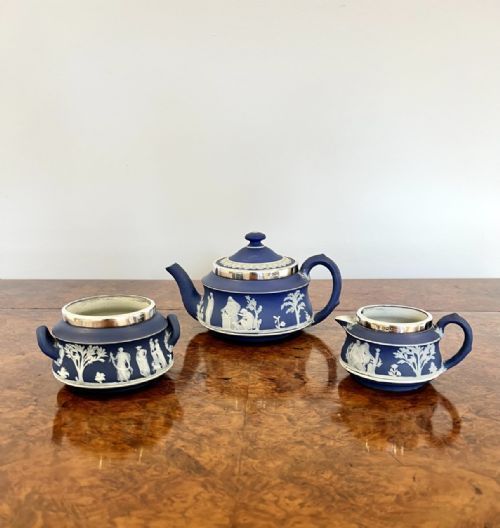


Three Piece Tea Service
A three piece tea service brings traditional hospitality to the table, offering a matched set for pouring daily tea.

Three Piece Tea Service
A three piece tea service comprises a teapot, a milk jug and a sugar basin designed to match in style and material. These sets appear across Victorian, Edwardian and Art Deco periods, spanning the nineteenth and twentieth centuries.
The versions most common on this page are Edwardian silver plated sets alongside solid silver services from various decades. Buyers also encounter ceramic variations featuring Jasperware and stoneware mounted in silver.
Forms range from plain domestic sets to ornate pieces decorated with grapevine detailing or traditional embossing. Each service provides the core vessels required for serving tea in a formal or informal setting.

How they were made
Silver plating on base metal became widespread during the Victorian and Edwardian eras, offering the appearance of solid silver at a lower cost. Manufacturers applied a thin layer of silver to a supportive metal body through electroplating.
Solid silver sets involved smiths hammering, raising and soldering sheet silver into hollowware forms. Handles often incorporated insulators made from ebonised wood or ebony to prevent heat transfer from the boiling pot.
Three Piece Tea Service Retail Price Guide 2026
Typical asking prices for three piece tea service among the pieces listed under this phrase on Sellingantiques today, from the lower quarter to the upper quarter. They describe what is for sale here now, not the wider market.
What varies in quality
The weight of the metal and the thickness of the silver plate dictate the substantial feel of a three piece tea service. Thicker plating resists wear through generations of polishing and daily use.
Detailing distinguishes standard production from finer work, seen in crisp embossing, cast handles and balanced spouts. Maker marks from established firms indicate higher standards of silversmithing and design.
Walker & Hall·Goldsmiths & Silversmiths Co.·Henry Clifford Davis·A. Davenport·Harrods
The Three Piece Tea Service Glossary
- Hollowware
- Vessels such as teapots, jugs and basins formed from sheet metal rather than cast solid. These pieces require skilled raising and joining.
- Silver Plate
- A base metal coated with a thin layer of silver. This technique provided an affordable alternative to solid sterling silver.
- Jasperware
- A type of fine stoneware developed by Josiah Wedgwood, known for its matte surface and applied white reliefs. It frequently appears mounted in silver on tea sets.
- Hallmark
- A stamp indicating the purity of the metal, the maker and the assay office. These marks help date solid silver services accurately.
- Insulator
- Spacer rings fitted into metal handles to keep them cool. They are typically fashioned from ebony or ebonised wood.
Three Piece Tea Service: Frequently Asked Questions
What pieces are in a three piece tea service?
A standard three piece tea service includes a teapot, a milk jug and a sugar basin. Together they provide the essential vessels needed for hosting tea.
Additional items such as a matching tray or hot water kettle are absent in a three-piece configuration, which focuses strictly on the core trio.
How do I clean an antique tea service?
Cleaning depends on the material, requiring gentle silver polish for plated or solid silver surfaces. Soft cloths prevent scratching the softer metal.
Ceramic components like Jasperware need mild soapy water rather than abrasive cleaners to protect their delicate matte finish and white reliefs.
Can I use my silver tea service daily?
Silver and silver-plated services were built for regular domestic use and withstand everyday pouring when handled with care. Hand washing is essential to preserve the finish.
Avoid using dishwashers, as harsh detergents and high heat will damage silver plate and ruin ebonised wood handle insulators.
How do I date a silver tea service?
Solid silver sets carry hallmarks that reveal the exact assay office and year of manufacture through specific date letters. Maker marks also help narrow down the production period.
Plated sets rely on style indicators, patent marks and manufacturer catalogues, as official date hallmarks were not applied to base metals.