




Thatched Cottage Artwork
Thatched cottage artwork captures the enduring appeal of rural English pastoral life through Victorian and twentieth-century paintings.
Thatched Cottage Artwork
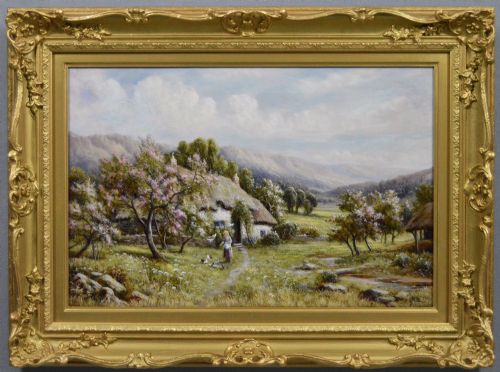
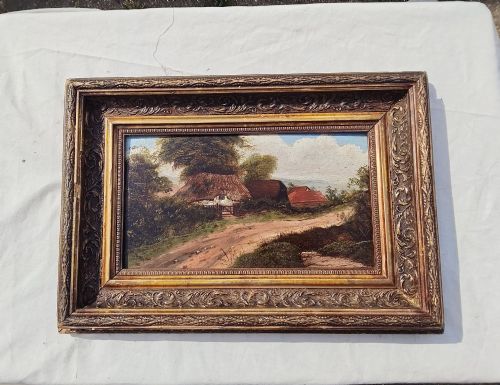
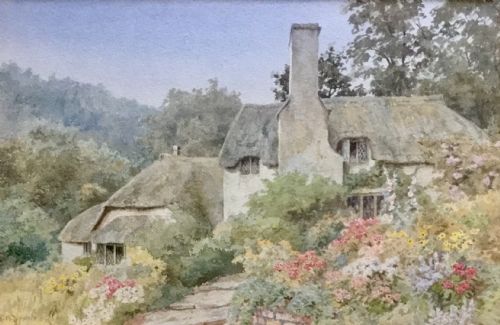
These pieces depict rural English scenes, centring on traditional cottages with straw roofs, gardens, and village landscapes. When searching for thatched cottage artwork, buyers encounter framed watercolours and oil paintings dating from the nineteenth and twentieth centuries.
The works span Victorian and Edwardian periods, stretching into the mid-twentieth century through styles like English pastoral realism and landscape painting. Most examples use paper or canvas mediums housed in wood and gilt frames.
How they were made
Artists worked primarily in watercolour pigment on paper or applied oil paints directly onto canvas and card. These traditional painting methods capture fine details of foliage, figures, and weathered roof textures.
Finished works received protective framing using wood, glass, and gilt mouldings to preserve the delicate pigments and surfaces of both watercolours and oil paintings.
What varies in quality
Quality rests upon the artist's ability to handle light, atmosphere, and architectural proportion within the pastoral setting. Works by listed academic painters display greater nuance in brushwork and composition than anonymous school pieces.
The preservation of the medium, especially the vibrancy of watercolour pigment against paper and the integrity of original gilt wood framing, elevates the standing of an individual piece.
Robert John Hammond·John McDougal·Harry Sylvester Stannard·Robert Hollands Walker·Thomas James Lloyd·Joseph Kirkpatrick·Walter Henry Sweet·Thomas Nicholson Tyndale·Arthur Claude Strachan·David Heward·Yeend King·Joseph Hughes Clayton·Georgina Lara·Thomas Rowlandson·Joseph Paul
The Thatched Cottage Artwork Glossary
- Watercolour
- A painting method where fine pigment is suspended in a water-based solution, typically applied to paper.
- Oil on Canvas
- A technique utilising pigment mixed with drying oil applied to a stretched cloth surface, common in nineteenth-century landscapes.
- English Pastoral Realism
- An artistic style focusing on authentic rural scenery, agricultural life, and countryside architecture.
- Gilt Wood
- Timber framing finished with a thin layer of gold leaf or metallic gilding.
Thatched Cottage Artwork: Frequently Asked Questions
What periods do these paintings come from?
The available selection spans from the nineteenth century through the Edwardian era and into the mid-twentieth century. Most examples originate from the Victorian and early 1900s periods.
Creators ranged from regional amateurs working in watercolour to established landscape painters exhibiting during the Georgian, Victorian, and later decades.
What mediums were used for these works?
Artists utilised watercolour pigments on paper alongside oil paintings executed on canvas or card. Many pieces combine these paint mediums with supportive wooden or gilt frames.
Selection includes both delicate watercolours protected under glass and robust oil on canvas compositions.
How do I care for framed watercolours?
Watercolour paintings require protection from direct sunlight to prevent the fading of delicate pigments on paper. Displaying them away from moisture sources keeps the paper and wooden framing stable.
Maintaining a stable indoor climate prevents the glass from trapping condensation that could damage the antique artwork.
What is English pastoral realism?
English pastoral realism is an artistic approach depicting authentic countryside scenes, village life, and rural architecture. These paintings record everyday rural settings without romanticised exaggeration.
Artists working in this style focused on accurate representations of cottages, figures, and surrounding farmland.