



Rural Genre Painting
Rural genre painting captures the everyday lives of country folk, farmworkers, and children amidst cottages and fields through the eyes of Victorian artists.
Rural Genre Painting
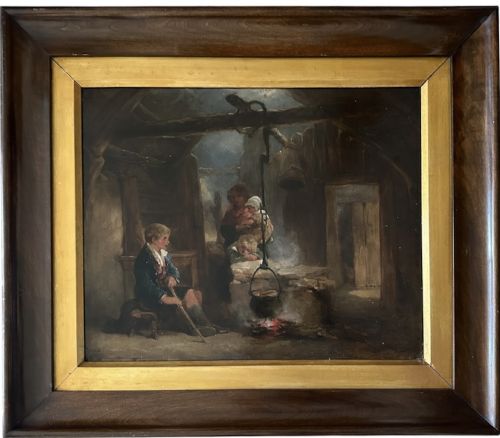
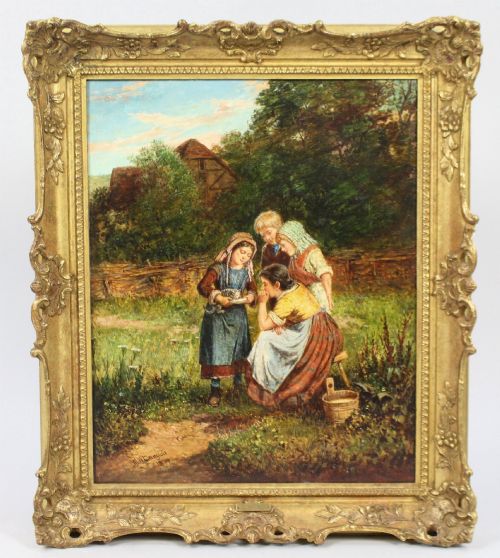
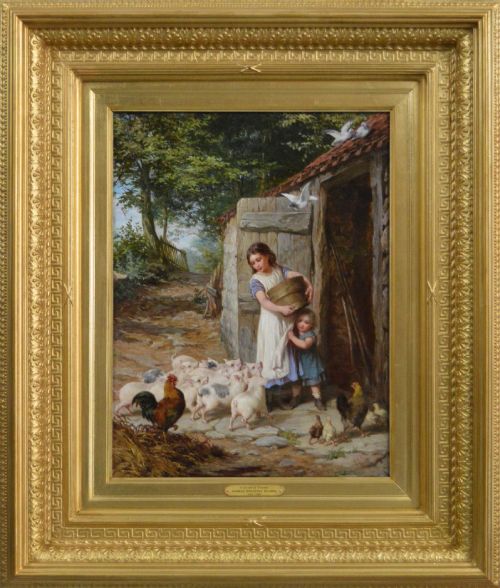
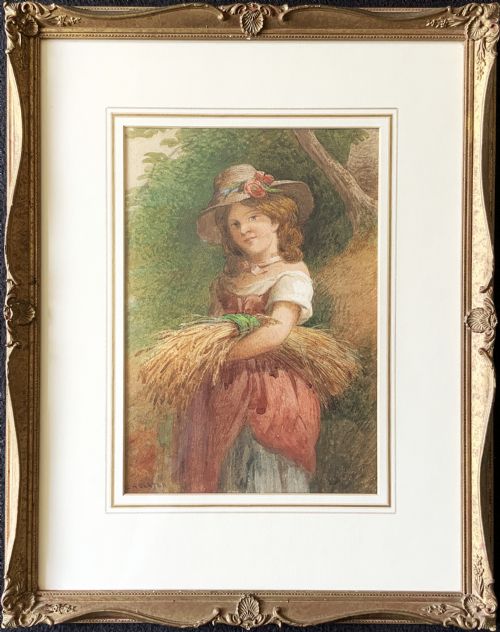
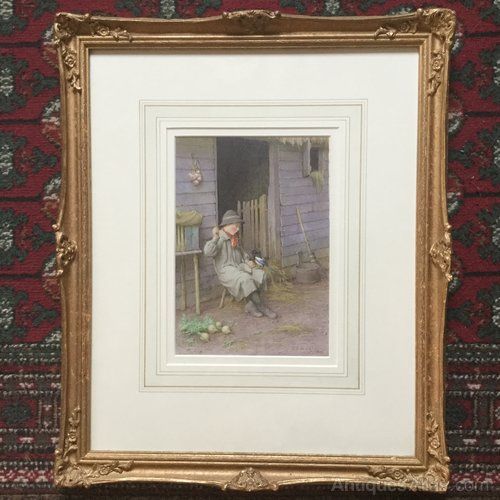
Rural genre painting focuses on domestic and farmyard scenes depicting cottage life, agricultural workers, and children with animals during the nineteenth and early twentieth centuries. These artworks frequently portray sentimental moments such as feeding animals, children playing near ponds, and farm laborers resting with their horses.
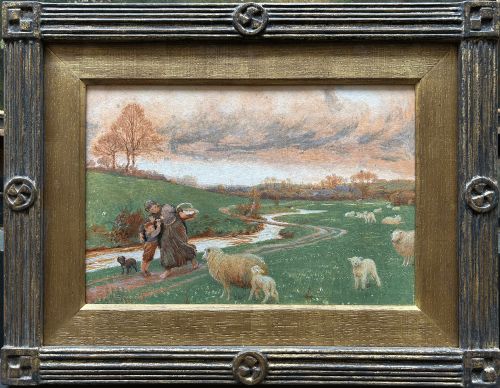
The pieces available here lean heavily into Victorian pastoral aesthetics produced across the nineteenth and early twentieth centuries, spanning the 1850s to the 1910s. Works range from intimate watercolours on paper to substantial oil paintings on canvas framed in gilt wood and gesso.
Materials and methods
Artists primarily utilised oil paint on canvas or board, alongside delicate watercolours on paper and lithographs. Canvases are frequently housed within decorative gilt wood and gesso frames that reflect the period taste.
Pigments were applied with varied brushwork to capture the textures of farmyards, livestock, foliage, and rustic clothing. Support materials like wood boards and heavy canvas underpin the survival of these nineteenth-century pieces.
Listings feature works spanning the nineteenth century up to the 1920s, executed in oil on canvas, watercolour, and lithography.
Separating the ordinary from the exceptional
Quality rests upon the artist's ability to render human expression, animal anatomy, and atmospheric light convincingly within a rustic setting. Skilled draughtsmanship in complex compositions featuring multiple figures and livestock elevates a piece above standard decorative works.
The handling of the medium, whether through the luminous transparency of a watercolour or the rich layering of an oil painting, dictates the visual depth of the scene. Furthermore, the integrity of the original gilt wood and gesso framing contributes significantly to the overall standing of an artwork.
Mark William Langlois·George Augustus Holmes·Miles Birkett Foster·Charles Henry Slater·Charles Edward Wilson·James Kyd·Henry John Yeend King·Arthur Longley Vernon·Helena Maguire·Edward Brice Stanley Montefiore·John Henry Dell·Ralph Hedley·Jane Maria Bowkett·George Kilburne·Vernon Stokes·Daniel Pasmore·Ernest Walbourn·Alfred Banner·John Frederick Herring Jnr·Edward Killingworth Johnson·Robert McGregor·Arthur Claude Strachan·George Cole·Henry Charles Bryant·William Stephen Coleman
The Rural Genre Painting Glossary
- Genre painting
- A style of art depicting scenes from everyday life, typically involving ordinary people engaged in domestic or agricultural activities. It contrasts with historical, portrait, or landscape painting by focusing on human social narratives.
- Oil on canvas
- Pigments bound in a drying oil applied to a stretched fabric surface. This combination allows for rich blending of colours and durable longevity.
- Watercolour
- A painting method where fine pigment is suspended in a water-based solution on paper. It creates luminous, translucent washes characteristic of nineteenth-century works.
- Gesso
- A plaster-like mixture applied to wood frames before gilding. It provides a smooth surface for shaping ornamental details.
- Gilt wood
- Wood coated with a thin layer of gold leaf or metallic gilt. It frames Victorian paintings with reflective, ornate borders.
Rural Genre Painting: Frequently Asked Questions
What is a rural genre painting?
A rural genre painting is an artwork depicting everyday country life, typically showing farmworkers, children, cottages, and domestic animals.
These pieces reflect Victorian romanticism regarding the simplicity and charm of agricultural labour and rural communities.
How should I hang these paintings?
Hang these artworks away from direct sunlight and damp environments to protect the canvas, paper, and gilt frames.
Pairing them with traditional or eclectic home decor allows the rich nineteenth-century framing to complement your interior space.
How do I date an oil painting?
Dating relies upon artist signatures, stylistic markers of the Victorian period, and the construction methods of the canvas support.
Examining the stretcher frames, backing boards, and the composition style helps narrow down the decade of creation.
What subjects appear most often?
Common subjects include children playing with pets, farm labourers with horses, women gathering berries, and picturesque cottage gardens.
Animals such as pigs, ducks, and heavy horses frequently accompany the human figures in these pastoral scenes.