
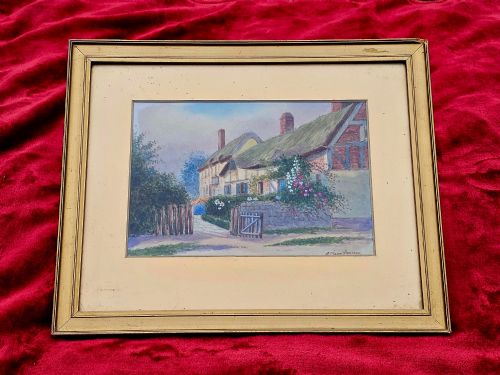
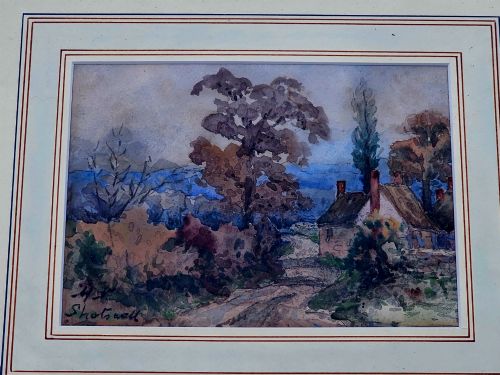
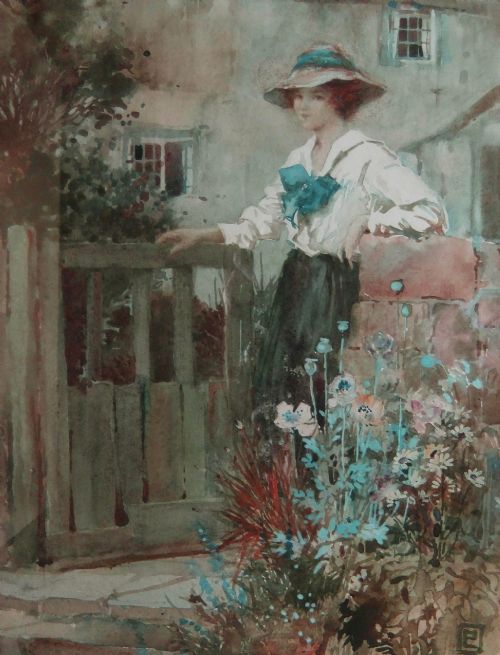
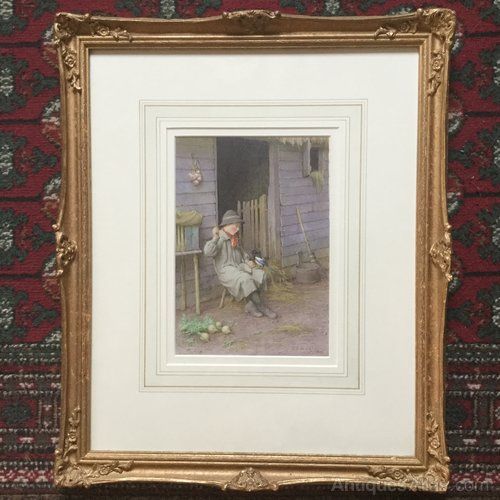


Edwardian Watercolour Cottage
These edwardian watercolour cottage paintings capture pastoral life through pigment on paper, bringing rural scenes into domestic interiors.
Edwardian Watercolour Cottage
An edwardian watercolour cottage depicts rural domesticity, thatched roofs, and country gardens across paper supports. The listings present framed wall art executed in styles such as British Impressionism, Victorian Pastoral, and English Pastoral Realism.
Most pieces show cottages in Devon, Somerset, Hampshire, and Dorset, populated by figures engaged in everyday tasks like feeding hens or tending gardens. The core period spans the late nineteenth century through the nineteen-thirties, with a strong concentration of Edwardian examples.
Materials and execution
Artists painted primarily with watercolour pigment on paper, occasionally housed behind glass in wooden frames. The medium relies on transparent washes of paint applied to white or tinted paper to capture natural light.
Techniques range from loose Impressionist brushwork to detailed pastoral realism. Pigments retain their tone when protected from direct sunlight behind proper glazing.
Several cottages on this page share space with surprisingly cooperative pet rabbits and hens.
Assessing quality in pastoral watercolours
Quality rests upon the artist's handling of light, brushwork fluidity, and the preservation of pigment vibrancy on the paper. Stronger works display confident composition and atmospheric depth rather than stiff botanical illustration.
Condition matters significantly, particularly the absence of foxing spots and fading on the paper. Framed pieces retaining their original relationship to the glass and backing paper command greater regard.
A. Marie Parsons·Percy Lancaster·Charles Edward Wilson·Theresa Stannard·Linnie Watt·Lilian Stannard·Harry Sylvester Stannard·Robert Hollands Walker·Thomas James Lloyd·B. Kaufmann·David Woodlock·Henry Spernon Tozer·Joseph Kirkpatrick·Arthur Claude Strachan·John Abernethy Lynas-Gray·Walter Henry Sweet·Thomas Nicholson Tyndale·Benjamin D. Sigmund·Henry Silkstone Hopwood·George Frederick Nicholls·David Heward·Yeend King·Alfred George Stevens·Arthur H Buckland·Alfred Parsons
The Edwardian Watercolour Cottage Glossary
- Watercolour
- A painting method in which the paints are made of pigments suspended in a water-based solution. The paper surface often shows through the translucent washes.
- Foxing
- Brown spots of chemical oxidation that appear on old paper over time. Proper conservation and dry storage help prevent this organic deterioration.
- Pastoral
- A genre of art depicting rural life and idealized country landscapes. These scenes often feature cottages, farm animals, and agricultural labourers.
- Impressionism
- A style of painting that focuses on capturing the immediate visual impression of a scene, paying particular attention to the shifting effect of light. British practitioners adapted these principles to rural landscapes.
Edwardian Watercolour Cottage: Frequently Asked Questions
How do I hang a watercolour painting?
Keep watercolours away from direct sunlight to prevent the pigment from fading on the paper.
Use picture wire and secure wall hooks suited to the weight of the wooden frame and glass.
What is the Edwardian pastoral style?
This style depicts idealized country scenes, thatched cottages, and garden paths with soft natural light.
Artists emphasised tranquil rural subjects during a period of rapid urbanisation.
How do I identify an Edwardian watercolour?
Look at the paper support, framing materials, and the characteristic clothing styles of any figures depicted.
Signatures, dates, and stylistic markers often align with the early twentieth century.
Were these paintings always framed?
Watercolours on paper required framing behind glass soon after completion to protect the delicate pigment.
Original frames provide context, though many pieces have been reframed over the decades.