

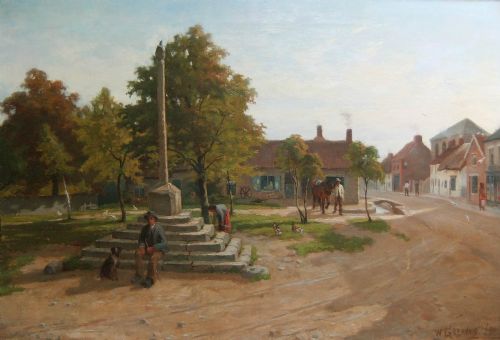


Rural Village Artwork
Rural village artwork captures country life and quiet settlements through traditional oil and watercolour.
Rural Village Artwork
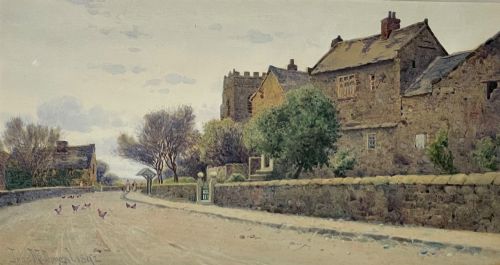
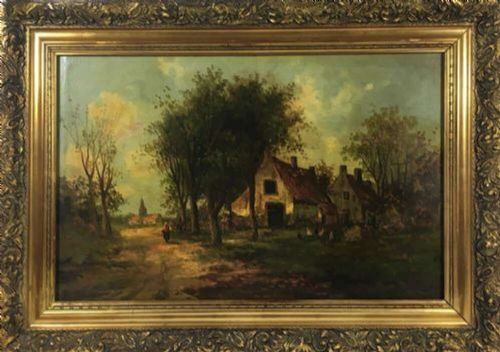
Rural village artwork depicts country settlements, farmyards, and local landscapes through traditional painting forms. When exploring this selection, buyers encounter framed oil paintings and watercolours that record communities across different decades.
The pieces available span the nineteenth and twentieth centuries, encompassing Victorian works alongside later impressionist and realist interpretations. Scenes range from English parishes in Yorkshire and Sussex to French farmyards.
Compositions often incorporate daily country activities such as hay wagons, village taverns, and horses on cart tracks. These works offer a visual record of rural existence shaped by regional British and continental artists.
Materials and methods
Makers utilised oil paint on canvas or board, alongside watercolour applied to paper sheets. Supports frequently sit within period wooden frames, occasionally accented with gesso and gilt finishes.
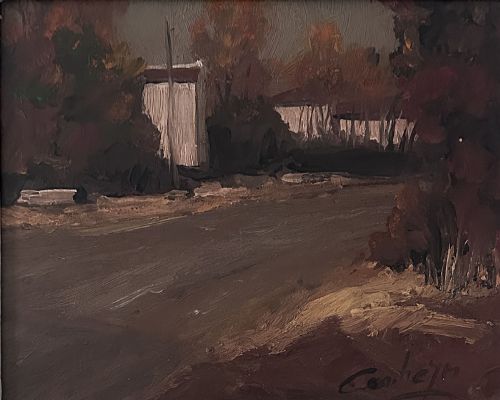
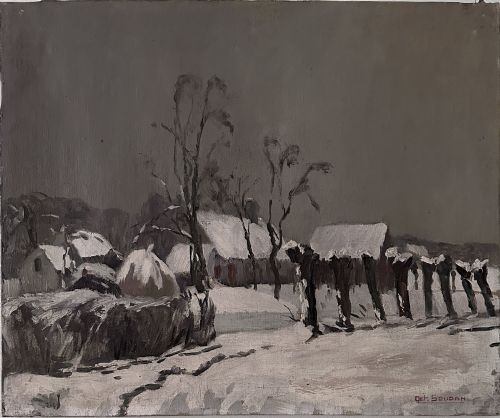
Brushwork varies from precise nineteenth-century realism to looser post-impressionist applications seen in mid-century pieces. Pigments are layered to capture natural light across village streets, fields, and rural architecture.
A young foal occasionally steals fruit from a basket while the rural village carries on around it.
Assessing quality and execution
Execution depends on the artist's handling of light, atmosphere, and perspective within the settlement scene. Stronger pieces demonstrate confident brushwork that brings depth to village buildings and surrounding landscapes.
Material preservation also distinguishes examples, particularly the stability of the canvas, paper, and original framing. Well-maintained surfaces retain their original pigment intensity without excessive retouching or structural degradation.
John McDougal·William Greaves·Charles Vickers·Helena Maguire·John Edward Bale·Robert Hollands Walker·Robert McGregor·Kershaw Schofield·Henry Charles Bryant·Maurice Asselin·Jeffrey Pratt·Georgina Lara·Eugene Battaille·Fred Lawson·Alfred Rimmer·Joseph Thors·David Heward·Stephanie Cooper·John Holland Snr·M. C. Hider
The Rural Village Artwork Glossary
- Oil on Canvas
- Pigment mixed with drying oil applied to a stretched woven fabric support. This combination allows for rich colour blending and texture.
- Watercolour
- A paint consisting of water-soluble pigments applied to paper. It yields translucent washes that capture soft light in landscape scenes.
- Gesso
- A plaster-like mixture applied to wooden frames as a base before gilding. It provides a smooth surface for metallic leaf applications.
- Post-Impressionism
- An art movement extending beyond impressionist methods to emphasise geometric forms and expressive qualities. Artists working in this manner prioritize emotional resonance over strict visual recording.
- Barbizon School
- A group of French painters associated with the Realist movement who worked closely from nature. Their rural landscapes focus on unidealised farmyards and country settings.
Rural Village Artwork: Frequently Asked Questions
What periods do these paintings cover?
The selection spans from the nineteenth century through the mid-twentieth century. Pieces date from the Victorian era up to the 1950s and 1960s.
Works reflect shifting artistic movements across these decades, moving from traditional realism to post-impressionist interpretations of country life.
Are the frames original to the art?
Many listings include period wooden frames, some featuring gesso and gilt detailing appropriate to the creation date of the canvas or paper.
Framing styles correspond to the era of the painting, helping to preserve the visual context of the artwork.
How do I identify a watercolour from an oil painting?
Watercolours are painted on paper supports, often showing translucent washes and delicate brush marks under glass. Oil paintings use oil-based pigments on canvas or panel, offering thicker texture and opaque coverage.
Examining the surface through a magnifying glass reveals whether the pigment sits on woven fabric or absorbent paper.