


Thatched Cottage Art
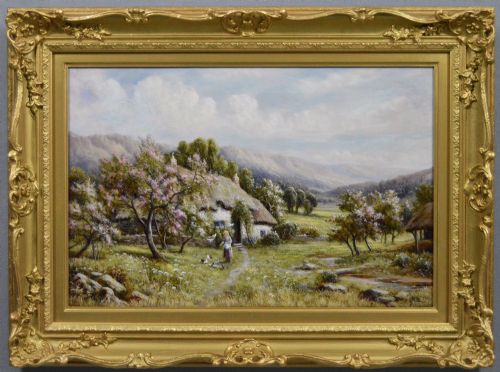
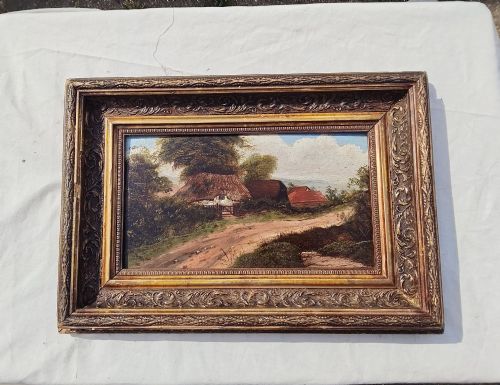
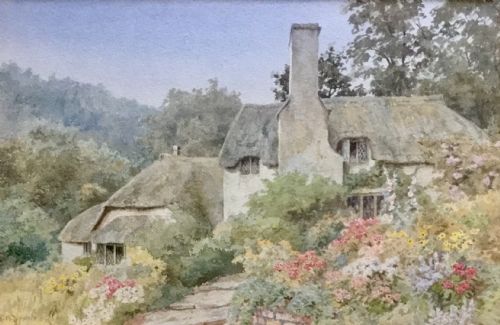
These pieces of thatched cottage art capture the rural idyll through paintings and fine art works spanning the nineteenth and twentieth centuries.
Thatched Cottage Art
Thatched cottage art brings together pastoral scenes, village life, and rural architecture rendered in various fine art mediums. You will frequently encounter watercolours and oil paintings depicting English countryside settings from the Victorian and Edwardian periods.
The selection ranges from detailed topographical watercolours by named artists to primitive folk art paintings and occasional charms. These works record a vanishing rural landscape through depictions of gardens, streams, and thatched roofs.
Originating largely from British rural traditions, the pieces vary from intimate nineteenth-century studies to mid-twentieth-century interpretations. They reflect a sustained artistic interest in rustic domesticity and pastoral realism.
Materials and techniques
Artists utilised watercolour pigment on paper and oil on canvas or card to build these rural scenes. Pigments were applied to capture the varied textures of rustic masonry, foliage, and dried reed thatch.
Frames commonly incorporate wood and gilt wood to house the paintings and watercolours securely. Some objects integrate enamel and gold in smaller decorative items such as charms.
A polychrome treen string box shaped as a thatched cottage hides domestic twine inside its roof.
Assessing quality
Quality rests upon the artist's handling of light, atmospheric perspective, and the specific detail given to architectural elements like thatch and timber. Finer works display confident brushwork and a balanced composition within the landscape.
The distinction between standard decorative pieces and superior works lies in the provenance and the artist's ability to render organic textures convincingly. Period framing and original condition further elevate the standing of an individual piece.
Robert John Hammond·John McDougal·Harry Sylvester Stannard·Robert Hollands Walker·Thomas James Lloyd·Joseph Kirkpatrick·Arthur Claude Strachan·Walter Henry Sweet·Thomas Nicholson Tyndale·David Heward·Yeend King·Joseph Hughes Clayton·Alfred Leyman·Georgina Lara·Thomas Rowlandson·Joseph Paul·David Woodlock·John Abernethy Lynas-Gray
The Thatched Cottage Art Glossary
- Watercolour painting
- A work executed with water-soluble pigments on paper, known for its translucent washes and delicate depiction of light.
- Oil on canvas
- A traditional painting medium using pigments bound in a drying oil, offering rich colour depth and textured application.
- Pastoral realism
- An artistic style focusing on the realistic depiction of rural life, agricultural labour, and country landscapes.
- Primitive folk art
- Art created by self-taught or non-academic painters, characterised by a flat perspective and direct expression.
- Gilt wood
- Wood that has been treated with a thin layer of gold leaf or gilt paint, typically found on period picture frames.
Thatched Cottage Art: Frequently Asked Questions
What periods do these pieces date from?
The works span from the Georgian era through the Victorian and Edwardian periods into the mid-twentieth century.
Most examples cluster around the late nineteenth and early twentieth centuries when pastoral subjects were particularly popular among artists.
How were these artworks originally displayed?
Paintings and watercolours were typically framed in wood or gilt wood and hung within domestic interiors as wall art.
Smaller items like painted charms served personal or decorative functions rather than acting as wall decorations.
How do I care for antique watercolours?
Works on paper require protection from direct sunlight to prevent the watercolour pigments from fading over time.
Displaying them in stable environmental conditions away from excessive moisture preserves both the paper support and the original frame.
How can I distinguish between oil and watercolour?
Watercolours are painted on paper with a translucent quality that often shows the paper grain beneath the pigment.
Oils are executed on canvas, board, or card with an opaque, heavier layer of paint that retains visible brush strokes.