


Terracotta Wool Saddlebag
These terracotta wool saddlebag examples are woven tribal textiles of practical nomadic origin, sought after for their rich earthy hues and authentic rural craftsmanship.
Terracotta Wool Saddlebag
When you search for terracotta wool saddlebag, you are looking at utilitarian woven carriers and panels produced by nomadic groups across Persia, Anatolia, and the Caucasus. These items include complete double-sided saddlebags, trimmed bag faces, fragments, and cushions made from durable wool.
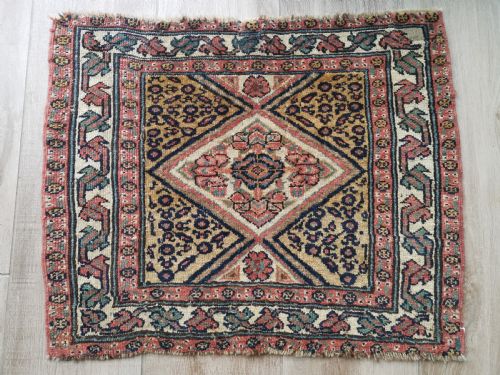
The pieces on this page span from the late nineteenth century into the early twentieth century, showing the traditional designs of tribal weavers. You will encounter formats ranging from complete khorjin saddlebags with their original backs to single bag faces and repurposed panels.
Origins represented in these listings trace back to specific groups such as the Shahsavan, Qashqai, Afshar, Khamseh, and Heriz communities. Each region imparts distinct design characteristics through geometric patterns, central medallions, and soumak or knotted techniques.
What varies in quality
The fineness of the knotting or the tightness of the soumak weave distinguishes standard utility items from exceptionally detailed tribal pieces. Greater density in the textile structure allows for sharper geometric definition and more intricate design work.
The completeness of the piece also influences character, as intact double-faced khorjin bags retain a different functional integrity compared to single bag faces or trimmed fragments. Preservation of the original edges, natural dye saturation, and structural soundness complete the assessment of quality.
Listings feature nineteen-century and early twentieth-century tribal textiles utilising natural dyes, hand-spun wool, and cotton across Persian and Anatolian origins.
The Terracotta Wool Saddlebag Glossary
- Khorjin
- The traditional Persian term for a double-sided saddlebag used by nomads for transport on animals.
- Soumak
- A flatweave technique utilising coloured supplementary wefts wrapped around warp threads to create a textured surface.
- Bag face
- The decorative front panel of a saddlebag, often preserved and displayed independently after the back wears away.
- Warp
- The vertical foundation threads stretched tightly on a loom before the weaving process begins.
- Weft
- The horizontal threads passed across and interlaced through the warp threads to build the fabric.
Terracotta Wool Saddlebag: Frequently Asked Questions
What is a terracotta wool saddlebag?
A terracotta wool saddlebag is a woven nomadic utility container designed for animal transport, featuring durable wool construction and earthy reddish-brown natural dyes.
These textiles were originally made by tribal groups in regions such as Persia and Anatolia to store belongings during seasonal migrations.
How were these bags used?
Nomadic families slung these double-pouch bags across horses, donkeys, or camels to carry household goods, grain, and personal possessions while moving camp.
Over time, many of these utilitarian items lost their backs through heavy use, leaving surviving decorative front faces that collectors now prize as textile art.
How do I style a bag face at home?
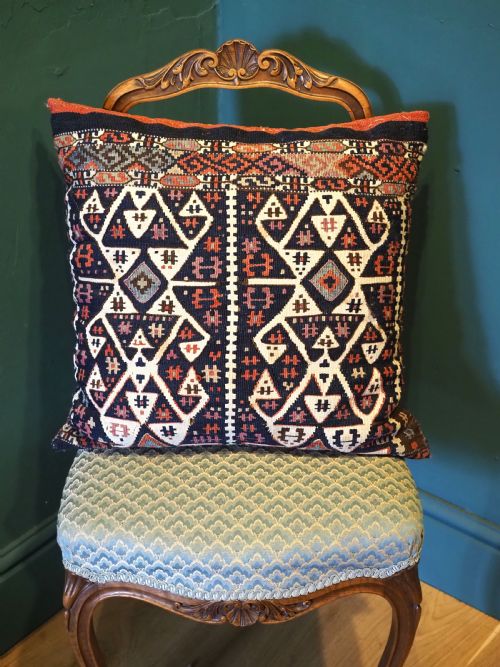
Bag faces and small panels can be mounted on walls as textile art or utilised directly as decorative cushions and pillows on seating furniture.
Their robust wool construction and rich terracotta tones allow them to ground neutral modern interiors with traditional tribal texture and warmth.
How do I identify different tribal groups?
Tribal attribution relies on specific structural characteristics, such as the distinctive soumak technique of the Shahsavan or the detailed colour palettes of Qashqai weavers.
Examining the specific geometric motifs, knotting density, and regional wool preparation helps link a textile to areas like Fars, Moghan, or Khorasan.