


Terracotta Garden Statues
Terracotta garden statues bring classical presence to a lawn or terrace, offering weathered surfaces and sculptural weight.
Terracotta Garden Statues
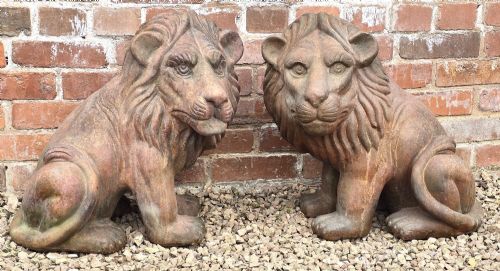
Terracotta garden statues encompass sculptural forms designed for exterior display, ranging from grand architectural guardians to garden lanterns. Buyers searching for terracotta garden statues will frequently encounter substantial pairs of lions and companion plinths originating from the nineteenth century.
The selection includes figures in stoneware, earthenware, and composition stone alongside traditional terracotta. Victorian and early twentieth-century examples dominate, often reflecting neoclassical, Italianate, or classical revival tastes.
How they were made
These pieces utilise moulded and hand-sculpted clay, fired to achieve durable porous earthenware or dense stoneware bodies. Salt glazing and buff finishes appear among the production methods recorded in the evidence.
Manufacturers formed large figures in sections before assembly and firing, mounting substantial works on matching terracotta or stoneware bases and plinths.
Listings feature nineteenth-century and early twentieth-century examples rendered in terracotta, stoneware, salt glazed pottery, and composition stone.
What varies in quality
The distinction lies in the ambition of the modelling and the crispness of the anatomical or architectural detail. Hand-sculpted examples display a depth of character and physical scale that simpler production methods lack.
Surface patination and the natural weathering of the clay body contribute significantly to the visual weight of the piece over time.
Hurlford Kilmarnock
The Terracotta Garden Statues Glossary
- Terracotta
- Fired brownish-red earthenware clay used for sculptural and architectural objects. The material weathers outdoors to develop a distinct aged surface.
- Stoneware
- A dense, vitrified ceramic fired at higher temperatures than earthenware. It offers increased frost resistance for exterior garden use.
- Plinth
- An architectural base or pedestal supporting a statue or urn. These elevate garden sculpture above ground level.
- Italianate
- A stylistic influence derived from Italian Renaissance villas and gardens. It shapes the classical proportion of many nineteenth-century pieces.
- Salt glazed
- A pottery finish achieved by throwing common salt into the kiln during high-temperature firing. This produces a characteristic textured glaze.
Terracotta Garden Statues: Frequently Asked Questions
Where should I place terracotta garden statues?
Position these pieces along garden pathways, flanking entrance gates, or upon dedicated stoneware plinths to create focal points in landscape designs.
Ensure they rest on stable, well-drained surfaces to protect the ceramic body from prolonged moisture absorption during freezing weather.
How do I identify nineteenth-century pieces?
Look for the characteristic scale, heavier wall construction, and dense buff or red terracotta bodies typical of Victorian production methods.
Examine the surface for natural weathering patterns and hand-sculpted tool marks rather than modern mould seams.
Are stoneware and terracotta the same?
Both materials originate from fired clay, but stoneware undergoes firing at much higher temperatures until the body vitrifies.
This process results in a harder, less porous material compared to standard earthenware terracotta.
Can these statues stay outside all winter?
Many nineteenth-century stoneware and terracotta garden pieces withstand outdoor conditions, provided they avoid standing water.
Elevating sculptures on plinths prevents direct ground moisture from entering the base during frost.