


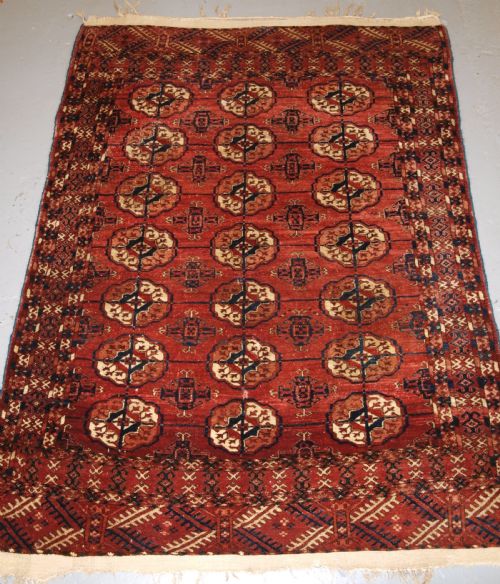
Tekke Gul Pattern Carpet
These tekke gul pattern carpet examples are tribal wool floor coverings created across late nineteenth and early twentieth century Central Asia.
Tekke Gul Pattern Carpet
A tekke gul pattern carpet is a woven textile featuring traditional Turkmen design motifs created by nomadic and tribal makers. These pieces originate primarily from the late nineteenth and early twentieth centuries, spanning periods from eighteen eighty to nineteen thirty.
The format typically appears as a rug, a carpet, or a specialised dowry piece. Buyers frequently encounter wedding dowry rugs alongside heavier utility carpets produced within Turkmen and Afghan tribal traditions.
Originating across Central Asian regions including the Emirate of Bukhara, these floor coverings combine functional durability with distinct cultural artistry. The examples available on this page reflect diverse nineteenth and twentieth century tribal workshops.
How they were made
Construction relies entirely upon wool materials, utilised for both the foundation structures and the dense pile surfaces. This natural fibre provides the heavy duty and hard wearing qualities recorded across the Afghan Turkmen carpet tradition.
Weavers employed traditional hand knotting techniques alongside soft wool selections, particularly evident in smaller dowry rugs dated to the fourth quarter of the nineteenth century. The resulting textiles balance structural resilience with pliable handle and tactile depth.
Object forms on this page include area rugs, carpets, and specialised wedding dowry pieces from Central Asia.
What varies in quality
Quality differentiates through the fineness of the wool and the complexity of the woven design motifs. Pieces featuring scarce ovoid gul designs or unusual borders occupy a different tier compared to standard traditional patterns.
The handling of the wool and the precision of the tribal patterning establish the grade of each textile. Earlier nineteenth century examples often display softer material grades and distinctive regional variations that distinguish them from later productions.
The Tekke Gul Pattern Carpet Glossary
- Gul
- The primary octagonal medallion motif repeated across Turkmen carpets. This design element serves as both clan identifier and decorative geometry.
- Dowry rug
- A specialised textile woven for wedding ceremonies or familial alliances. These smaller pieces often exhibit finer wool manipulation and symbolic patterning.
- Turkmen tribal
- The regional and cultural attribution for weavers inhabiting Central Asian territories. This style encompasses distinct border arrangements and characteristic palette choices.
- Emirate of Bukhara
- A historical Central Asian state associated with carpet production. Items originating from this territory display specific regional weaving characteristics.
Tekke Gul Pattern Carpet: Frequently Asked Questions
How old are these carpets?
The pieces span a chronological range from eighteen eighty through to nineteen thirty, encompassing late nineteenth century tribal output and early twentieth century examples.
Most items concentrate around the eighteen eighty to nineteen twenty brackets, reflecting active periods of Central Asian nomadic weaving.
What materials were used?
Construction is executed entirely in wool, selected for durability and tactile softness depending on the intended function of the rug.
Heavier utility formats utilise robust fibres, while wedding dowry pieces frequently incorporate exceptionally soft wool selections.
Where were they made?
Originating from Central Asian tribal groups, these textiles include pieces attributed to Turkmen and Afghan makers as well as the Emirate of Bukhara.
Nomadic and semi nomadic workshops produced these floor coverings across the region during the late nineteenth and early twentieth centuries.
How do I identify a dowry rug?
Dowry rugs typically present in smaller dimensions and are traditionally associated with wedding ceremonies and familial exchanges.
They often feature soft wool and specific design variations such as ovoid gul motifs or distinctive border treatments.