




Teak Console Table
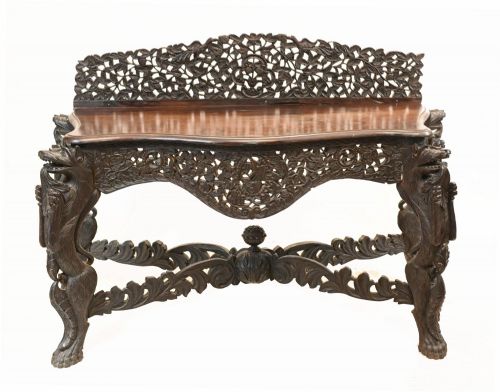
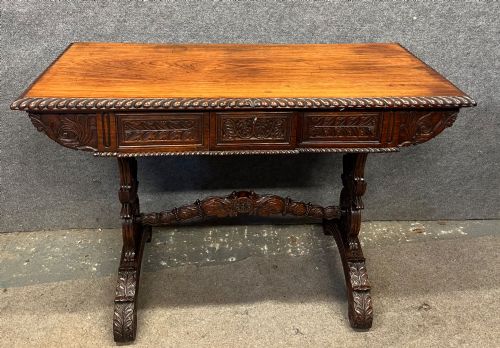
These teak console table pieces are heavily carved 19th-century colonial items that bring distinctive Anglo-Indian and Burmese craftsmanship into a modern hall.
Teak Console Table
A teak console table sits against a wall in a hallway or reception room, bringing dense botanical and figurative carving into the interior. These pieces emerge predominantly from nineteenth-century colonial workshops in India and Burma.
The selection on this page centres heavily on Anglo-Indian and Burmese furniture, alongside related forms such as pier tables, centre tables, and hall benches. Buyers encounter heavily carved hardwood structures frequently adorned with motifs like elephants.
While most examples date to the 19th century, occasional variations stretch towards 1880, 1900, or 1920. Forms range from long Chinoiserie console tables to painted village tables and compact occasional pieces.
Materials and construction
Makers utilised solid teak and related hardwoods, often carving the dense timber deeply by hand to create elaborate relief patterns. Surface decoration occasionally incorporates bone inlay, marble inserts, glass elements, or painted finishes.
The construction relies on traditional joinery methods suited to tropical hardwoods, accommodating intricate sculptural details along aprons, legs, and tabletops. Secondary woods or rosewood elements appear alongside the primary teak structure.
Teak Console Table Retail Price Guide 2026
Typical asking prices for teak console table among the pieces listed under this phrase on Sellingantiques today, from the lower quarter to the upper quarter. They describe what is for sale here now, not the wider market.
Listings span the nineteenth century into the early twentieth, featuring solid teak, rosewood, marble, and bone inlay across Anglo-Indian and Burmese styles.
Evaluating quality
Quality rests primarily in the depth, crispness, and ambition of the hand carving across the teak surface. Superior examples display sharply defined figural elements, such as elephants or intricate foliage, carved directly from the solid timber without soft edges.
The choice of supplementary materials also distinguishes the pieces, with integrated marble tops, fine bone inlay, or well-preserved painted surfaces marking out more elaborate workshop production. Structural integrity in the heavy hardwood frames ensures the piece functions reliably as a hall or console table.
The Teak Console Table Glossary
- Anglo-Indian
- Furniture made in India during the British period, combining British furniture forms with local Indian carving traditions. These items often feature dense botanical motifs in solid teak or hardwood.
- Console table
- A table designed to stand against a wall, frequently secured to it or supported by front legs. In these listings, they appear with heavy hand-carved ornamentation.
- Pier table
- A decorative table specifically built to sit against the wall beneath a wall mirror or between windows. They share many construction traits with standard console tables.
- Bone inlay
- A decorative technique where small pieces of bone are set into the wooden surface to form geometric or floral patterns. This ornamentation contrasts sharply with dark carved teak.
- Chinoiserie
- European interpretations of Chinese and East Asian artistic traditions, expressed here through carved furniture forms. It appears within the listings alongside Burmese and Indian vernacular styles.
Teak Console Table: Frequently Asked Questions
Where should I place a teak console table?
These tables suit narrow hallways, entryways, or living rooms where they sit flat against a wall. Their substantial carved presence makes them a strong focal point upon entering a room.
Because they often feature deep carving and materials like marble or bone inlay, keep them away from direct heat sources to protect the historic timber.
How do I care for carved teak furniture?
Dust the deep carvings regularly with a soft brush to prevent dirt settling into the recesses of the wood. Avoid harsh chemical polishes and instead use a microfibre cloth.
Maintain a stable room humidity to ensure the dense nineteenth-century hardwood does not dry out or crack over time.
What is the difference between an Anglo-Indian and Burmese table?
Anglo-Indian pieces typically blend British furniture shapes with traditional Indian botanical and figurative carving. Burmese examples often display distinct regional vernacular motifs and village construction styles.
Both styles utilise solid teak and heavy hand-carving from the nineteenth century, but the regional hand is visible in the specific motifs chosen.
Are these tables sturdy enough for daily use?
The heavy teak and hardwood construction makes these tables robust and stable for supporting lamps, decorative items, or everyday hallway objects. Their solid frames are built to last.
Care should be taken with delicate elements like bone inlay or painted surfaces, treating them with the respect due to nineteenth-century antiques.