


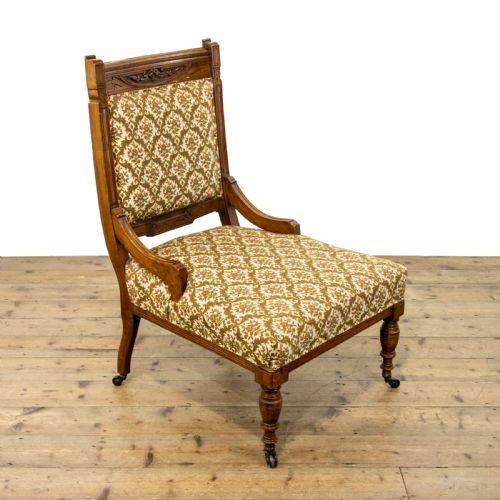


Tapestry Upholstered Nursing Chair
A tapestry upholstered nursing chair brings low seating and textile art together, offering a comfortable and decorative addition to a traditional interior.
Tapestry Upholstered Nursing Chair
A tapestry upholstered nursing chair combines low-slung seating with period textile panels, designed originally for ease of nursing infants by the fire. The pieces seen here span the Victorian and Edwardian eras, encompassing related forms such as slipper chairs, occasional chairs, and bedroom chairs.
Most examples rely on a sturdy timber frame of mahogany or walnut, paired with padded seats and backs covered in woven tapestry or floral fabric. You will frequently encounter Victorian walnut and mahogany iterations featuring carved details and scrolled backs.
Materials and construction
Makers constructed these frames from solid hardwoods like mahogany and walnut, often shaping the wood with curves and carvings characteristic of Victorian Rococo Revival and Aesthetic Movement styles. Turned wooden legs sometimes terminate in brass and ceramic castors for mobility across carpets.
Upholstery techniques involved dense stuffing secured over webbing and springs, finished with textile panels including woven tapestry and floral fabric. Button back detailing appears on several pieces, providing additional structure and surface texture to the padded components.
Materials recorded across the inventory include mahogany, walnut, brass, ceramic, and various textiles.
Distinguishing quality
The distinction between standard and superior pieces rests on the crispness of the timber carving and the integrity of the frame construction. Heavier walnut and mahogany frames with intricate scrollwork or buttoned upholstery generally represent more ambitious workshop production.
The condition and fineness of the tapestry or textile covering also dictate the overall standard of an example. Original floral tapestry work that remains intact and tightly woven elevates the visual impact of the seating.
Gillows
The Tapestry Upholstered Nursing Chair Glossary
- Nursing chair
- A low-seated chair designed in the nineteenth century for comfort, traditionally used in bedrooms or nurseries.
- Tapestry
- A form of heavy textile art woven on a loom, utilised here to cover the back and seat of the chair.
- Aesthetic Movement
- A late nineteenth-century design style focusing on visual beauty and artistic expression rather than narrative content.
- Scroll back
- A wooden frame design featuring outward-curving terminals at the top of the chair back.
- Button back
- An upholstery method where deep buttons are pulled through the padding to create a diamond-patterned relief.
Tapestry Upholstered Nursing Chair: Frequently Asked Questions
What is a nursing chair?
A nursing chair is a low-seated Victorian or Edwardian chair designed for sitting close to a nursery fire. The reduced height made tending to infants more comfortable for the sitter.
These pieces were also placed in bedrooms and dressing rooms, functioning as occasional seating. Their compact proportions suit smaller spaces in modern homes.
How do I date a nursing chair?
Dating relies on timber choices, leg styles, and upholstery details recorded across the nineteenth and early twentieth centuries. Victorian examples often feature mahogany or walnut frames with carved scrollwork.
Later Edwardian versions tend to show simpler lines and lighter timbers. Comparing the decorative motifs to known period styles clarifies the chronology.
Where should I place these chairs?
These pieces work well as accent seating in living rooms, bedrooms, or studies where their low profile will not block sightlines. Their decorative tapestry upholstery makes them suitable as focal points in a traditional room.
Avoid placing them in areas of direct sunlight to protect the textile coverings from fading. Pairing them with a reading lamp creates a functional corner.
Are tapestry chairs durable?
Tapestry covers are woven from sturdy threads designed to withstand regular use, though nineteenth-century textiles require gentle care. Checking the tightness of the weave helps determine how well the fabric will hold up to daily sitting.
Professional cleaning and careful maintenance preserve the structural integrity of both the textile and the hardwood frame underneath.