


Tall Ship Seascape Painting
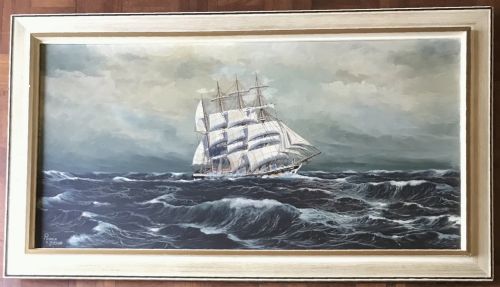
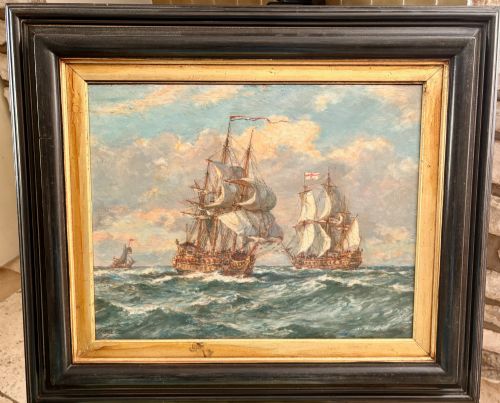
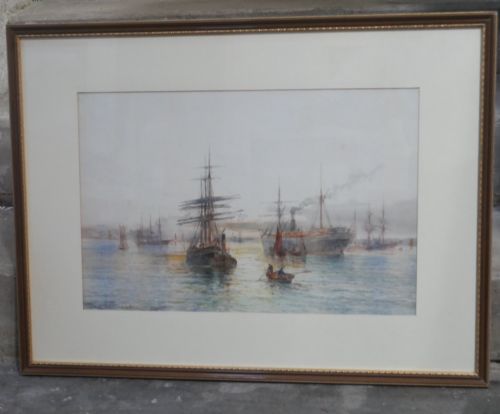
These tall ship seascape painting examples capture the drama of maritime movement across canvas, board and paper from the nineteenth and twentieth centuries.
Tall Ship Seascape Painting
A tall ship seascape painting depicts sailing vessels, clippers and marine battles in oil or watercolour across periods spanning the Georgian, Regency, Victorian and Edwardian eras. Buyers searching this phrase encounter framed works ranging from intimate watercolours on paper to substantial oil paintings on canvas and board.
The subjects focus on named vessels, harbour scenes, stormy seas and coastal shipping movements. Artists record specific historic moments, such as the journey towards Trafalgar or portraits of individual ships off major lighthouses and ports.
Materials and technique
Painters utilise oil paint and watercolour applied to traditional supports including canvas, prepared wood board and heavy paper. Many works retain their original giltwood frames, which complement the maritime subject matter.
Artists build up the composition through layered brushwork to render the complex rigging of tall masts, choppy waters and atmospheric skies. The handling of medium defines whether a piece takes the form of a detailed watercolour or a heavy oil painting.
Listings feature works executed in oil on canvas, watercolour on paper, and oil on board across the nineteenth and twentieth centuries.
Assessing quality and execution
The distinction between works rests upon the artist's command of maritime architecture, rigging accuracy and the convincing movement of water. Skilled hands render the intricate geometry of sails and hull proportions with precision.
Atmospheric depth separates standard decorative marine pieces from superior works. Strong compositions capture light on water and the force of wind in canvas with confident, deliberate brushwork rather than rigid formulas.
Bernard Gribble·William Frederick Settle·Dion Pears·John Callow·Frank Wood·Joseph Heard·William Boyce·Frank Wasley·George Stainton·Rowland H. Hill·Stephen Brownlow
The Tall Ship Seascape Painting Glossary
- Seascape
- A work of art depicting the sea, coastal views or marine vessels. These compositions focus primarily on water and maritime subjects.
- Watercolour
- A paint medium where coloured pigments are suspended in a water-based solution, typically applied to paper. This technique produces translucent washes of colour.
- Giltwood
- Wood carved and covered with a thin layer of gold leaf or gold paint. This finish frequently appears on the antique frames enclosing marine paintings.
- Clipper
- A very fast nineteenth-century merchant sailing ship with three masts and a square rig. These vessels feature prominently in maritime art.
Tall Ship Seascape Painting: Frequently Asked Questions
How do I date a marine painting?
Examine the rig of the ships, the clothing of any figures, and the style of the frame. Ship design and naval architecture evolved rapidly from the eighteenth through the twentieth centuries.
Signatures, inscriptions on the reverse, and the material support such as canvas or wood board also provide clear chronological indicators.
Where should I hang a large oil painting?
Choose a wall with stable humidity away from direct sunlight to protect the canvas and oil pigments. Heavy giltwood frames require secure wall fixings suited to the weight.
Position the work at eye level in a principal room where the details of the rigging and seascape can be properly observed.
What is the difference between oil and watercolour?
Oil paint uses drying oils to bind pigments on canvas or board, allowing for rich textures and deep layering. Watercolour uses water-soluble pigments on paper, creating lighter and more translucent effects.
Watercolours require glass protection in their frames, whereas traditional oil paintings remain open to the air.
How do I care for antique canvas art?
Keep the painting away from extreme temperature fluctuations and damp environments that could affect the wood stretcher and canvas tension. Dust the surface gently with a soft, dry brush.
Avoid using any liquid cleaners or chemical agents on the painted surface or the giltwood frame.