



Tall Brass Pricket Stands
Tall brass pricket stands are commanding liturgical and decorative candle holders designed to elevate altar lights, offering dramatic vertical presence and rich historical character.
Tall Brass Pricket Stands
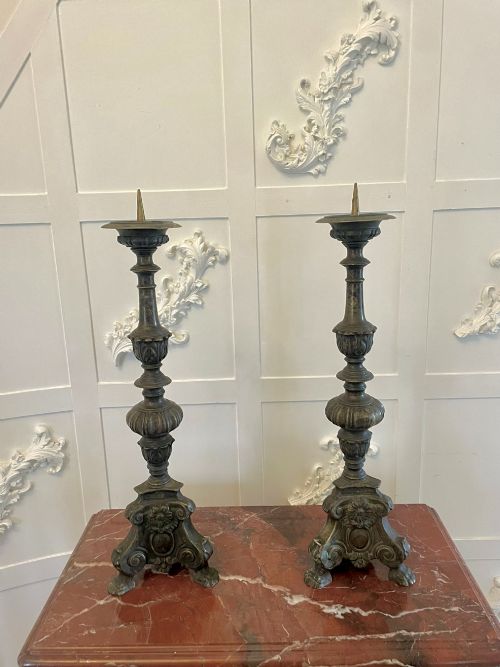
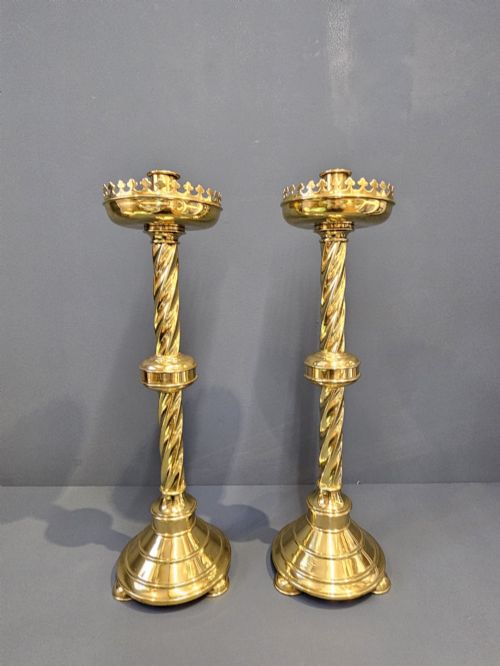
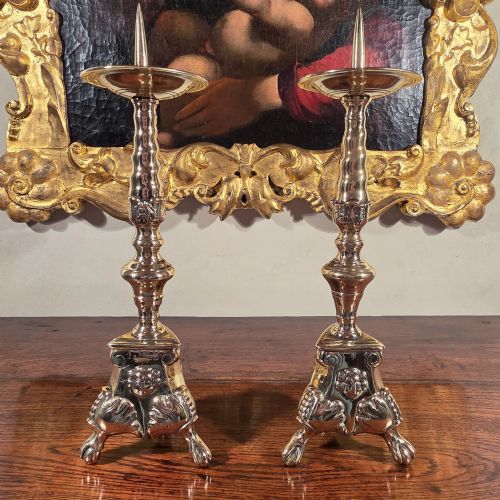
When you search for tall brass pricket stands, you encounter substantial church and altar lighting fixtures designed with a central spiked spike, known as a pricket, to secure large candles rather than a socket. The selection spans floor standing church candle holders and heavy table variants originating across the eighteenth, nineteenth, and early twentieth centuries.
The prevailing examples on this page are nineteenth century Victorian pieces alongside eighteenth century and later items, frequently appearing in matched pairs or individual monumental forms. Their primary function was ecclesiastical illumination, which translates today into striking architectural decor for large interiors.
How they were made
Makers utilised heavy cast brass, bronze, copper, and wrought iron, frequently combining these metals with hardwood components to achieve structural stability and varied textural contrast.
Construction techniques relied upon traditional foundry casting and metalworking methods appropriate to periods from the eighteenth century through the Art Nouveau, Amsterdam School, and Gothic Revival movements.
Listings feature items spanning the eighteenth century through nineteen forty, utilising brass, bronze, copper, iron, and hardwood across diverse design movements.
What varies in quality
Quality rests in the proportional balance, the weight of the cast metal, and the crispness of decorative detailing across styles ranging from Baroque and Regency to Gothic Revival.
Superior examples demonstrate substantial heft, confident handling of mixed materials such as copper and brass, and distinct artistic ambition evident in signed works and deliberate regional design characteristics.
The Tall Brass Pricket Stands Glossary
- Pricket
- A sharp metal spike atop a candlestick designed to impale the base of a candle and hold it steady. This form predates the standard socket candlestick.
- Gothic Revival
- An architectural and decorative style drawing inspiration from medieval forms, featuring pointed arches and ornate tracery common in nineteenth century ecclesiastical metalwork.
- Amsterdam School
- An architectural and decorative arts movement originating in the Netherlands around nineteen hundred, characterised by rounded forms, expressive massing, and traditional craft integration.
- Regency
- A British stylistic period spanning the early nineteenth century defined by neoclassical restraint, archaeological motifs, and clean architectural lines.
Tall Brass Pricket Stands: Frequently Asked Questions
What is a pricket stand?
A pricket stand is a heavy candle holder featuring an upright metal spike instead of a traditional socket. This spike holds large candles securely in place.
Historically utilised in churches for heavy altar candles, these stands provide significant height and a strong vertical focal point.
How do I date these stands?
Dating relies on stylistic clues, manufacturing methods, and material combinations spanning the eighteenth through the twentieth centuries. Gothic Revival and Baroque details point to specific nineteenth century revivals.
Examining the casting methods, wear patterns, and fastener types helps distinguish eighteenth century examples from later nineteenth and twentieth century interpretations.
Were these made for churches?
Many tall pricket stands originated as ecclesiastical church candlesticks designed to illuminate altars and chancels. Their imposing scale suited large religious interiors.
Over time, these ecclesiastical pieces transitioned into domestic settings where their dramatic height serves decorative architectural purposes.
How do I clean brass stands?
Cleaning requires a gentle approach to preserve the historical patina accumulated over centuries. Harsh chemical polishes can strip away desirable aged surfaces.
Light dusting and occasional soft cloth wiping maintain the metal without removing the character developed through age.