
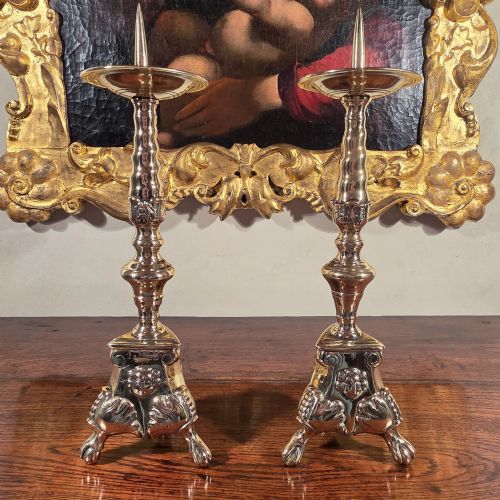


Gold Metal Altar Candlesticks
Gold metal altar candlesticks bring solemn ritual presence and glowing warmth into a room, formed in brass, gilt bronze, and ormolu.
Gold Metal Altar Candlesticks
When you search for gold metal altar candlesticks, you are looking at ecclesiastical lighting designed for sacred spaces, repurposed over time for domestic interiors. The pieces appearing here span from the eighteenth century through the Victorian era and into the early twentieth century.
You are most likely to meet pairs and sets of tall brass or gilt metal candlesticks, alongside French altar lamps and gilded bronze candelabras. These objects often display strong regional styles including Gothic Revival, Rococo, and Baroque ornamentation.
The forms range from simple pricket candlesticks designed to hold large wax tapers to ornate multi-branched candelabras. Their survival reflects both durable metalwork and the changing domestic tastes for ecclesiastical furnishings.
Materials and construction
The construction relies heavily on cast brass and cast bronze, shaped to achieve substantial height and stable bases. Metalworkers utilised casting and turning techniques to create heavy shafts and drip pans capable of supporting heavy wax candles.
Surface finishes include fire-gilding, ormolu, and applied gilt metal layers that give these pieces their characteristic golden sheen. Over decades of handling, these metallic surfaces acquire a distinct mellowing that reveals the underlying brass or bronze.
Current listings demonstrate a concentration of nineteenth-century French and British production, spanning brass, gilt bronze, and ormolu materials.
Judging quality and character
Quality in these ecclesiastical pieces rests upon the crispness of the casting and the weight of the metal used in the shaft and base. Finer examples display deeply chased ornamentation and balanced proportions that maintain stability despite considerable height.
The integrity of the original gilt surface also dictates the standing of a piece, distinguishing items with preserved fire-gilding or ormolu from those with later surface alterations. Better examples retain their original components without replacement parts or structural compromise.
The Gold Metal Altar Candlesticks Glossary
- Pricket
- A sharp metal spike on top of a candlestick designed to secure a large candle, common on ecclesiastical pieces. This form predates socket-type candle holders.
- Ormolu
- Finely ground high-carat gold mercury-gilded to a bronze object, creating a bright golden finish. The technique was widely employed in French metalwork.
- Candelabra
- A branched candlestick holding multiple lights from a single base. These large fixtures served both ritual and grand domestic illumination.
- Cast Brass
- Molten alloy of copper and zinc poured into a mould to form solid components. It provides the heavy structural core for many antique candlesticks.
Gold Metal Altar Candlesticks: Frequently Asked Questions
What is an altar candlestick?
An altar candlestick is a heavy lighting fixture originally produced for church altars to hold ceremonial candles during services. These pieces are typically taller and more substantial than standard domestic candlesticks.
Over time, many of these liturgical items have transitioned into interior decoration, prized for their height, architectural presence, and warm metallic finishes.
How do I clean antique brass?
Antique brass and gilt metal generally require minimal intervention to preserve their historic surface appearance and patination. Gentle dusting with a soft, dry cloth is usually sufficient for regular maintenance.
Avoid aggressive metal polishes or chemical cleaners, as these can strip away remaining gilding and destroy the accumulated character of centuries.
How do I tell periods apart?
Dating these metal pieces relies on identifying the decorative style, casting quality, and assembly methods used in the construction. Eighteenth-century examples often show hand-finished surfaces and simpler regional casting techniques.
Nineteenth-century items frequently exhibit specific revival styles such as Gothic Revival or Rococo, while early twentieth-century pieces demonstrate standardised industrial production methods.
Were these made for churches?
Many of these pieces were originally commissioned for ecclesiastical use in chapels, churches, and monastic settings. Their robust construction and impressive height were intended to project visibility in large sacred spaces.
Their survival outside of religious institutions demonstrates a long history of secular adaptation for grand domestic interiors.