
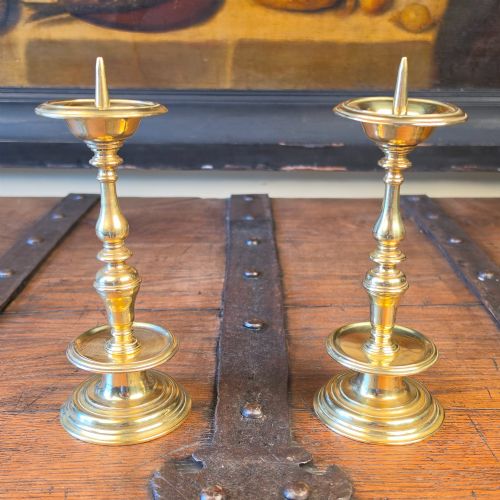
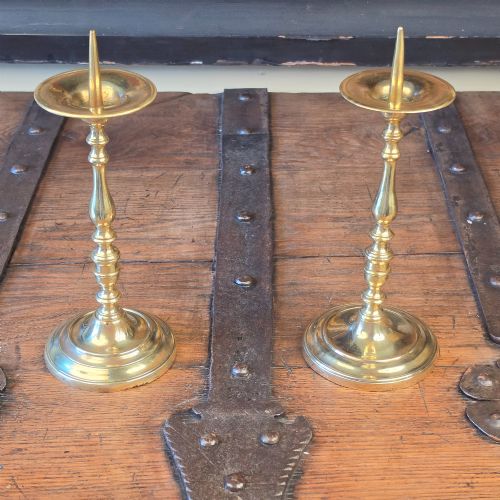
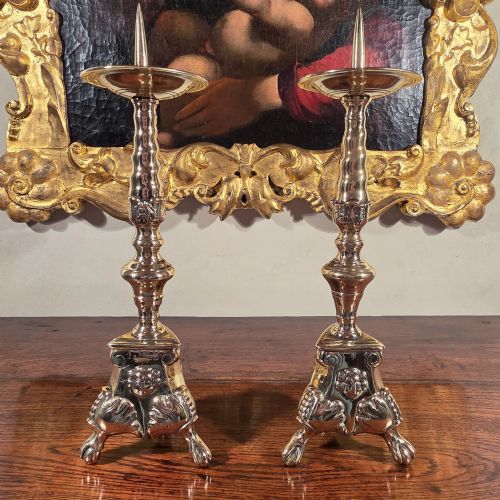


Baroque Brass Candle Stands
Baroque brass candle stands bring heavy cast metal and dramatic historical form into a room.
Baroque Brass Candle Stands
When you search for baroque brass candle stands, you encounter heavy cast metal objects designed to hold candles securely aloft. These pieces span centuries of metalworking, taking the form of standard lamps and candlesticks.
The versions you meet most frequently on this page include 17th century originals from regions like the Netherlands, Germany, and Sweden, alongside later 19th century revival pieces. They appear as single items, pairs, or larger matched groups.
Makers shaped these items in styles ranging from Flemish and Dutch baroque to Italianate and Rococo. Their profiles include pricket tops, bell formations, and knoped stems.
How they were made
Foundries produced these items primarily through metal casting, utilising brass, bronze, gilt bronze, and copper alloy. Craftsmen worked molten metal into thick, robust components that could support heavy candles without tipping.
Individual sections like bases, stems, and drip pans were cast separately and then joined together. Surfaces often received finishing touches through turning on a lathe and hand-chiselling to sharpen cast details.
Some seventeenth-century brass stands double as ringing bells, uniting the call to prayer with the flicker of candlelight.
What varies in quality
Quality rests heavily on the crispness of the original cast and the weight of the metal utilised. Superior examples retain sharp profiling on their knops and bases, whereas weaker ones show softened contours from worn or repeated moulds.
Originality of components also dictates the standing of a piece. Stands that retain their matching drip pans and uncompromised structural joints sit higher in the hierarchy than composite assemblies or heavily restored items.
The Baroque Brass Candle Stands Glossary
- Pricket
- A sharp spike on a candlestick designed to impale the base of a candle to hold it upright. This form appears frequently on older liturgical and domestic lighting.
- Knop
- A knob or protuberance on the stem of a candlestick. It provides a secure grip for the hand when moving the lit object.
- Bell brass
- A specific alloy of copper and tin traditionally used for bells, known for its resonant quality and bright golden hue. It yields a particularly sturdy and durable casting.
- Gilt bronze
- Bronze that has been coated with a thin layer of gold or gold-coloured alloy to give a rich surface finish. It appears on Venetian examples.
- Standard lamp
- A tall floor-standing lighting support derived from smaller table forms. These items lift the light source well above floor level.
Baroque Brass Candle Stands: Frequently Asked Questions
What are baroque brass candle stands?
They are heavy cast metal lighting devices created to support candles in domestic or institutional settings. These objects utilise durable alloys to achieve sculptural forms.
Designs reflect historical periods ranging from the seventeenth century through to nineteenth-century revivals. They function both as utilitarian light sources and decorative sculptural items.
How were they used historically?
People relied on these stands to illuminate rooms before the advent of electricity. Their heavy bases prevented accidental tipping when moved about.
Pricket versions held large wax dips on spikes, while socket types cradled tapered candles. They stood on tables, altars, and floors depending on their height.
How do I live with them?
Place them on heavy wooden surfaces where their warm metallic tones complement antique grain and patination. They anchor a room with historical weight.
Keep them away from damp environments to protect the metal surface. Gentle dusting preserves the natural ageing of the brass.
How do I tell periods apart?
Examine the casting technique, wear patterns, and stylistic details to determine age. Seventeenth-century pieces often display heavier casting marks and simpler, robust proportions.
Revival pieces from the nineteenth century frequently copy these earlier motifs with different finishing techniques. Regional traits, such as Swedish or Dutch styling, also help pinpoint origins.