


Tall Brass Candleholders
These tall brass candleholders bring height and warm metal presence to a room, ranging from church pieces to domestic column designs.
Tall Brass Candleholders
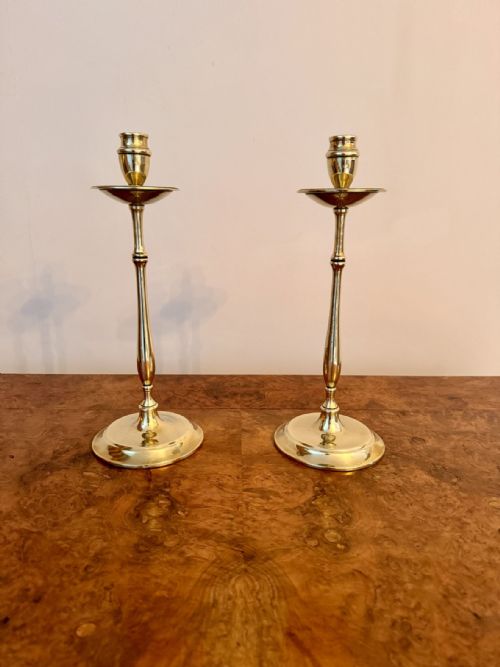
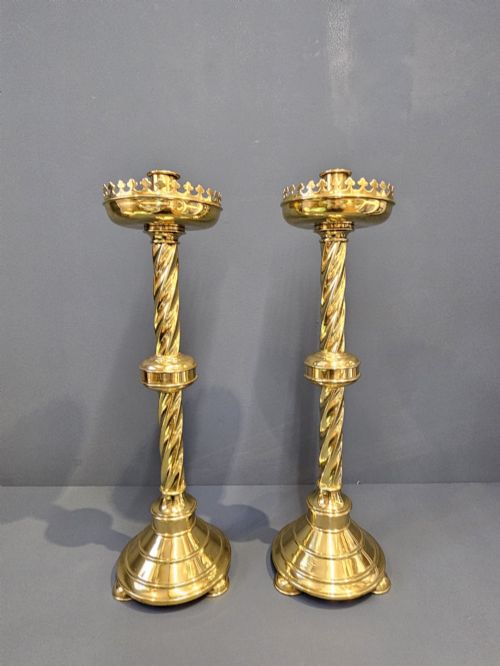
Tall brass candleholders appear in forms designed for churches, studies and formal rooms, with pairs dominating the selections. You encounter large Victorian church designs alongside Georgian column sticks and Regency Grand Tour pieces.
The objects span the nineteenth century, including specific dates from the eighteen-eighties and eighteen-nineties, together with Regency and Edwardian examples. Makers such as James Clews emerge among standard Victorian output, alongside Arts and Crafts and Gothic interpretations.
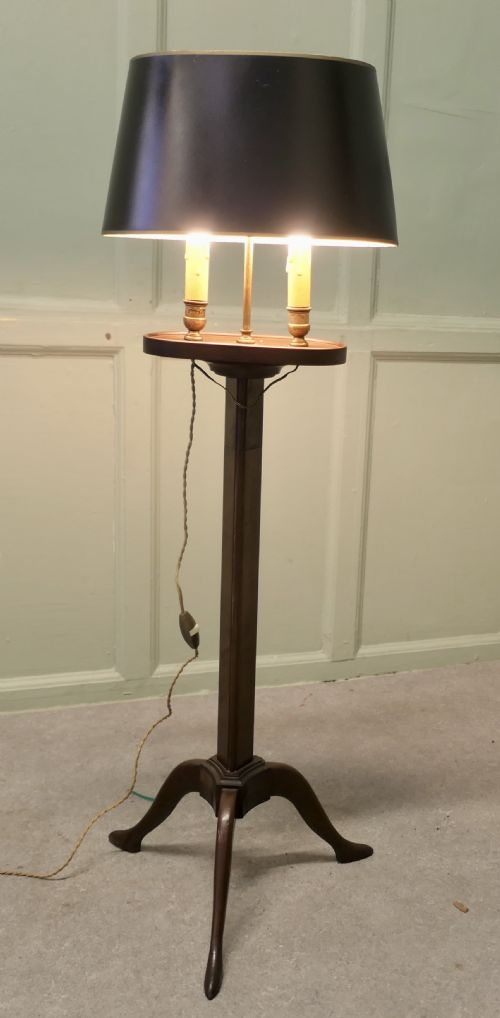
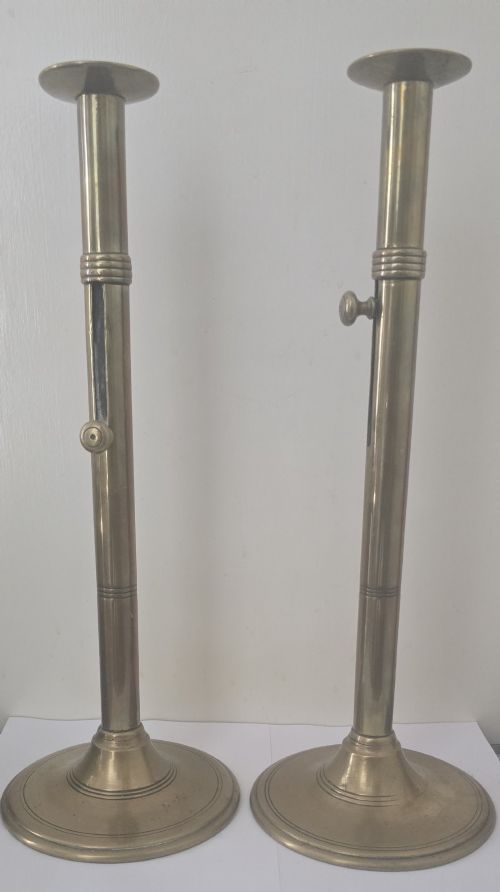
Formations include twist stems, beehive turnings and side ejectors, as well as floor-standing variations like the bouillotte lamp. Materials stretch from cast brass to bronze, ormolu and combinations incorporating mahogany.
Materials and construction
Construction relies primarily on brass and bronze, often shaped through casting and turning on lathes. Many nineteenth-century pairs utilise seamed bronze or brass components joined together to achieve considerable height.
Detailing involves applied elements, side ejectors for clearing wax, and twisted or faceted stems. Certain pieces integrate mahogany wood bases or turnings alongside the metal work to create contrasting textures.
Judging quality
Substance and weight separate robust examples from lighter pieces, with heavy cast columns and substantial bases showing greater durability. The crispness of turning on beehive or twist stems indicates the maker's precision.
Completeness of original elements, such as side ejectors, sconces and matched pairs, elevates specific items. Finer finish work and unpolished patination retain the character accumulated over the centuries.
James Clews
The Tall Brass Candleholders Glossary
- Pricket
- A candlestick featuring a central metal spike upon which a large candle is impaled. This form is common in ecclesiastical settings.
- Sconce
- The socket or cup at the top of a candlestick that holds the base of the candle. It catches dripping wax during use.
- Ormolu
- Gilt bronze decoration applied to metalwork, providing a rich golden surface finish. It appears on neoclassical and Regency decorative items.
- Bouillotte
- An adjustable lamp design featuring a central shade and candle arms, originating for card games. Examples utilise metal stands and fabric or silk shades.
- Ejector
- A mechanical slide built into the side of a candlestick shaft to push out remaining candle stubs. This mechanism simplifies cleaning.
Tall Brass Candleholders: Frequently Asked Questions
How do I clean antique brass?
Dust gently with a soft dry cloth to preserve the aged surface and dark patination accumulated over time.
Avoid harsh chemical polishes that strip away historical character and leave the metal unnaturally bright.
Were these always used in pairs?
Many surviving examples were created as matched pairs for symmetry on sideboards, altars and mantelpieces.
Single items do appear, reflecting losses over generations or specific functional placements in rooms.
What is a church candlestick?
Church candlesticks are extra tall brass or bronze items built for ecclesiastical rituals and large altars.
They often feature heavy bases and pricket spikes designed to support substantial wax tapers.
How do I date a brass candlestick?
Dating relies on manufacturing techniques like seam marks, base construction, and distinct period styles.
Victorian pieces show machine precision, while earlier Georgian examples display hand-finished casting irregularities.