
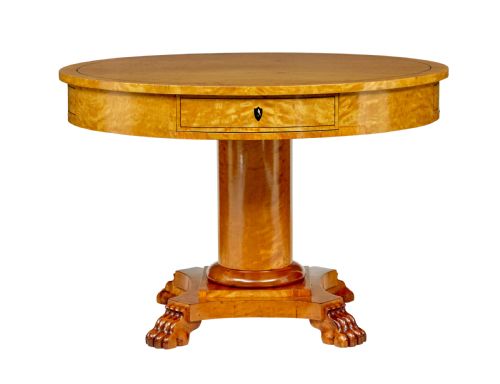


Swedish Empire Table
These swedish empire table pieces bring monumental classical lines and pale northern timbers to a room, offering a distinct northern take on continental neoclassical design.
Swedish Empire Table
When you search for a swedish empire table, you are looking at substantial neoclassical forms scaled for northern European interiors, most frequently seen here as circular centre tables and pedestals. These pieces belong primarily to the nineteenth century or later revival periods, carrying the heritage of grand continental design adapted to local taste.
The assortment on this page leans heavily toward birch and satin birch, alongside mahogany and occasional ebonised details. You will encounter centre tables, console tables, side tables, and desks that share a distinct architectural presence rooted in the empire style.
Materials and construction
Cabinetmakers utilised pale northern timbers such as birch and satin birch alongside rich mahogany, frequently framing the grain to striking visual effect. These woods provided the primary surfaces for tables and desks, establishing a bright counterpoint to darker imported species.
Metalwork played a defining role in the ornamentation, with cast brass, ormolu, and gilt bronze applied to mounts, collars, and feet. The contrast between polished yellow metal and figured wood defines the physical character of these works.
Swedish Empire Table Retail Price Guide 2026
Typical asking prices for swedish empire table among the pieces listed under this phrase on Sellingantiques today, from the lower quarter to the upper quarter. They describe what is for sale here now, not the wider market.
Listings combine original nineteenth-century items with later empire revival pieces from the early twentieth century, spanning birch, mahogany, and burr elm.
Assessing quality
The distinction between ordinary and exceptional pieces rests upon the selection of timber veneers and the crispness of the gilt bronze or ormolu mounts. Finer examples display carefully matched grain patterns across the primary surfaces rather than plain boards.
Proportion and structural harmony separate superior craftsmanship from lesser workshop production. The balance between the central pedestal or legs and the top surface dictates the visual weight of the piece.
The Swedish Empire Table Glossary
- Centre table
- A freestanding table designed to be viewed from all sides, placed in the middle of a room rather than against a wall.
- Ormolu
- Gilded bronze used for decorative mounts and furniture fittings during the period.
- Pedestal desk
- A heavy writing table supported by two banks of drawers or columns rather than four independent legs.
- Satin birch
- A northern European hardwood with a shimmering, reflective grain highly prized in fine cabinetmaking.
- Console table
- A wall-mounted or bracket-supported table designed to stand against a flat surface.
Swedish Empire Table: Frequently Asked Questions
Where should I place a centre table?
These tables work best when given space to be seen from every angle, often anchoring the middle of a principal room or a large hallway.
Because they are finished on all sides, they do not need to rest against a wall and serve well as display surfaces for lamps or decorative objects.
How do I care for birch furniture?
Keep northern European timbers away from direct sunlight and sudden temperature shifts to prevent the wood from drying out or splitting.
Dust regularly with a dry cloth and apply a quality wax sparingly when the surface appears dull to maintain the natural sheen.
What defines the empire style?
The style draws heavy inspiration from classical antiquity, featuring bold geometric forms, architectural columns, and restrained classical ornamentation.
In Swedish interpretations, these grand motifs are softened by the use of pale domestic woods like birch rather than heavy dark mahogany.
Are revival pieces well made?
Revival items from the late nineteenth and early twentieth centuries often match the construction standards of earlier decades, using traditional joinery methods.
Cabinetmakers of the revival era faithfully copied original neoclassical proportions and material combinations.