
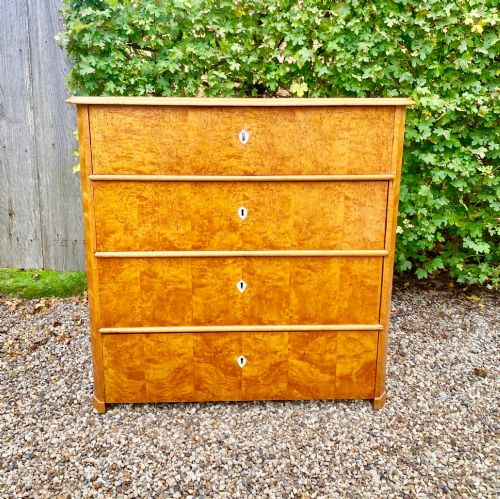
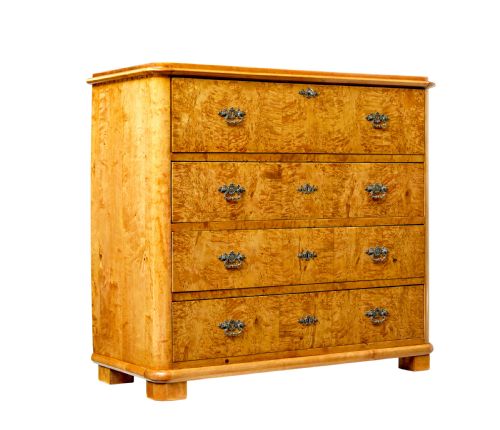
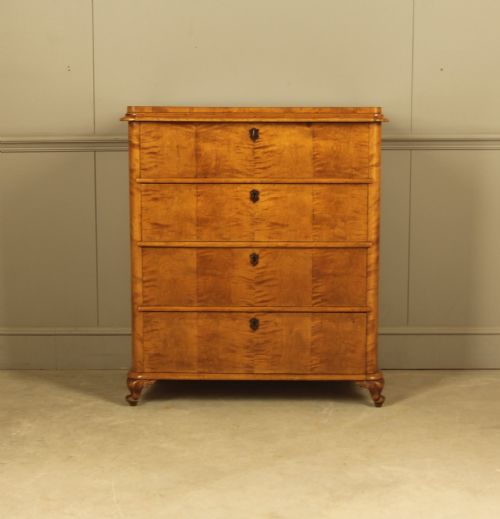
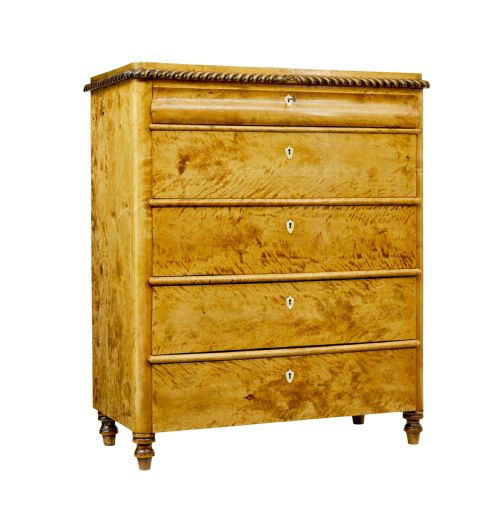


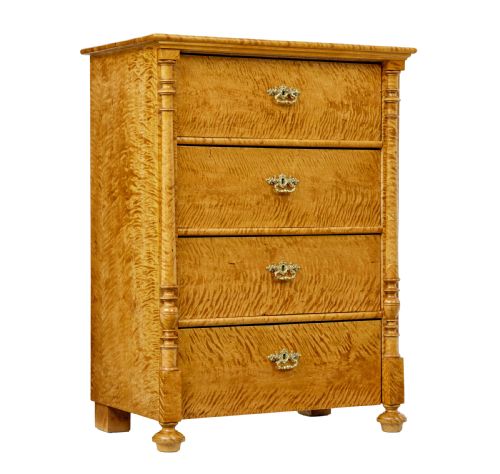

Swedish Birch Tallboy
A Swedish birch tallboy brings architectural presence and striking wood grain into a room, offering generous storage through deep, well-proportioned drawers.
Swedish Birch Tallboy
A swedish birch tallboy typically manifests as a chest of drawers or a secretaire chest of drawers originating from the nineteenth century or the year nineteen thirty. These items serve as functional storage furniture that doubles as a strong focal point in a room due to their pale timber and clean geometric lines.
The majority of pieces encountered here belong to the nineteenth century, often reflecting the regional interpretation of Biedermeier or Empire Revival aesthetics. Buyers regularly find variations that include straight drawers, caddy tops, or drop-front writing compartments known as secretaires.
Construction frequently incorporates secondary timbers such as pine alongside primary show woods, while iron and brass hardware provides structural reinforcement and decorative contrast.
How they were made
Cabinet makers utilised native Scandinavian timbers, applying finely figured veneers such as flame birch, burr birch, masur birch, and tiger birch over solid pine carcases. This technique displayed the dramatic natural patterns of the wood across wide drawer fronts and upright surfaces.
Surfaces were meticulously prepared and polished to highlight the chatoyancy and depth of the birch grain. Hardware components like brass key escutcheons and iron mechanisms were integrated directly into the timber framework to ensure both durability and visual balance.
Even simulated birch gets its day in the sun when painted by Gemla Fabrikers.
What varies in quality
The visual impact of a swedish birch tallboy depends heavily on the choice and book-matching of decorative veneers across the drawer fronts. Pieces displaying symmetrical flame, burr, or tiger figure command attention through their rich optical depth.
Structural integrity and the precision of the joinery distinguish finer cabinet work from more utilitarian output. The smoothness of drawer movement and the crispness of carved details or applied mouldings indicate the level of care invested by the original maker.
Gemla Fabrikers
The Swedish Birch Tallboy Glossary
- Secretaire
- A desk form featuring a hinged writing flap that drops down to reveal internal compartments and small drawers. This clever design conceals a functional workspace within the upper section of a standard chest.
- Flame birch
- A specific cut of timber displaying wave-like patterns that resemble flickering flames across the polished surface. Cabinet makers prized this veneer for its dynamic movement and visual warmth.
- Biedermeier
- A influential Central and Northern European design style spanning the nineteenth century characterised by utilitarian comfort and clean architectural lines. Pieces from this movement rely on wood grain rather than heavy ornamentation for their decorative effect.
- Caddy top
- A raised or stepped upper moulding profile reminiscent of tea caddy lids from the period. This specific edge treatment adds subtle sculptural depth to the top surface of a case piece.
- Masur birch
- A natural growth variation in birch timber resulting in distinctive dark swirling spots and ripples across the grain. Craftsmen selected this figured wood specifically for prominent drawer faces.
Swedish Birch Tallboy: Frequently Asked Questions
How do I use a secretaire chest?
A secretaire chest functions simultaneously as a traditional set of drawers and a compact writing desk. The middle or upper drawer front folds down to reveal a fitted interior with small letter compartments and writing space.
This dual purpose makes it a practical choice for living rooms or home studies where floor space is limited.
How do I care for birch veneer?
Maintain birch veneer surfaces by keeping them away from direct sunlight and consistent moisture fluctuations to prevent the timber from drying or warping. Regular dusting with a soft, dry cloth preserves the polished finish.
A light application of appropriate furniture wax occasionally helps nourish the wood grain.
What periods are represented here?
The selection consists largely of nineteenth-century pieces alongside items from nineteen thirty. Nineteenth-century examples often embody Biedermeier or Empire Revival styles.
Later twentieth-century production adapts these traditional Scandinavian forms using hand-painted simulated finishes.
How do Biedermeier and Empire styles differ?
Biedermeier design prioritises domestic comfort, understated elegance, and the natural beauty of wood grain without excessive ornamentation. Empire Revival pieces draw upon classical antiquity with bolder architectural proportions and contrasting details.
Both styles utilise birch extensively in Scandinavian furniture making.