

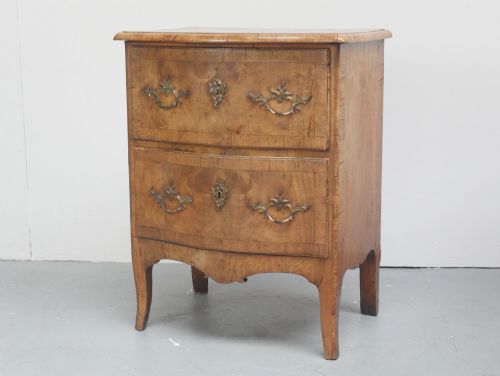


Swedish Bedside Chests
Swedish bedside chests bring architectural restraint and understated proportion to a bedroom, offering practical surface space alongside clean Scandinavian lines.
Swedish Bedside Chests
Swedish bedside chests appear primarily as small chests of drawers and commodes originating from the eighteenth and nineteenth centuries. These pieces reflect regional interpretations of European neoclassical and rococo movements, translated into domestic scales suitable for intimate rooms.
The dominant forms on this page include painted pine and softwood cases, often arranged as two-drawer commodes or serpentine shapes. Examples span from the Gustavian period through to later nineteenth-century interpretations featuring carved elm and faux marble tops.
Buyers encountering these items will find both matching pairs and single cabinets, frequently finished in monochrome paint or retaining traces of historic decoration. Their utility lies in providing compact storage whilst introducing distinct Scandinavian character to an interior scheme.
How they were made
Cabinetmakers constructed these chests predominantly using native softwoods like pine, alongside denser timbers such as birch and elm for structural integrity or decorative contrast. Carved elements demonstrate traditional joinery techniques suited to regional timber supplies.
Surfaces were frequently treated with layers of paint, often applied to softwood carcasses to mimic more expensive materials or to achieve a smooth, light-reflecting finish. Metal fittings, including brass handles and escutcheons, provide functional accents against the painted or polished wood.
Swedish Bedside Chests Retail Price Guide 2026
Typical asking prices for swedish bedside chests among the pieces listed under this phrase on Sellingantiques today, from the lower quarter to the upper quarter. They describe what is for sale here now, not the wider market.
What varies in quality
The standard of a piece rests heavily on the crispness of its proportions and the integrity of its timber construction. Sophisticated mouldings and well-executed serpentine fronts separate finer cabinetwork from simpler provincial carpentry.
Surface finish also dictates distinction, with original paint surfaces holding greater visual harmony than later repainting. The subtlety of carved detail, particularly on Gustavian-influenced examples, demonstrates the maker's skill and ambition.
The Swedish Bedside Chests Glossary
- Gustavian
- A Swedish neoclassical style spanning the late eighteenth century, characterised by restrained symmetry, fluted columns, and pale palettes. It draws inspiration from French Louis XVI design but maintains a distinct Nordic austerity.
- Commode
- A low chest of drawers or cabinet, typically standing on legs. In Scandinavian furniture, the term often describes decorative chests placed in bedrooms or reception rooms.
- Serpentine
- A shape of furniture front or top that curves outward in the centre and inward at the sides. This contour requires precise woodworking and adds visual fluidity to the piece.
- Softwood
- Timber derived from conifers, such as pine, which was widely utilised in regional Swedish cabinetmaking for its workability and abundance. It formed the hidden and painted carcasses of many domestic chests.
Swedish Bedside Chests: Frequently Asked Questions
What periods do these chests come from?
The pieces span the eighteenth and nineteenth centuries, capturing periods from the height of Gustavian influence to later provincial revivals. Eighteenth-century examples tend to show earlier rococo curves, while nineteenth-century pieces often adopt stricter classical lines or painted finishes.
Dating relies on construction methods, timber choice, and stylistic markers such as hardware and leg profiles rather than exact documentation. Each era brought subtle shifts in proportion and ornamentation to the traditional chest of drawers.
Are painted finishes original?
Many chests retain historic paint layers, though the distinction between original, early, and modern overpainting requires close inspection of the surface wear and underlying wood. Eighteenth and nineteenth-century pieces often received multiple coats of lead-based or oil paint to protect the softwood beneath.
Over decades, these finishes develop a characteristic crackleur and softening around the edges of drawers. Traces of earlier colours sometimes peek through worn areas, adding depth to the surface.
How do I use them as bedside tables?
Their height and surface area make them well-suited for modern bedroom layouts, providing adequate space for lamps and reading material while offering concealed drawer storage. Two-drawer commodes fit comfortably beside standard mattress heights.
Pairing single chests or utilising matching pairs creates symmetry in larger rooms. The enclosed drawers keep bedside clutter hidden, maintaining a tidy aesthetic.
What timber was used underneath the paint?
Pine and softwood serve as the primary foundational materials for the majority of these painted chests, chosen for their local availability and ease of carving. Elm and birch appear less frequently, often reserved for structural elements or unpainted surfaces.
The choice of softwood made the pieces lighter to move around rural homes. Cabinetmakers relied on tight-grained regional timber to ensure the painted finish adhered smoothly.