


Studded Leather Ottoman
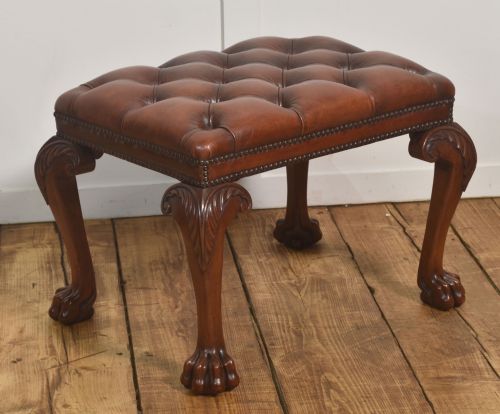
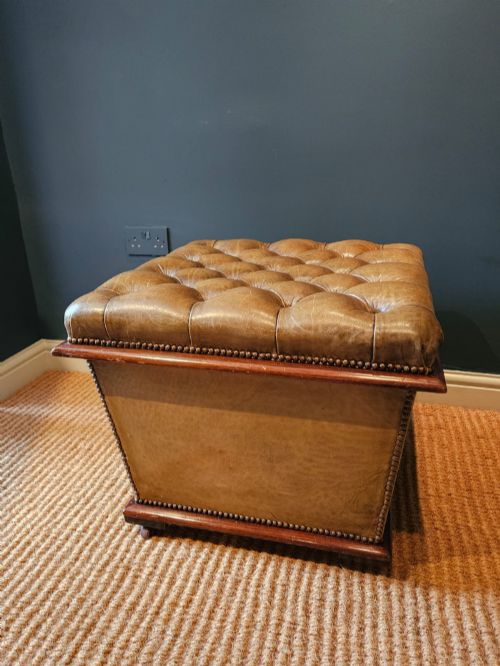
A studded leather ottoman brings solid mahogany, rosewood and brass detail together into a substantial seat that anchors a room.
Studded Leather Ottoman
A studded leather ottoman combines robust timber framing with upholstered leather seating and metal studwork, functioning as a stool, bench or low seat. These pieces appear across Victorian, Regency and Edwardian periods, alongside revival styles like Chippendale.
The form stretches from compact dressing stools and low footstools to large country house benches and box ottomans designed for storage. Mahogany and oak dominate the timber frames, while the leather upholstery frequently carries buttoning and brass studding along the borders.
Materials and construction
Makers built the frames primarily from dense hardwoods such as mahogany, rosewood, walnut and oak, shaping them with cabriole legs, fluted supports or X-frames. These structural timbers provide the necessary weight and stability for low seating.
Upholstery combines hand-dyed leather secured with individual brass studs, often finished with deep buttoning. The hides are stretched tightly over internal padding to create a firm yet resilient surface.
Among the stately mahogany and rosewood benches, a lone oak stool bears carved lions' heads, watching the room with quiet vigilance.
Assessing craftsmanship and proportion
The standard of a studded leather ottoman rests on the selection of timber and the precision of the frame joinery. Finer examples display carefully carved details, such as lions' heads or crisply moulded cabriole legs, rather than plain or hurried woodwork.
Upholstery technique defines the upper tiers of quality, seen in evenly spaced, hand-driven brass studs and symmetrical buttoning that maintains tension across the leather. The grain and finish of the hide also dictate the depth of character in the piece.
The Studded Leather Ottoman Glossary
- Ottoman
- A low, upholstered seat or bench without a back or arms. It frequently includes internal storage or serves as a footrest.
- Cabriole leg
- A furniture leg that curves out and then in, resembling the leg of an animal. This form appears frequently on Victorian and revival pieces.
- Buttoned
- An upholstery technique where depressions are pulled into the padding using buttons or tufts. This secures the filling and creates a patterned surface.
- X-frame
- A structural support formed by two intersecting members shaped like the letter X. It provides sturdy support for formal stools and benches.
Studded Leather Ottoman: Frequently Asked Questions
How are studded leather ottomans used?
These pieces function primarily as low seating, footstools or coffee table alternatives in a living space. Larger box variants also provide concealed storage for blankets and household items.
Their robust timber frames and durable leather surfaces allow them to withstand daily use while anchoring the room's proportions.
What periods do these ottomans come from?
The listings span the Regency, Victorian and Edwardian eras, alongside later revival pieces from the early twentieth century. Construction methods and wood choices shift across these decades.
Regency pieces often utilise rosewood with refined lines, whereas Victorian examples tend towards heavier mahogany frames and deep buttoning.
How do I maintain leather upholstery?
Leather surfaces require regular dusting with a dry cloth and occasional treatment with appropriate leather conditioners to prevent drying. Avoiding direct sunlight helps preserve the original dye and suppleness of the hide.
Proper care protects the brass studwork and maintains the structural integrity of the upholstered top.
Are these pieces suitable for daily seating?
Solid hardwood frames and dense internal padding make these ottomans exceptionally sturdy for regular sitting or resting feet. Their low height and stable construction support heavy daily use.
Over time, the leather develops a natural patina that reflects this active service.