



Steamship Watercolour Artwork
Steamship watercolour artwork captures the maritime energy of the 19th century and Edwardian eras through pigment and paper.
Steamship Watercolour Artwork
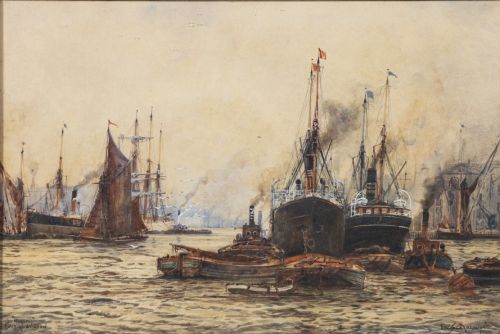
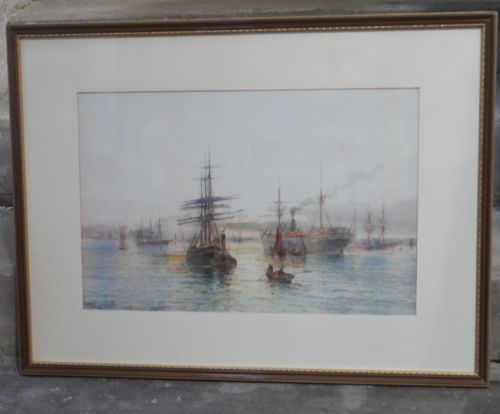
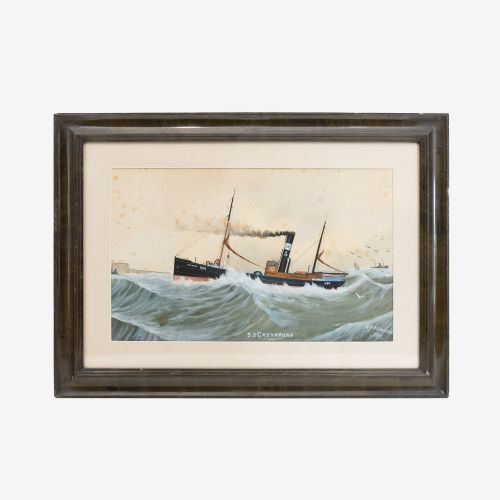
Steamship watercolour artwork represents marine scenes executed in watercolour, gouache and paper, capturing vessels such as the S.S. Greyhound, tugs, and ships on the Thames or at Dublin Bay. These maritime paintings span the 19th century, 1890, 1900, 1910 and the Edwardian period, often depicting busy ports and river life.
The primary examples met on this page include portrayals of London's Upper Pool and Lower Pool, river Thames views with St Paul's Cathedral, and coastal towing scenes. Artists working in British School Maritime, Victorian Marine Realism and Edwardian Maritime styles created these works on paper.
Buyers seek these paintings to connect with maritime history, maritime trade, and early steam propulsion depicted through traditional watercolour techniques. The subjects range from specific named steamships to general port activity handled by period artists.
How steamship watercolour artwork was made
Artists applied watercolour pigment and gouache onto paper supports, often combining media to achieve opaque highlights on smoke, steam, and water surfaces. Gouache provided the body colour necessary to render the billowing smoke of steamships and the foam of tugboat wakes against the river.
Works were framed behind glass within wooden mouldings to protect the delicate paper and water-soluble pigments from atmospheric moisture and handling. This traditional mounting preserves the subtle washes of blue, grey, and ochre that define nineteenth-century maritime skies and water.
Steamship Watercolour Artwork Retail Price Guide 2026
Typical asking prices for steamship watercolour artwork among the pieces listed under this phrase on Sellingantiques today, from the lower quarter to the upper quarter. They describe what is for sale here now, not the wider market.
Styles represented span Victorian Marine Realism, Edwardian Maritime, and British School Maritime.
What varies in quality
The level of detail in vessel rigging, hull construction, and atmospheric effects such as industrial smoke distinguishes works across the range. Superior compositions capture accurate maritime architecture alongside the bustling activity of ports like London and Scarborough.
The handling of light and water surface reflections dictates the visual strength of the piece. Masterful control of watercolour washes creates convincing movement in river currents and transparency in coastal water.
Frank William Scarbrough·Ernest Dade·Walter Duncan·Alexander Harwood·Frances E Nesbitt·J Syer
The Steamship Watercolour Artwork Glossary
- Watercolour
- A painting method in which the paints are made of pigments suspended in a water-based solution. It relies on the white of the paper to provide luminosity through translucent washes.
- Gouache
- An opaque water-based paint consisting of pigment, water, and a binding agent such as gum, often used alongside watercolour to add highlights.
- Edwardian
- Pertaining to the reign of King Edward VII, spanning from 1901 to 1910, characterised in art by a continuation of late Victorian naturalist and impressionist tendencies.
- Marine Realism
- An artistic style focusing on the accurate, detailed representation of ships, coastal scenes, and maritime weather conditions without romantic exaggeration.
Steamship Watercolour Artwork: Frequently Asked Questions
What periods do these paintings date from?
The selections span the late 19th century, 1890, 1900, 1910, and the Edwardian era. These dates reflect the height of steamship travel and port expansion.
Most works originate from British artists documenting industrial waterways and maritime transport during this transformative era of steam power.
What subjects appear in these watercolours?
Common subjects include steamships like the S.S. Greyhound, tugboats towing vessels into port, and bustling river scenes on the Thames. Landmarks such as St Paul's Cathedral frequently anchor the background of London port views.
Artists also recorded coastal shipping at Scarborough and Dublin Bay, capturing both commercial vessel traffic and urban river life.
How should watercolour art be framed?
Watercolour paintings require framing behind glass to shield the paper and water-soluble pigments from dust, humidity, and direct sunlight. Acid-free mounts prevent chemical damage to the paper support over time.
Wooden frames traditionally complement these works while securing the glass and backing board firmly in place.
How do watercolours and gouache differ?
Watercolour uses transparent washes where the white paper reflects light through the pigment. Gouache incorporates a binding agent that makes the paint opaque, allowing for solid highlights.
Artists frequently combined both mediums on paper to render the dense smoke of steamships alongside translucent river water.