
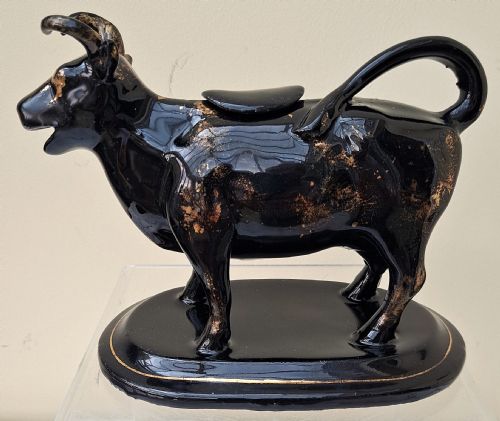
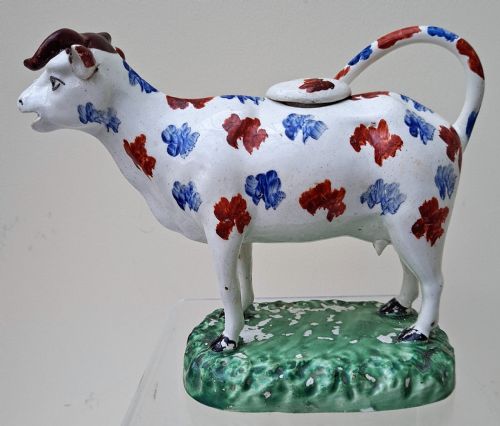


Staffordshire Cow Creamer
These charming staffordshire cow creamer figures combine utility with folk art, offering whimsical table service from past centuries.
What They Are
A staffordshire cow creamer is a ceramic vessel shaped as a bovine, often accompanied by a milkmaid or milkman figure. These figural cream jugs served a functional role on the tea table while doubling as decorative folk art.
The pieces listed here span the nineteenth century, including Regency examples and the year 1800. Buyers most frequently meet Victorian pottery items, alongside Welsh Georgian pieces and items bearing specific finishes such as Jackfield, Prattware, and pearlware.
Forms vary from single beasts to pairs, some featuring lids or flat bases. Regional variations include Yorkshire pearlware hobbled cow creamers and figures decorated with willow pattern transfer prints.
How They Were Made
Potters constructed these figures using earthenware and pearlware bodies, finished with ceramic glaze or glaze. Surface decoration relied on hand painting, sponge decoration, and blue and white transfer printing.
Details such as lustre and gilt accents enhanced certain models. Lidded variants required precise ceramic moulding to ensure the cover fitted the aperture on the cow's back.
Retail Price Guide 2026
Typical UK retail prices for staffordshire cow creamer, calculated from the Sellingantiques database of over a million retail prices indexed since 2003. This retail price guide relies exclusively on Sellingantiques data; no external sources or auction records are used, so the figures do not describe the wider market.
Regional variations span English and Welsh folk art traditions, including specific Yorkshire pearlware and Jackfield pottery examples.
What Varies in Quality
Quality rests in the crispness of the modelling and the finesse of the hand-painted or transfer-printed decoration. Simpler folk art interpretations display charming rustic directness, whereas finer examples show more detailed anatomical shaping and facial expression on the cow and attendant figures.
The application of glaze and colours dictates visual appeal. Consistent lustre, well-defined blue and white transfer patterns, and carefully applied gilt or paint elevate the decorative presence of the piece.
The Staffordshire Cow Creamer Glossary
- Pearlware
- A refined earthenware body developed in the late eighteenth century, featuring a bluish-white glaze that pooled in recesses.
- Jackfield
- A type of dark, glossy black pottery, often associated with a rich metallic sheen resembling lustre.
- Prattware
- Earthenware decorated underglaze in a restricted palette of ochre, blue, brown, green, and yellow.
- Spongeware
- Pottery decorated by dabbing pigment onto the biscuit or glazed surface with a sponge to create mottled patterns.
- Flat base
- A supportive, unmodelled plinth beneath the figure, typical of early nineteenth-century Staffordshire and Yorkshire ceramics.
Frequently Asked Questions
How do you fill a cow creamer?
Liquid cream is poured through an opening on the top of the cow's back, often concealed beneath a removable lid.
The milk or cream is then poured out from the animal's mouth during tea service.
What is a milkmaid cow creamer?
These figural pieces incorporate a human figure, usually a milkmaid or milkman, standing beside or leaning against the cow.
Such figures introduce a narrative element to the functional creamer.
How do I date a staffordshire cow creamer?
Dating relies on identifying the ceramic body, such as early pearlware versus later Victorian earthenware, alongside stylistic markers.
Glaze characteristics, transfer printing techniques, and the presence of flat bases also help establish the period.
Are these creamers meant for daily use?
While originally designed for the table, these antique ceramic pieces are now treated primarily as decorative display items.
Careful handling is recommended to preserve the fragile glazes and painted surfaces.