
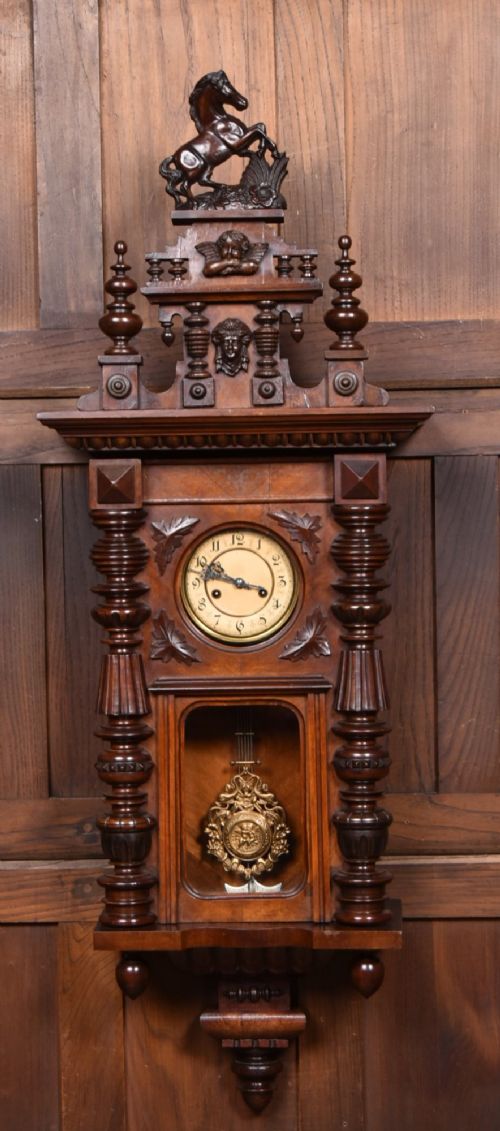
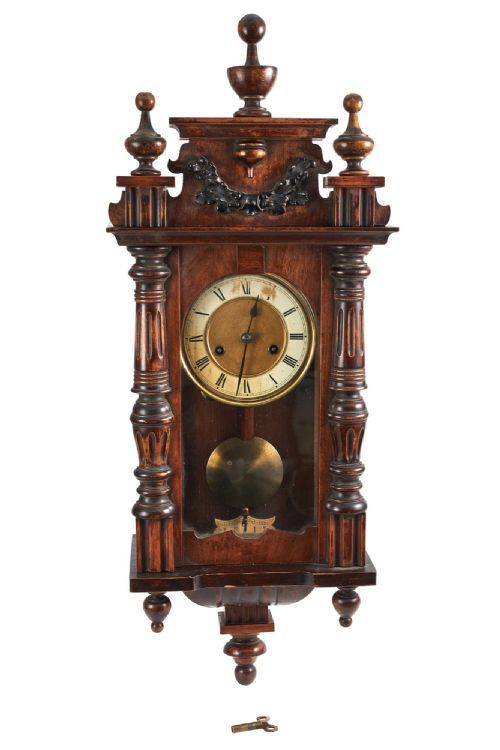

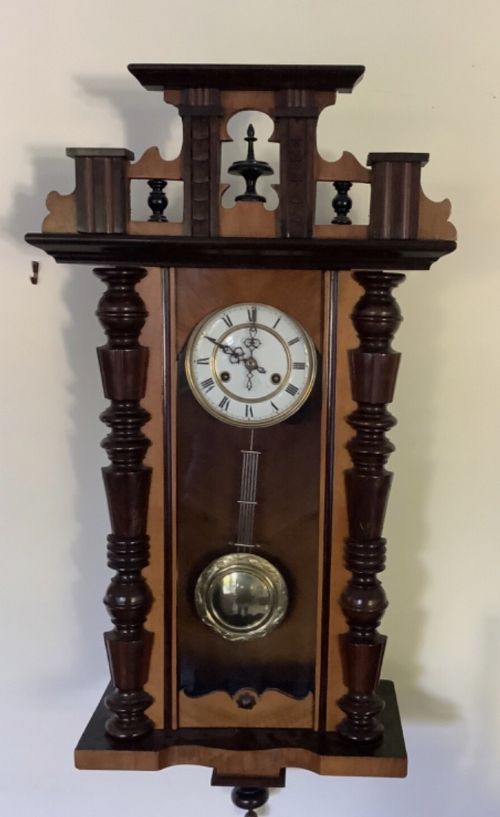


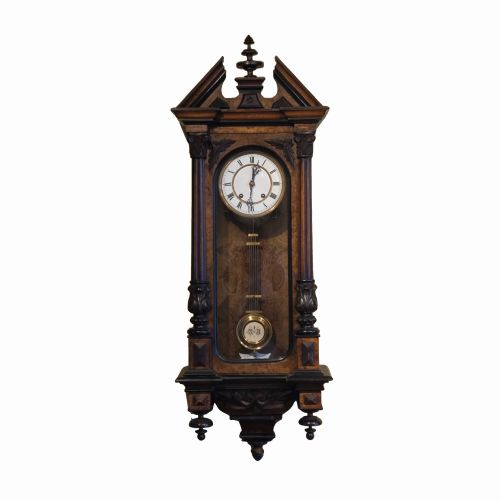


Spring Driven Wall Clock
These spring driven wall clock examples offer reliable mechanical timekeeping paired with rich timber cases, making them a practical choice for period interiors.
Spring Driven Wall Clock
A spring driven wall clock represents a dependable mechanical timekeeper housed in a wall-mounted timber case, typically powered by a mainspring rather than hanging weights. When you search for a spring driven wall clock, you are looking at timepieces that range from straightforward domestic dials to elaborate regulator formats.
The versions you are most likely to meet on this page span the Victorian and Edwardian eras, with a strong showing of walnut Vienna wall clocks alongside mahogany and ebonised examples. These pieces combine functional timekeeping with decorative woodwork suited for domestic spaces.
How They Were Made
Cases are constructed from timber veneers and solids, predominantly walnut and mahogany, with some ebonised wood finishes. Brass movements work alongside glass panelling to protect the dial while allowing the pendulum to remain visible.
Dials frequently feature enamel or silvered metal surfaces with clear chapter rings. Metal components work in tandem with the wooden cabinetry to create a stable housing for the spring driven mechanism.
German workshops produced numerous Vienna wall clocks featuring intricate pendulum assemblies designed to catch the ambient light as they swung.
What Varies in Quality
The distinction between standard domestic models and finer examples often lies in the execution of the timber case and the refinement of the movement. Richer grain selection and more elaborate carving distinguish the upper tier.
Dial legibility and the crispness of the metalwork contribute to the overall character of the piece. Well-preserved enamel and clear lettering indicate better original manufacture.
Cording of London·Johann Baptist Beha·John Seddon of London·Gustof Becker
The Spring Driven Wall Clock Glossary
- Mainspring
- A coiled ribbon of spring steel that stores potential energy to power the clock movement. This component removes the need for hanging weights.
- Regulator
- A precision timepiece designed for high accuracy, often featuring an elongated case and a prominent pendulum. These clocks were commonly used as timing standards.
- Escapement
- The mechanical linkage that converts rotational force into impulsive pendulum swings. It controls the release of power from the mainspring.
- Ebonised
- Wood finished to resemble ebony through staining or painting. This treatment creates a dark, uniform surface often seen on Victorian cases.
- Bracket clock
- A portable timekeeper originally designed to sit on a wall bracket or table. Many examples include mounting fixtures for secure wall placement.
Spring Driven Wall Clock: Frequently Asked Questions
How do I wind a spring driven wall clock?
Use the designated key on the winding arbors to tension the mainspring until resistance is felt. Care should be taken not to overwind the mechanism.
Consistent winding routines help maintain steady timekeeping performance across the week.
Where should I hang my wall clock?
Mount the clock on a sturdy internal wall away from direct sunlight and damp conditions. A stable surface prevents vibrations that can disrupt the pendulum.
Ensure the case hangs level so the beat of the escapement remains even and regular.
What does an eight day movement mean?
An eight day movement requires winding approximately once a week to maintain continuous operation. This configuration offers practical convenience for daily household use.
Spring driven systems achieve this duration by storing sufficient energy within the barrel mainspring.
How do I identify a Vienna wall clock?
Vienna wall clocks typically feature long glass-fronted doors, visible pendulums, and walnut or ebonised timber cases. Their dials are often detailed with distinct chapter rings.
These pieces developed from precision regulators into decorative domestic timepieces during the nineteenth century.