
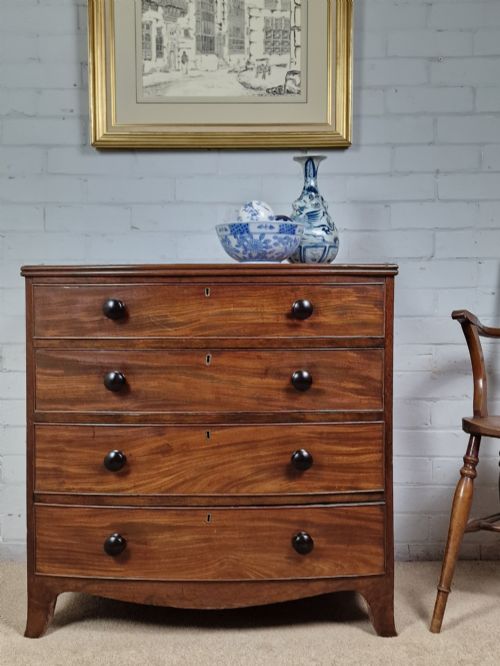

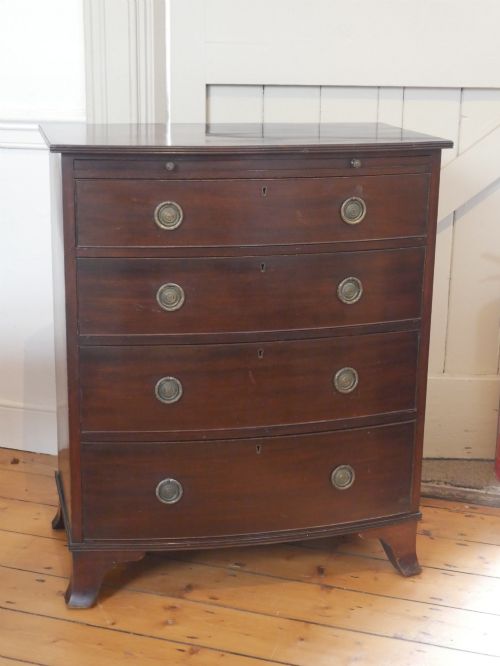
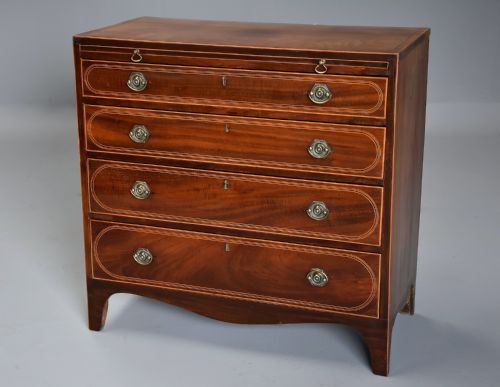

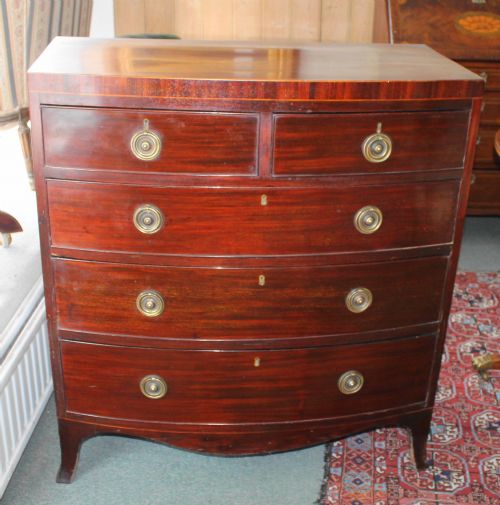
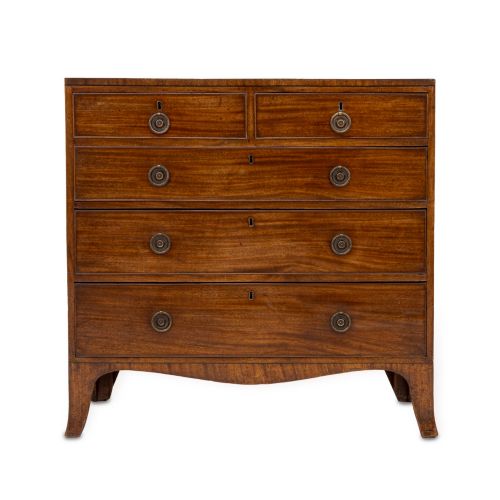
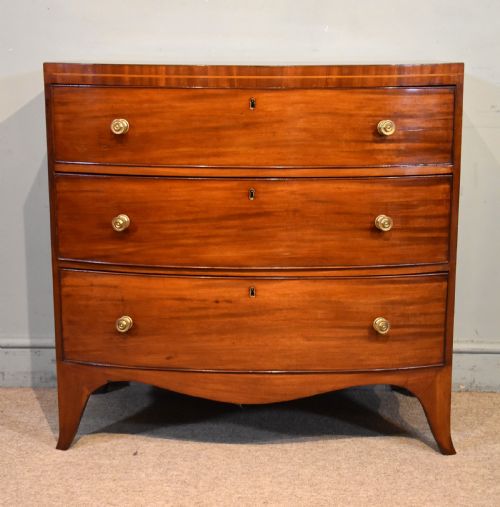

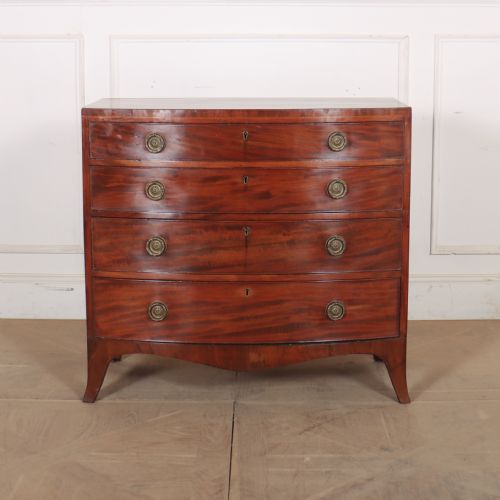


Splay Leg Chest
A splay leg chest offers elegant storage with outward-angled supports, combining functional timber cabinetry with a lighter silhouette.
Splay Leg Chest
A splay leg chest brings together traditional drawer storage and distinctive outward-slanting supports. The selections found here span the Georgian and Regency periods through to later revivals, displaying forms such as the bow front and the serpentine commode.
Makers utilised rich timbers including mahogany and satinwood, occasionally incorporating boxwood inlay or painted finishes. These pieces range from compact proportions suited to smaller rooms to larger tallboy formats.
Materials and construction
Cabinetmakers constructed these chests primarily from solid mahogany and oak, applying finely figured veneers to drawer fronts and top surfaces. Satinwood and boxwood stringing provided decorative contrast.
Structural integrity relied on dovetailed drawer construction and stable bracket or splayed foot assemblies. Brass hardware, including handles and escutcheons, was fitted to complete each piece.
Judging quality and proportion
Quality rests upon the selection of timber grain, the crispness of inlaid stringing, and the harmony of the overall proportions. Pieces with well-matched veneer panels and original brass hardware stand apart from simpler examples.
The finesse of the splay legs themselves dictates much of the visual success, determining whether the base feels balanced or heavy beneath the upper drawers.
Druce & Co
The Splay Leg Chest Glossary
- Bow front
- A convex curved front to a chest of drawers that softens the rectangular outline. This shape appears frequently in Georgian and Regency cabinetwork.
- Serpentine
- A horizontally undulating front design featuring a convex centre flanked by concave curves. It requires advanced woodworking skill to execute properly.
- Bracket foot
- A foot fitted beneath the corner of a case piece, shaped like a bracket. On these items, they often transition into splayed configurations.
- Tallboy
- A tall chest of drawers built as a single unit or as a chest stacked upon another chest. They maximise vertical storage space in domestic interiors.
- Caddy top
- A tabletop style with a raised, moulded edge resembling the lid of a tea caddy. This detail signals attention to finishing touches in 18th-century pieces.
Splay Leg Chest: Frequently Asked Questions
What is a splay leg chest?
A splay leg chest is a wooden drawer unit featuring outward-angled feet that lift the body of the cabinet off the floor. This design provides a lighter visual stance compared to standard block or bracket feet.
Such pieces appear in various forms, including bow fronts and serpentine commodes, predominantly executed in mahogany during the Georgian and Regency eras.
How do I date a chest?
Dating relies on examining timber choices, construction techniques such as dovetailing, and stylistic markers like stringing and brass hardware. Earlier pieces often display solid secondary woods and hand-cut joints.
Comparing the proportions and decorative motifs against known historical periods helps narrow down the decade of manufacture.
Where should I place it?
These chests function effectively in bedrooms, hallways, or living spaces where surface area and drawer storage are both required. Their compact footprint allows them to fit well against walls without dominating a room.
Placing them away from direct heat sources helps protect the mahogany veneers and polished finishes over time.
Are drawers always oak lined?
Drawer linings vary depending on the workshop and the period of construction, though oak and pine are common secondary woods. Fine cabinets often use oak for internal framing and drawer sides.
Inspecting the interior reveals the standard of craftsmanship and helps verify the period of the piece.