


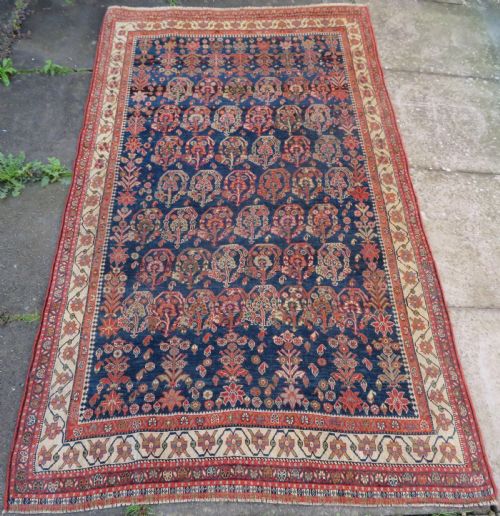


Southwest Persian Carpet
A southwest persian carpet brings nomadic artistry into your home, offering rich tribal patterns and deep historical roots.
Southwest Persian Carpet
A southwest persian carpet encompasses hand-knotted tribal weavings originating from the Fars Province and Luristan, created by confederacies and subtribes such as the Khamseh, Qashqai, Luri, and Afshar. These nomadic and village floor coverings serve as functional art, reflecting the specific heritage and symbolism of their makers.
The most common versions met on this page include rugs and carpets from the nineteenth century, specifically dating across decades like eighteen eighty, eighteen ninety, and nineteen hundred. Collectors encounter formats ranging from area rugs and runners to substantial carpets bearing distinct tribal motifs.
Tribal weaving traditions dictate the aesthetic, often displaying geometric layouts, repeated boteh motifs, and characteristic colour palettes native to the region. Each piece tells a distinct story of the group that knotted it, preserving nomadic design vernaculars through generations.
Materials and Technique
Makers constructed these floor coverings using wool for the pile and foundation, often pairing it with cotton for structural stability in specific tribal traditions. This organic fleece provides durability and a rich texture that develops character over decades of use.
Natural dyes impart the distinctive coloration seen across these textiles, sourced from local plants and minerals to create deep hues that age gracefully. Weavers utilised traditional hand-knotting techniques passed down within confederacies and subtribes, securing the wool onto warp and weft threads without modern machinery.
Listings feature nineteenth century pieces alongside works dated eighteen eighty, eighteen ninety, nineteen hundred, and nineteen ten, primarily utilising wool, cotton, and natural dyes.
Assessing Quality
Knot density and structural tightness set finer examples apart from coarser work, dictating how sharply defined the geometric motifs appear on the surface. Tightly beaten wefts create a firm, resilient handle that withstands heavy foot traffic.
The vibrancy and complexity of the natural dye palette influence the visual hierarchy of these textiles, with nuanced colour shifts adding depth. Artistry in the tribal design execution, balance in proportions, and originality of subtribal symbols elevate specific pieces above standard village productions.
The Southwest Persian Carpet Glossary
- Boteh
- A stylised almond or pear-shaped motif symbolising life and eternity. It frequently appears repeating across Qashqai and Khamseh weaving fields.
- Fars Province
- A region in south-west Persia known for its rich nomadic and tribal weaving traditions. Many distinct confederacies reside here.
- Khamseh Confederation
- An alliance of five diverse tribes in south-west Persia creating distinct knotted carpets. Their work often includes Arab, Basseri, and Baharlu subtribal elements.
- Natural Dyes
- Colourants derived from plants, insects, and minerals rather than synthetic chemistry. They create subtle tonal variations known as abrage.
- Rug Runner
- A long, narrow carpet format designed for hallways or corridors. These examples show distinct tribal borders and elongated central medallions.
Southwest Persian Carpet: Frequently Asked Questions
How do I identify a Khamseh carpet?
Look for dense geometric patterns, bird or animal motifs, and deep indigo or red backgrounds characteristic of south-west Persian subtribes. These rugs often display distinctive starry rosette borders.
Examination of the wool and structural rigidity also helps confirm tribal attribution, separating them from urban workshop pieces.
Where were these tribal rugs made?
Nomadic and village weavers produced these textiles across the Fars Province and Luristan in south-west Persia. Different confederacies like the Qashqai and Khamseh worked within specific territories.
Their seasonal migrations influenced the wool quality and structural materials utilised in each weaving.
How should I care for an antique rug?
Vacuum gently using suction attachments without beater bars to protect the wool pile from unnecessary friction. Keep the textile out of direct sunlight to prevent natural dye fading over time.
Rotate the carpet periodically to ensure even wear across high-traffic areas in your home.
What does nineteenth century mean for these rugs?
Pieces attributed to the nineteenth century or specific decades like eighteen eighty were knotted before modern commercial dye introduction. This era preserves authentic tribal designs created for personal use or local barter.
Such age reflects decades of traditional craftsmanship prior to industrial standardisation.