
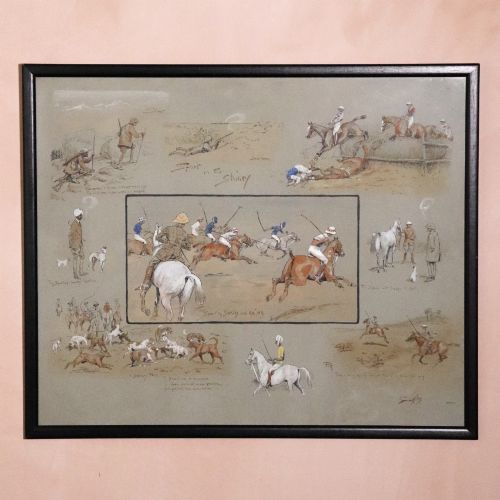


Snaffles Equestrian Print
Snaffles equestrian print works capture the character of early twentieth century sporting life through hand finished lithography and watercolour.
Snaffles Equestrian Print
A snaffles equestrian print depicts the scenes, characters and humour of British hunting and military life during the early twentieth century. These pieces record the work of Charles Johnson Payne, whose military service and passion for horses informed every plate he produced.
Buyers encounter subjects ranging from regimental life in India to Leicestershire hunting fields, often bearing the artist characteristic signature and blind stamp. The selection available spans the decades from nineteen hundred to nineteen forty, capturing changing social backgrounds and rural traditions.
How they were made
The process begins with a pen and ink drawing or watercolour, which is then translated into a hand coloured print on paper. Many plates incorporate additional touches of gouache applied by hand, giving each framed work its own individual colour palette.
Original oak frames frequently house these pieces behind glass, preserving the delicate pigments and paper from atmospheric damage. The combination of printed line and manual watercolour application defines the physical presence of these works.
Listings feature works created across four decades, utilising materials including paper, glass, oak frames, watercolour, and gouache.
What varies in quality
Quality rests in the vibrancy of the hand applied watercolour and the crispness of the underlying printed line. Examples that retain their original tones without fading display the skill of the colourist most clearly.
The presence of contemporary framing materials, such as original oak moulding and period glass, contributes to the integrity of the piece. Works that preserve their margins and proper inscriptions sit at the upper end of what survives today.
Charles Johnson Payne Snaffles
The Snaffles Equestrian Print Glossary
- Blind stamp
- A circular embossed mark applied to the paper, often featuring a bit or bridle motif associated with the artist. This seal acts as a mark of authenticity on genuine published plates.
- Hand coloured
- A print finished manually with watercolour or gouache after the mechanical printing process. This technique ensures that no two published plates are identical in every pigment detail.
- Lithograph
- A planographic printing method using stone or metal plates to reproduce original pen and ink drawings. The resulting line work forms the foundation before manual colour is added.
- Gouache
- An opaque water-based medium that provides dense highlights to the clothing and horses in these hunting scenes. It creates depth when contrasted with transparent watercolours.
- Sporting art
- A genre dedicated to depicting horses, hounds, hunting, and rural pursuits. This tradition forms the core context for early twentieth century British equestrian works.
Snaffles Equestrian Print: Frequently Asked Questions
Are these prints original?
The works listed include original hand coloured prints and watercolours produced during the artist lifetime. Each piece reflects the printing and painting techniques characteristic of the early twentieth century.
Paper stock, ink quality, and publishing details help identify authentic period production from later reproductions.
How should I frame these prints?
Original oak frames complement the hunting subject matter and period aesthetic of the artwork. Conservation mounting using acid free materials protects the paper during display.
Placement away from direct sunlight preserves the hand applied watercolour pigments over time.
What subjects do they show?
The compositions cover fox hunting scenes, military life, regimental characters, and equestrian sports. Titles range from Leicestershire hunting runs to colonial military episodes.
Each plate tells a story drawn from the personal experiences of the artist in Britain and abroad.
How do I date these works?
Dating relies on the recorded publication years, stylistic changes, and the historical context of the military or hunting scenes depicted. Most examples on this page originate between nineteen hundred and nineteen forty.
Subject matter often reflects the changing fashions of the Edwardian era and the interwar period.