
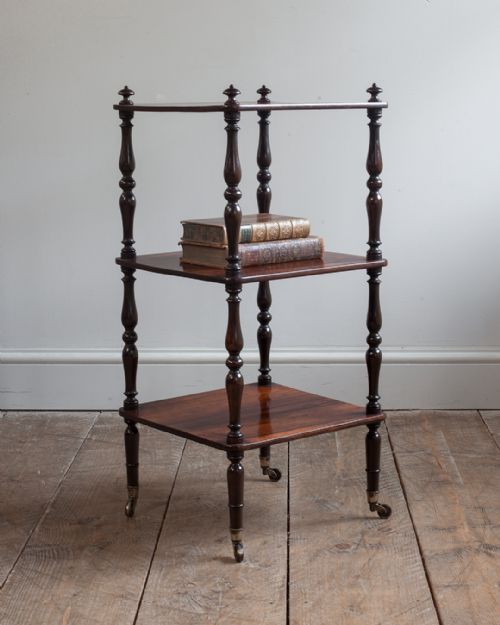


Small Rosewood Shelf Stand
A small rosewood shelf stand brings compact display space and rich dark timber to a room, offering tiered surfaces for books and ornaments.
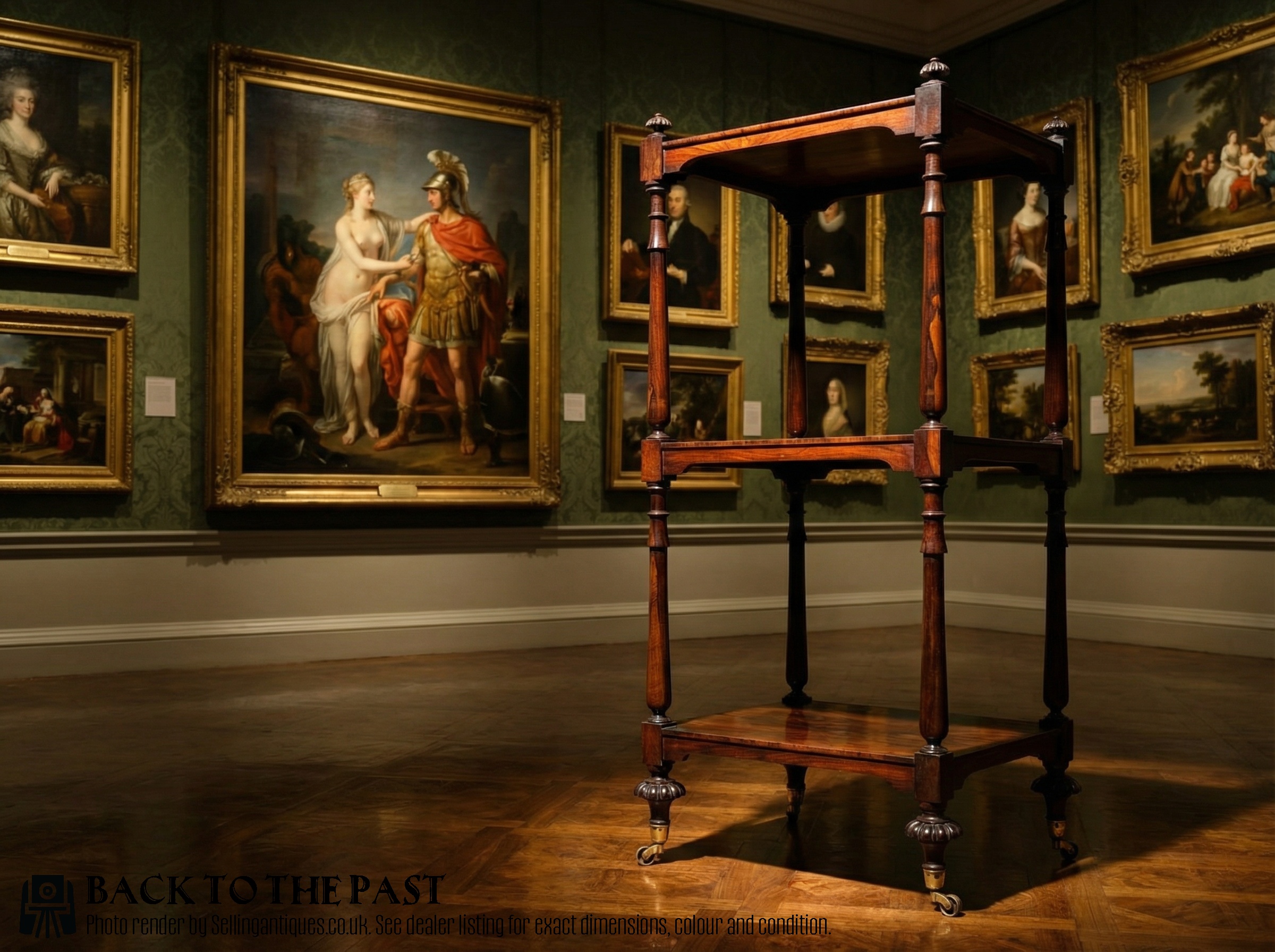
Small Rosewood Shelf Stand
A small rosewood shelf stand primarily takes the form of a whatnot, etagere or open bookcase designed for compact spaces. These pieces provide multiple tiers supported by uprights, intended for displaying small decorative objects or holding accessible volumes.
The versions most commonly met on this page date from the nineteenth century, spanning the Georgian, Regency, William IV, George IV and Victorian periods. Makers from this era utilised the dense grain and deep tone of rosewood to create functional furniture with refined architectural proportions.
Alongside standard floor-standing etageres and open bookcases, the selection includes tabletop variants and waterfall configurations. These varied forms share a common purpose of organising and displaying possessions within a domestic interior.
How they were made
Construction relies heavily on solid rosewood and mahogany, often enhanced with fruitwood inlay to create decorative contrasts on shelves and panels. Artisans also incorporated brass elements, ormolu mounts and mirrored backs to catch the light and enrich the visual texture of the tier supports.
Joinery techniques from the nineteenth century ensure stability across multiple stacked platforms, whether on a freestanding whatnot or a delicate tabletop etagere. The integration of brass castors and fine turning on upright columns demonstrates the precise cabinet-making standards applied to these smaller items.
The listings show nineteenth-century pieces spanning the Georgian, Regency, William IV, George IV and Victorian periods, constructed in rosewood, mahogany and fruitwood inlay.
What varies in quality
Quality in a small rosewood shelf stand rests on the crispness of its turned uprights and the harmony of its proportions. Pieces with subtle fruitwood inlay or finely chased ormolu mounts show a higher degree of artisan attention than plain structural examples.
The integrity of the timber selection also defines the upper tier of pieces, where rich grain patterns remain undisturbed across larger visible surfaces. Refined edging and balanced shelf spacing separate standard utility items from more ambitious cabinet work.
The Small Rosewood Shelf Stand Glossary
- Whatnot
- A piece of furniture with multiple open shelves designed to hold books, ornaments or curiosities. It gained widespread popularity during the nineteenth century.
- Ormolu
- Gilded bronze used for decorative mounts and furniture embellishment. It provides a bright metallic contrast against dark rosewood timber.
- Waterfall bookcase
- A set of open shelves where each successive shelf is set back from the one below it, creating a stepped profile.
- Fruitwood inlay
- Light-coloured timber inserted into a contrasting darker ground to form geometric or floral patterns. It highlights the craftsmanship of the period.
Small Rosewood Shelf Stand: Frequently Asked Questions
What is a small rosewood shelf stand used for?
These pieces serve as compact display units for holding small decorative objects, collectibles or frequently read books. Their multiple tiers maximise vertical storage without occupying a large floor footprint.
Historically, they sat in parlours, libraries and drawing rooms to keep prized possessions accessible and neatly arranged. Today, they function well in similarly compact areas of a modern home.
How do I identify a Regency period piece?
Regency items typically display classical architectural restraint, with clean lines, rosewood veneers and occasionally brass inlay or fine turned supports. The proportions reflect an interest in ancient Greek and Roman design.
Looking at the construction methods and secondary timbers inside the frame helps confirm the nineteenth-century origin. Makers of this era favoured dense tropical hardwoods and restrained ornamentation.
Where should I place a tabletop etagere?
A tabletop etagere sits securely on top of a larger piece of furniture, such as a sideboard, desk or chest of drawers. It provides additional vertical display space without requiring extra floor room.
Positioning it away from direct sunlight protects the rosewood timber and any delicate fruitwood inlay from fading. Placing it where light catches the ormolu or mirror elements enhances its decorative impact.