
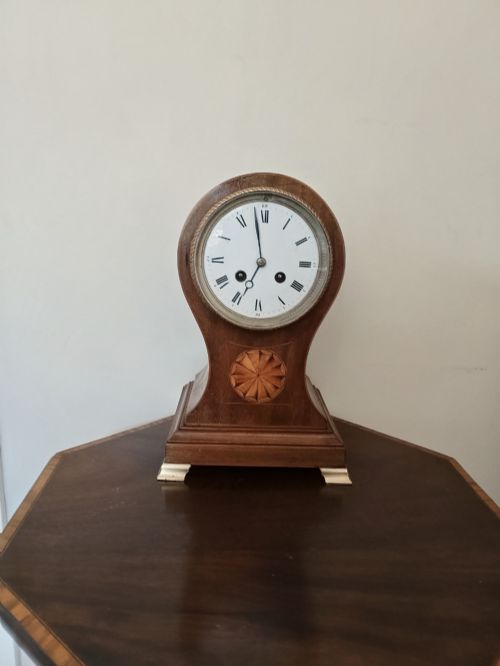
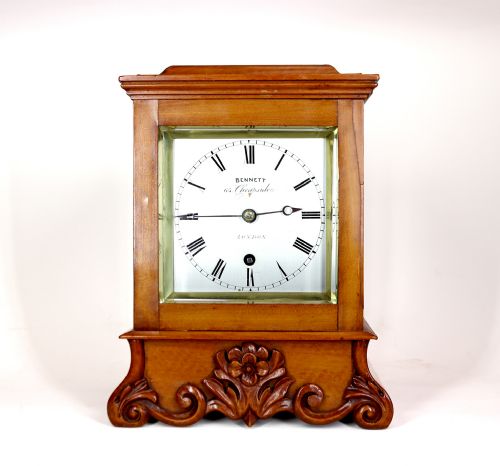


Small Bracket Clock
A small bracket clock offers precise mechanical timekeeping within a compact architectural case designed to sit neatly on tables, desks and mantelpieces.
Small Bracket Clock
A small bracket clock represents a portable mechanical timekeeper traditionally engineered for domestic rooms rather than grand halls. These pieces appear in forms ranging from traditional English fusee bracket clocks to French library clocks and decorative mantel pieces.
The selection encompasses periods from the eighteenth century through the Victorian era up to the early twentieth century, showing influences from Regency design to Louis XV revival and Chinoiserie.
Makers housed these movements in varied compact cases, including pad-top mahogany designs, ebonised wood, burr walnut, and striking balloon shapes.
Materials and Technique
Cases utilise dense hardwoods like mahogany, rosewood, and ebonised wood alongside decorative veneers such as satinwood and burr walnut, frequently ornamented with cast or gilt ormolu mounts and brass details.
Movements rely on mechanical ingenuity, incorporating fusee drives, verge escapements, and striking mechanisms including Ting-Tang configurations housed behind glass panels.
Dials display meticulous handwork, featuring silvered brass plates, enamel markers, and fine metallic hands protected beneath bevelled glass bezels.
Some nineteenth-century travellers carried portable library clocks simply to avoid relying on unpredictable local church bells.
Craftsmanship and Proportion
Excellence in a small bracket clock lies in the harmony between the refinement of the mechanical movement and the crispness of the case joinery. Finer examples display meticulous dial engraving, balanced proportions, and high-grade fusee mechanisms.
The distinction between standard production and superior craftsmanship rests on the execution of architectural details, such as well-defined pad tops, clean veneer matching, and original fire-gilt mounts.
Makers who signed their dials or movements often achieved a higher tier of horological sophistication, reflected in complex striking trains and steady eight-day performance.
Sir John Bennett·Louis Recordon·Payne and Co·Perigal of London·Joseph Jump·McCabe London·Perigal and Duterrau·Baldwin of Loughborough·Farr Bristol·John Durden·Barwise of London·Barraud·William James·Henry Archard·Robert Brown·F Waldek·Elliott of London·Richard Ganthony·Tennant London·J Walker
The Small Bracket Clock Glossary
- Fusee
- A conical pulley used in mechanical clocks to maintain an even pull on the movement as the mainspring unwinds. This device ensures consistent timekeeping across the duration of the wind.
- Bracket Clock
- A portable mechanical clock originally constructed with a matching wall bracket for support. Over time, the term came to describe table and mantel clocks of similar architectural proportion.
- Verge Escapement
- An early type of escapement mechanism controlling the release of energy in a clock. It relies on a crown wheel and a swinging verge axle to regulate the beat.
- Ting-Tang
- A two-bell striking mechanism that sounds a distinctive two-note warning or quarter chime before the hour. It is commonly found in nineteenth-century English and German bracket clocks.
- Ormolu
- Gilded bronze ornamentation applied to furniture and clock cases. The technique involves coating base metal with a finely ground mercury and gold amalgam before heating.
Small Bracket Clock: Frequently Asked Questions
What is a fusee movement?
A fusee is a conical drum connected to the mainspring via a fine chain or cord. It compensates for the decreasing power of the spring as it unwinds.
This clever mechanism ensures the clock receives a steady, even force from full wind to empty, which greatly improves timekeeping accuracy.
Where should I place a small bracket clock?
These compact pieces suit desks, bookshelves, side tables, and mantelpieces where space is limited. Their detailed cases allow them to serve as focal points in smaller rooms.
Avoid placing mechanical clocks near draughty windows, direct sunlight, or radiators to protect the delicate wood veneers and internal oils.
How can I tell the period of a clock case?
Case styles, timber choices, and dial designs offer clear clues to the era of manufacture. Regency pieces often feature bold mahogany and brass inlay, while Victorian examples lean toward heavy walnut or ebonised finishes.
Signatures on the dial or movement backplate also help date the piece when combined with construction traits like brass plates and pillar shapes.