
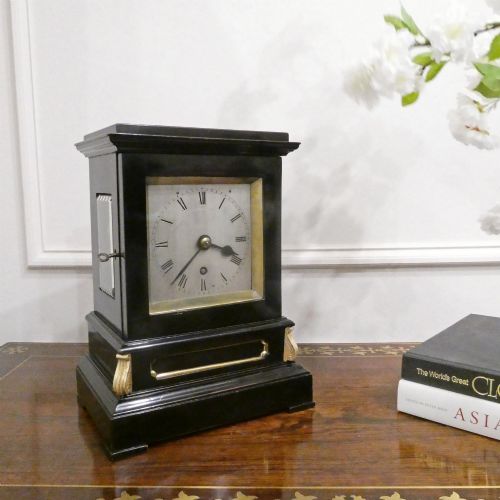


Single Fusee Mantel Clock
A single fusee mantel clock brings precise mechanical movement and refined period craftsmanship directly to any room.
Single Fusee Mantel Clock
A single fusee mantel clock is a self-contained mechanical timekeeper designed to sit on a shelf or mantelpiece, driven by a fusee cone that equalises the declining power of the mainspring. When you search for a single fusee mantel clock, you are looking at domestic horology spanning the Georgian, Regency, Victorian and Edwardian periods.
The pieces appearing on this page take various regional and domestic forms, from mahogany bracket clocks and inlaid balloon cases to library timepieces and four-glass brass designs. Library clocks and compact mantel timepieces in ebonised wood or mahogany emerge most frequently among these listings.
Makers from London, provincial towns and workshops across Britain produced these timepieces in styles ranging from Neoclassical and Rococo Revival to Egyptian Revival and Grand Regency. They served as functional daily timekeepers and decorative centrepieces for parlours, libraries and drawing rooms.
How They Were Made
Clockmakers housed these movements in cases constructed from native and exotic timbers such as mahogany, oak, rosewood, satinwood, coromandel and ebonised wood, alongside architectural mounts in ormolu, gilt bronze, brass, marble and slate. Silvered or enamelled dials display the hours, often protected beneath bevelled glass panels.
The technical heart of each piece is the single fusee movement, frequently utilising a chain drive rather than gut line to transmit power from the mainspring barrel to the gear train. This mechanical arrangement maintains steady torque as the spring unwinds, ensuring greater accuracy in timekeeping.
Listings feature cases in mahogany, ebonised wood, marble, slate, and brass, spanning the Georgian, Regency, Victorian, and Edwardian eras.
What Varies in Quality
Quality rests upon the execution of the movement and the integration of the case materials. Finer examples display signed dials and backplates from recognised London and provincial makers, alongside crisp hand-chasing on gilt bronze mounts or precise brass inlay within timber veneers.
The refinement of the timber case carpentry, the clarity of the silvered dial engraving, and the structural integrity of the fusee chain and gear train separate standard domestic timepieces from masterworks of the horologist's art.
W. Burton·Phillips Brothers·Wilkinson Leicester·Barrett London·J Kingerley Manchester·Thomas Cole·James Cole·Hunt And Roskell·William Hardy London·Hay London·Barraud and Lunds·Henry Berkeley Square·John Massey·Baetens London·Payne London·Bently & Beck·Payne & Co London·Fatton Eleve De Breguet·J.H. Rose Ramsgate·Vulliamy London·Fisher Old Bond Street·Gurdon Woodbridge·Webster London·Thomas Cox London·Frances Haywood London
The Single Fusee Mantel Clock Glossary
- Fusee
- A conical pulley used in a clock movement to counteract the diminishing force of the mainspring as it unwinds. This clever mechanism ensures even power delivery to the escapement.
- Bracket clock
- A portable spring-driven clock originally designed to sit upon a matching wall bracket. Many examples evolved into freestanding mantel clocks with pad, pagoda or arched tops.
- Library clock
- A compact timekeeper intended for reading rooms and studies, often encased in brass and glass to reveal the ticking movement within.
- Ormolu
- Gilt bronze created by applying a high-karat gold and mercury amalgam to a bronze base. The technique produces a rich metallic lustre seen on Regency and Victorian mounts.
- Silvered dial
- A brass clock face treated with a silver compound to create a matte white finish. Numerals and maker signatures are then engraved and filled with black wax for legibility.
Single Fusee Mantel Clock: Frequently Asked Questions
How do single fusee clocks work?
A fusee clock uses a spiralled conical pulley connected to the mainspring barrel via a delicate metal chain. As the mainspring unwinds and loses tension, the chain rides higher up the wider cone, maintaining constant torque.
This mechanical cleverness prevents the slowing down that affects simpler spring-driven clocks as they run down, resulting in dependable daily timekeeping.
Where were these clocks placed?
These timepieces sat upon drawing room mantelpieces, library tables, and bedroom shelves where their dependable movements served the household. Smaller carriage and library models were easily moved between rooms as needed.
Larger bracket and architectural marble versions anchored the decor of formal parlours and entrance halls during the Georgian and Victorian eras.
How do I identify a Regency clock?
Regency clocks typically display classical restraint, featuring architectural forms, ebonised wood, and rich ormolu mounts inspired by ancient Roman and Greek design. Look for bronze putti, brass inlay, and clean geometric lines.
Maker signatures on the dial or backplate from this era often point to notable London workshops working between the late eighteenth and early nineteenth centuries.