
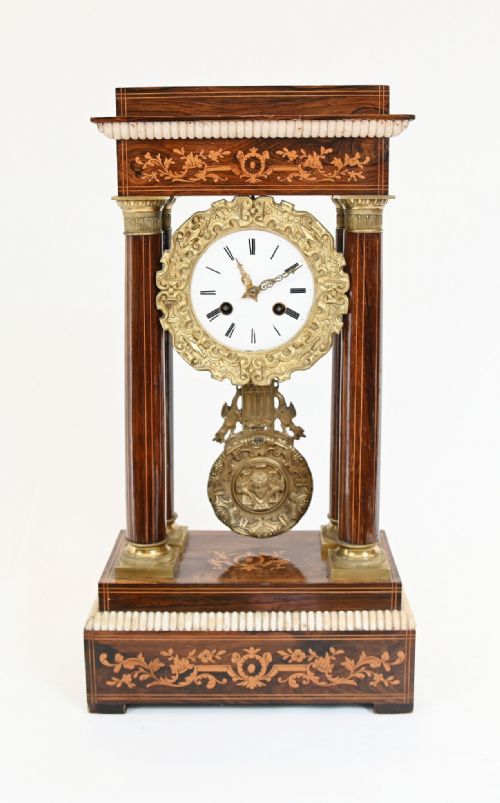
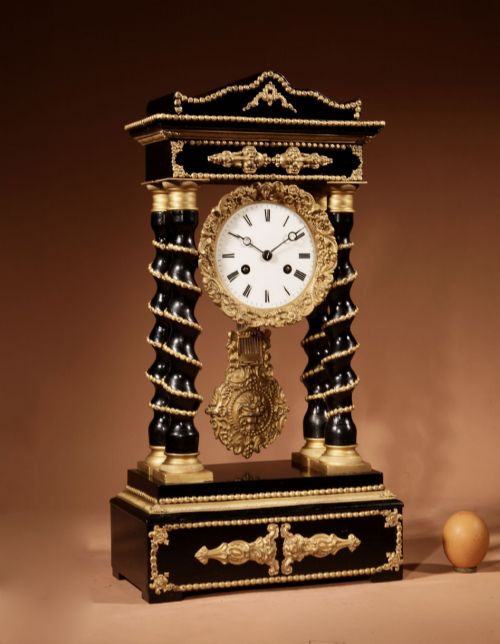


Architectural Portico Clock
An architectural portico clock commands a room with its monumental columns and precise dial, bringing classical symmetry into the domestic interior.
Architectural Portico Clock
An architectural portico clock stands as a distinct form of mantel clock, defined by its tall, temple-like frame supported by vertical pillars. When searching for an architectural portico clock, a buyer encounters pieces primarily originating from nineteenth-century France, spanning periods from the Charles X and French Empire eras through to the Victorian age.
Materials and construction
Cabinetmakers utilised rich timber veneers such as mahogany, rosewood, and ebonised wood to build the architectural framework. Marquetry and intricate inlay work frequently decorate the wooden bases and tops.
Metalwork played an equally vital role, with ormolu, gilt bronze, and brass mounts highlighting the capitals, plinths, and bezels. Glass elements, including cut crystal and glazed panels, protect the enamel or silvered dials and reveal the pendulum oscillating between the columns.
Listings feature mahogany, rosewood, alabaster, ormolu, and ebonised wood across nineteenth-century French mantel clocks.
Distinctions in execution
The refinement of the cast ormolu and gilt bronze mounts separates standard examples from the finest pieces, where hand-chasing brings sharp definition to leaf motifs and architectural details. The crispness of wood veneers and precision of marquetry also dictate the tier of craftsmanship.
Movement sophistication influences standing within the category, ranging from standard timepieces to single fusee mechanisms and table regulators equipped with knife edge suspension. The integration of delicate enamel dials with undamaged chapter rings completes a superior build.
The Architectural Portico Clock Glossary
- Portico clock
- A mantel clock styled like a classical building with vertical columns supporting a prominent top cornice. This architectural design creates an open central space where the pendulum swings.
- Ormolu
- Finely ground high-carat gold applied to a bronze base using a mercury amalgamation process. This technique produces a durable, rich golden finish characteristic of French luxury pieces.
- Single fusee
- A conical pulley mechanism connected to a cord or chain that equalises the driving force of the mainspring as it unwinds. It ensures consistent power delivery to the gear train for improved timekeeping accuracy.
- Knife edge suspension
- A delicate clock suspension system where the pendulum hangs from a sharp horizontal edge rather than a steel spring. This frictionless pivot reduces resistance and allows for precise regulation.
- Marquetry
- Decorative patterns formed by fitting small pieces of veneered wood into a prepared backing. Craftsmen employ contrasting timbers to create complex geometric or floral pictures on the clock case.
Architectural Portico Clock: Frequently Asked Questions
Where should I place a portico clock?
These clocks suit prominent mantelpieces, deep sideboards, or dedicated console tables where their vertical columns remain visible from multiple angles. Ensure the supporting surface is entirely level to keep the pendulum swinging true.
Keep the clock away from direct sunlight and strong draughts to protect delicate wood veneers and maintain the stability of the mechanical movement inside.
How do I identify a Charles X portico clock?
Charles X pieces often display lighter wood tones such as blond mahogany or maple, combined with restrained ormolu mounts that reflect a transition away from heavier Empire designs. The architectural lines remain strictly Neoclassical and orderly.
Dials on these clocks frequently feature finely painted enamel numerals framed by simple bezels, housed within a symmetrical wooden temple structure.
How do I care for alabaster and marble parts?
Dust these mineral components regularly with a soft, dry microfibre cloth to prevent accumulation in the porous surfaces. Avoid using household cleaning sprays or excessive water, which can stain the stone.
Handle the clock carefully by its solid wooden base rather than the decorative columns or top cornice when moving it to a new location.