
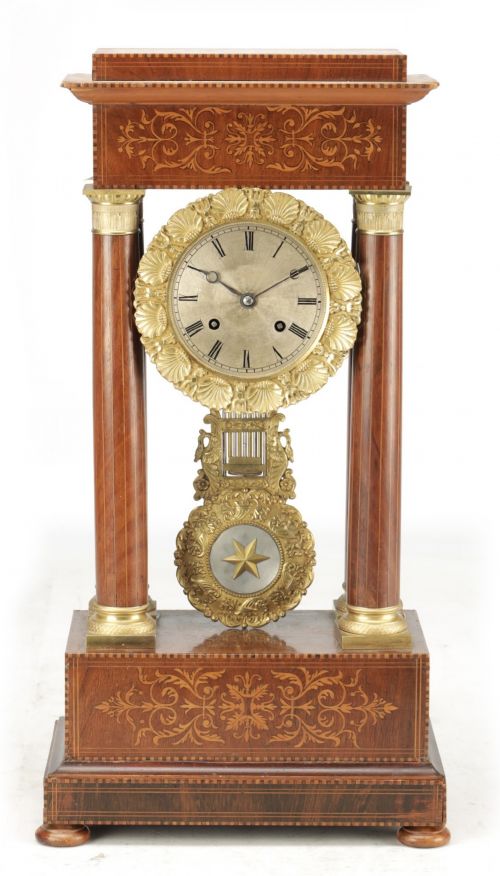
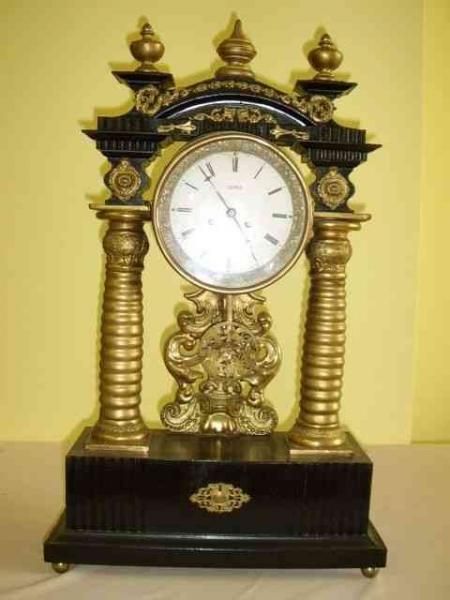
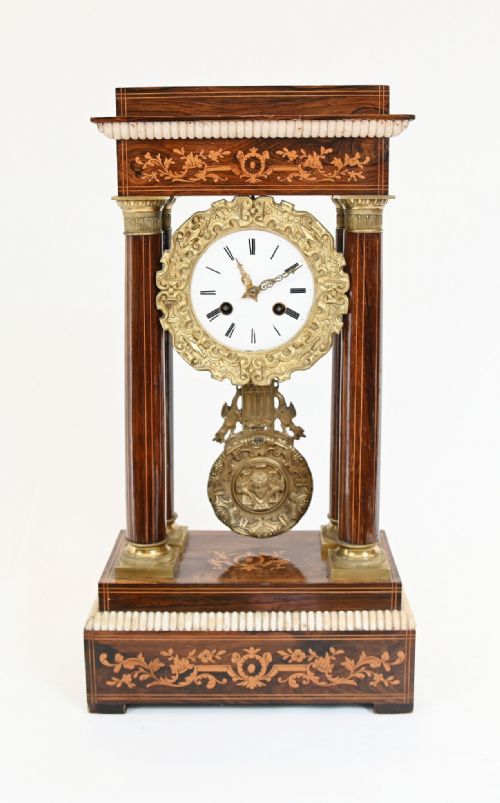
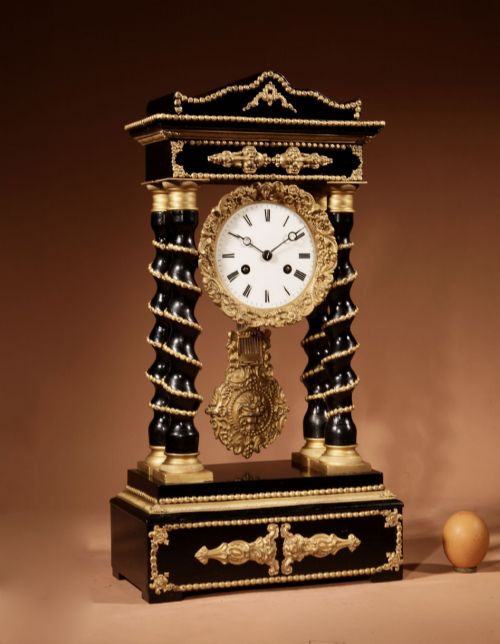


Empire Portico Mantel Clock
An empire portico mantel clock brings towering architectural form and precise French horology into a room, anchored by columns and striking pendulum movements.
Empire Portico Mantel Clock
An empire portico mantel clock is a striking timekeeper defined by its architectural frame, featuring parallel side columns supporting a distinct upper entablature and a suspended pendulum swinging centrally between them. These sophisticated pieces emerge predominantly from French workshops across the nineteenth century, capturing the enduring influence of Neoclassical design through balanced proportions and classical motifs.
The versions most commonly met on this page span the French Empire, Charles X, and Victorian periods, often housed beneath protective glass domes. They appear in architectural configurations ranging from austere ebonised wood to elaborate ormolu and marble, reflecting the evolving tastes of nineteenth-century interiors.
Makers integrated delicate enamel dials and visible movements into the structural core of the case, creating a harmonious dialogue between engineering and architecture. Whether formed as a standalone timepiece or part of a larger clock garniture with side ornaments, each piece commands attention through its vertical presence.
Materials and construction methods
The structural framework of an empire portico mantel clock relies on dense timbers such as mahogany, rosewood, and ebonised wood, frequently enhanced with contrasting inlay or satinwood details. Alternatively, makers utilised natural stones including white marble, siena marble, and alabaster to form the solid base, columns, and top plate.
Gilding and metalwork define the decorative vocabulary, with ormolu and gilt bronze applied to capitals, bezels, and pendulum bobs to catch the ambient light. Cut crystal and glass components frequently add transparency and brilliance, particularly in the formation of protective domes and light-catching columns.
Intricate mechanical movements sit centrally within the architectural composition, featuring enamel dials with finely painted numerals and specialised mechanisms such as single fusee or knife-edge suspension systems. Metal casting, hand-chiselling, and precise cabinet-making combine to ensure the heavy stone or wooden elements securely support the internal horology.
Current listings demonstrate materials ranging from delicate white marble and cut crystal to rich rosewood and gilded bronze.
Distinctions in quality and execution
The caliber of an empire portico mantel clock rests upon the crispness of its gilt bronze and ormolu mounts, where hand-chased detail and deep fire-gilding separate superior examples from flat, mass-produced replacements. The precision of the architectural joinery in rosewood, mahogany, or ebonised timber dictates the structural integrity of the tall column supports.
Horological refinement distinguishes the upper tier of timepieces, visible in the incorporation of signed dials, musical movements, or complex escapements like knife-edge suspension. The quality of the accompanying glass dome and the retention of original matching garniture pieces further elevate a clock's historical completeness.
Breguet·Baltazart
The Empire Portico Mantel Clock Glossary
- Portico clock
- A mantel clock structured with vertical side columns supporting an architectural entablature, framing a suspended pendulum. This design directly mirrors classical temple architecture.
- Ormolu
- Gilt bronze created by applying a mixture of gold and mercury to a bronze base and firing it in a furnace. This technique produces a durable, rich golden surface characteristic of fine French pieces.
- Fusee
- A conical pulley used within the clock movement to maintain equal power as the mainspring unwinds. It ensures consistent timekeeping accuracy.
- Clock garniture
- A matching set consisting of a central mantel clock accompanied by side ornaments or candelabra. These matched groupings were designed to create a symmetrical mantelpiece arrangement.
- Knife-edge suspension
- A delicate horological mechanism where the pendulum hangs from a sharp steel edge rather than a flat spring. This reduces friction and enhances the precision of the swing.
- Ebonised wood
- Timber treated to imitate ebony through staining or painting. It provides a dense, dark backdrop that accentuates bright ormolu mounts.
Empire Portico Mantel Clock: Frequently Asked Questions
How do I wind an empire portico mantel clock?
Winding requires a dedicated key inserted into the winding holes on the enamel dial, turning gently until resistance indicates the mainspring is fully tensioned. Care must be taken not to overwind the movement.
Many of these clocks feature an eight-day movement requiring weekly attention, while musical or striking variants may have separate trains that need independent winding.
Where should I place a portico clock?
These clocks require a stable, level surface such as a heavy mantelpiece or sideboard to ensure the pendulum swings truly between the columns. Vibrations from heavy footfall can disrupt the delicate balance of the escapement.
Keeping the clock away from direct sunlight and damp environments protects the delicate enamel dial, gilt bronze surfaces, and timber veneers from fading or warping.
How do I distinguish Charles X from Empire style?
Empire style clocks, produced during the early nineteenth century, favor severe military and classical motifs with heavy ormolu mounts and dark patinated bronze. They convey strict monumental symmetry.
Charles X pieces introduce lighter woods like rosewood and mahogany, softer architectural lines, and often incorporate cut crystal or floral marquetry while retaining classical proportions.
What is the glass dome for?
Glass domes protected the delicate ormolu, exposed pendulums, and soft enamel dials from airborne dust, soot from open fires, and accidental contact in nineteenth-century drawing rooms. They also helped stabilize the internal climate around the metal and wood components.
Finding a portico clock with its original glass dome significantly preserves the piece's historical integrity and visual balance.