
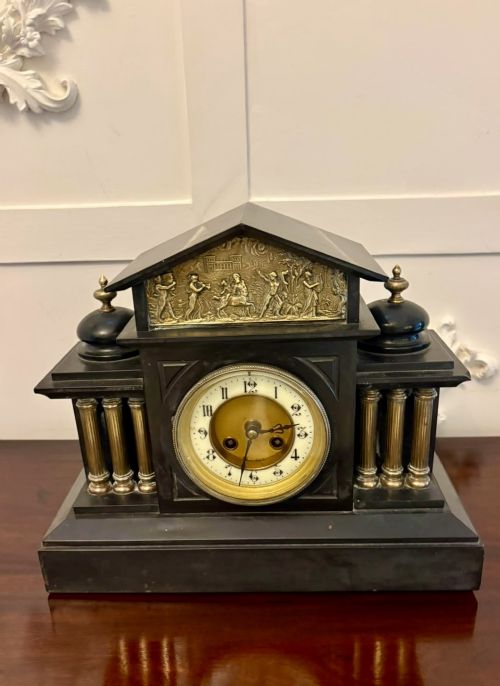


Classical Column Table Clock
A classical column table clock brings architectural dignity and precision timekeeping into a room, drawing the eye with stately columns and refined materials.
Classical Column Table Clock
A classical column table clock takes the architectural majesty of antiquity and scales it down to sit upon a mantelpiece, sideboard, or table. These timepieces draw heavily upon the vocabulary of ancient temples and grand houses, translating columns, porticos, and pediments into miniature scale.
How they were made
Craftsmen utilised heavy stone foundations, cutting and polishing black marble, white marble, slate, and alabaster to form the solid architectural base and columns. Metalwork played an equally vital role, with gilt bronze, ormolu, and brass applied for bezels, capitals, mounts, and decorative friezes.
The visual depth of these clocks often relied on contrasting textures, pairing polished dark stone with gleaming gilt highlights or transparent glass panels. Intricate dials, frequently enamelled or silvered, were set deep within the stone or metal framework to complete the construction.
Listings feature architectural mantel clocks spanning from 1860 through 1890, encompassing Neoclassical, Victorian, and French Empire styles.
What varies in quality
The distinction between tiers of quality rests upon the ambition of the architectural design and the crispness of the materials used. Superior examples display deeply chiselled ormolu mounts, perfectly matched stone or marble veining, and substantial weight that speaks of solid construction.
Finishing touches dictate the overall calibre, such as finely painted enamel dials, heavy cast bezels, and the integration of specialised movements like single fusee mechanisms. Simpler variations rely on plain timber carcasses disguised as stone or straightforward brass housings without sculptural enrichments.
Philippes Paris·Baby and Jannings·Benson
The Classical Column Table Clock Glossary
- Portico clock
- A clock featuring a freestanding architectural case supported by columns, typically framing a suspended pendulum that swings within the central opening.
- Ormolu
- Gilded bronze created by applying a mercury-gilding process to a bronze base, producing a rich and enduring golden surface.
- Fusee
- A conical pulley used within clock movements to equalize the declining power of a mainspring as it unwinds, ensuring steady timekeeping.
- Single fusee
- A movement driven by a single chain or cord wound around a fusee cone, common in higher-grade English and French architectural clocks.
- Enamel
- A glassy substance fused to a metal dial substrate through high heat, providing a smooth, durable, and white surface for painted numerals.
Classical Column Table Clock: Frequently Asked Questions
How do portico clocks work?
Portico clocks house their pendulum within the open central space beneath the dial, allowing the motion to remain entirely visible between the supporting columns. This delicate placement requires careful leveling on a stable mantelpiece to maintain proper rhythm.
The mechanical movement sits in the upper architectural entablature or directly behind the dial, transferring force downward or driving the hands through traditional gear trains. Many of these mechanisms rely on a spring-driven movement rather than hanging weights.
Where should I place a heavy marble clock?
Marble and slate architectural clocks carry considerable weight and require a sturdy, level surface capable of supporting dense stone. Placing them on a solid mantelpiece or heavy sideboard ensures the case remains stable and the internal pendulum swings truly.
Avoid locations subject to direct sunlight or damp conditions, which can affect the delicate gilding on brass and ormolu mounts. Ensuring a firm foundation also protects delicate marble corners from accidental impacts.
Are these clocks difficult to maintain?
Routine upkeep involves gentle dusting with a soft, dry cloth to keep marble and gilt surfaces free from buildup. Mechanical movements benefit from professional servicing every few years to clean old oils and ensure the gear train runs smoothly.
Moving the clock requires securing or removing the pendulum first to prevent damage to the suspension spring. Keeping the clock wound consistently helps maintain the tension of the mainspring.
What styles influence these mantel clocks?
Neoclassical and Victorian classical revival styles heavily influence these pieces, drawing directly from Greek and Roman architectural motifs. Columns, pediments, and symmetrical lines dominate the aesthetic of the cases.
French Empire, Charles X, and Napoleon III periods also contributed distinct variations, ranging from austere dark marble blocks to ornate porticos featuring rich ormolu highlights and crystal components.