
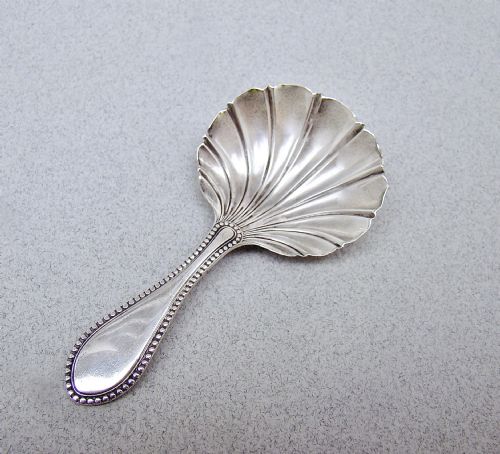

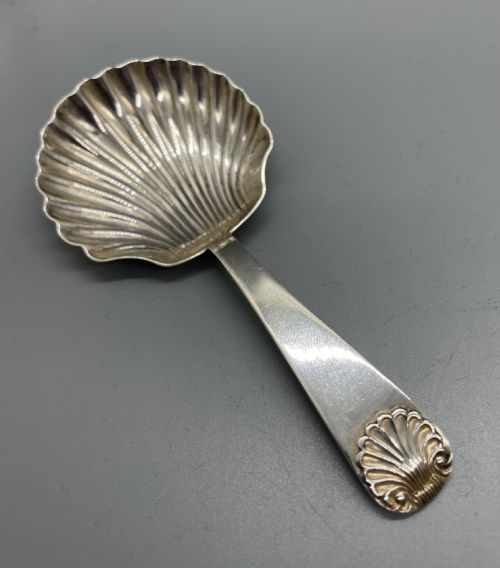
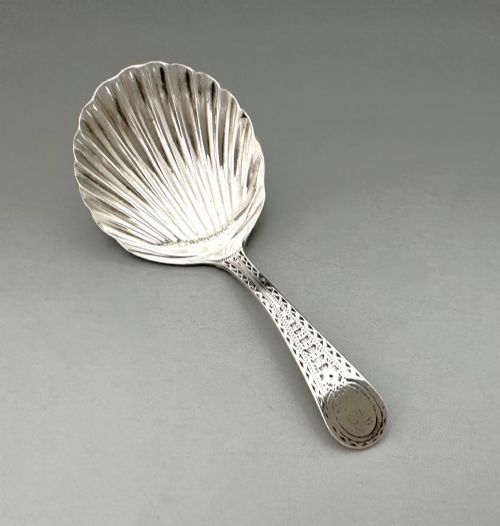
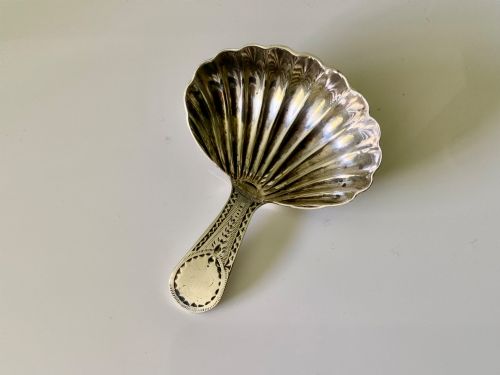


Silver Shell Caddy Spoon
A silver shell caddy spoon is a small, purposeful scoop for dry tea leaves, shaped like a maritime shell and prized for tactile elegance on the tea tray.
Silver Shell Caddy Spoon
A silver shell caddy spoon is a specialised tea accessory designed to measure dry leaves from caddy to pot. When you inspect this page, you meet pieces predominantly from the Georgian, Victorian, and Edwardian eras.
The bowl takes the literal form of a scallop or maritime shell, paired either with a slender engraved handle or integrated directly into a fiddle, thread and shell pattern. Most examples date from the late eighteenth century through to the early decades of the twentieth century.
Originating to serve loose tea when the leaf was a valuable commodity, these small spoons combine functional utility with delicate decorative metalwork. They appear in solid sterling silver, parcel-gilt finishes, and occasionally silver plate.
Materials and construction
Silversmiths constructed these spoons primarily from sterling silver, shaping the shell bowl by stamping or hammering metal into dies. Details such as fluting on the shell and engraving along the handle were added by hand with gravers.
Certain examples receive a secondary layer of gold through parcel-gilt techniques, creating a contrasting two-tone effect within the silver bowl. Hallmarks struck directly into the metal record the assay office, year, and maker.
Listings span Georgian, Victorian, Edwardian, and Regency styles, executed in sterling silver, silver gilt, and silver plate.
Assessing quality in silver shell caddy spoons
Quality rests upon the crispness of the shell fluting and the depth of the engraving on the handle. Stronger examples exhibit sharp, well-defined ribs in the bowl rather than worn or softened contours.
The weight of the silver and the clarity of the maker marks and hallmarks also distinguish finer work. Pieces carrying distinct regional or maker attributions command greater interest from collectors.
Martin Hall And Co·Mappin And Webb·Elizabeth Morley·P And A Bateman·George Smith III And William Fearn·William Devenport
The Silver Shell Caddy Spoon Glossary
- Caddy spoon
- A small spoon designed for measuring loose tea from a caddy. They gained immense popularity during the Georgian period.
- Parcel-gilt
- A technique where selective areas of an object are gilded with gold leaf while the rest remains silver. This creates a striking visual contrast.
- Fiddle, thread and shell
- A traditional cutlery pattern featuring a raised thread border and a shell motif at the terminal. It appears on handles of nineteenth-century spoons.
- Hallmark
- An official stamp applied by an assay office to guarantee the purity of precious metals. These marks identify the date and maker.
Silver Shell Caddy Spoon: Frequently Asked Questions
What is a silver shell caddy spoon?
A silver shell caddy spoon is a small scoop shaped like a scallop shell, created to measure loose tea leaves from a storage caddy into a teapot.
These pieces were essential accessories in wealthy households during the Georgian and Victorian tea ceremonies, combining daily utility with miniature artistry.
How do I date a silver caddy spoon?
You date a silver caddy spoon by reading the hallmarks stamped onto the metal, which include date letters corresponding to specific assay office years.
Stylistic clues such as handle engraving patterns and the depth of the shell bowl also help assign pieces to the Georgian, Victorian, or Edwardian eras.
Were these spoons used for sugar?
While primarily made for dry tea leaves, some related forms served sugar or were adapted for other caddy uses.
The distinct shell bowl, however, remains closely associated with measuring leaf tea during the eighteenth and nineteenth centuries.
How should I display a caddy spoon?
You can display these spoons inside glass cabinets, mounted in dedicated frames, or laid flat upon tea trays alongside period silver.
Because they are compact, grouping several examples together highlights the variations in shell design and handle engraving.