

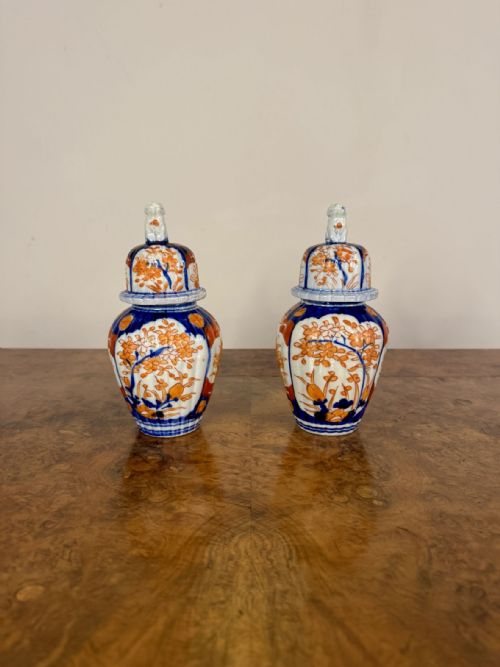


Shishi Finial Porcelain Urn
These shishi finial porcelain urn pieces bring striking Japanese Imari style and lidded form into your interior.
Shishi Finial Porcelain Urn
When you search for a shishi finial porcelain urn, you are looking at lidded vases, koros, and jars featuring traditional guardian dog finials atop the cover. The pieces available here span from the eighteenth century through the nineteenth century and into the Edwardian era, showing strong Japanese Imari style, Meiji period artistry, and Edo mannerisms.
You will most frequently encounter large lidded vases and pairs designed with octagonal baluster shapes or traditional jar forms. These objects draw on Japanese Meiji period aesthetics, and occasionally include European interpretations such as French production made in the Imari style.
Materials and construction
The foundation of these works is white porcelain shaped into vases and jars, often formed with faceted or baluster profiles. Makers applied cobalt blue underglaze to create deep blue motifs before firing.
Surface decoration relies heavily on iron red enamel, cobalt enamel, and applied gold leaf, gilding, or general gilt highlights. The covers are finished with sculpted shishi finials that complete the vessel.
Shishi Finial Porcelain Urn Retail Price Guide 2026
Typical asking prices for shishi finial porcelain urn among the pieces listed under this phrase on Sellingantiques today, from the lower quarter to the upper quarter. They describe what is for sale here now, not the wider market.
Every fierce guardian dog atop these lids keeps watch over your mantelpiece with unwavering, gilded loyalty.
Assessing quality and execution
The distinction between standard and superior examples lies in the crispness of the porcelain moulding and the precision of the hand-painted enamel work. Finer pieces demonstrate meticulous control over cobalt blue underglaze and rich, well-preserved gold leaf detailing.
Proportion and presence also dictate standing, particularly in large baluster vases, pairs, and heavily detailed incense burners. The modelling of the shishi finial itself shows the hand of the maker most clearly, with superior carving yielding greater expression and depth.
Samson
The Shishi Finial Porcelain Urn Glossary
- Shishi
- A mythical guardian lion or dog often depicted as a sculptural finial on the covers of large vases and incense burners. It serves as a traditional protective motif in East Asian art.
- Imari
- A type of Japanese porcelain decorated in underglaze blue, iron red, and gold, named after the port from which it was exported. The style became immensely popular in Europe during the Edo and Meiji periods.
- Koro
- A traditional Japanese incense burner, frequently fitted with a pierced cover and sculptural finial. These vessels often double as decorative lidded jars in Western collections.
- Baluster
- A vertical architectural form with a swelling lower portion, frequently used to describe the graceful body profile of these large vases.
- Underglaze
- A method of decorating pottery in which pigments are applied to the raw clay body before the clear glaze is fired. This protects the blue pigment permanently beneath the glossy surface.
Shishi Finial Porcelain Urn: Frequently Asked Questions
What is a shishi finial?
A shishi finial is the sculptural guardian lion placed on top of a vase or urn cover. It acts as a decorative handle while referencing traditional protection motifs.
These sculpted figures are typically glazed or gilded to match the palette of the main vessel body.
How were these urns used?
Many of these pieces functioned as decorative lidded vases displayed in prominent rooms, while others served as incense burners known as koros. Their striking palettes made them centrepieces in European and Japanese interiors alike.
The lids kept contents secure or simply completed the sculptural silhouette of the baluster form.
How do I style an Imari urn?
These large porcelain vessels suit placement on sturdy side tables, pedestals, or mantelpieces where their iron red and gold details catch the light. Pairs look particularly striking when balanced symmetrically on large surfaces.
Ensure they sit safely away from high-traffic areas due to their substantial size and delicate porcelain construction.
How do I date a porcelain urn?
Dating relies on stylistic clues, potting characteristics, and the specific palette of enamels and gilding used across the Edo and Meiji periods. Eighteenth-century pieces differ subtly in body weight and cobalt tone compared to nineteenth-century or Edwardian interpretations.
European copies, such as those made in the nineteenth century in the Imari style, often reveal themselves through paste composition and baseline markings.