
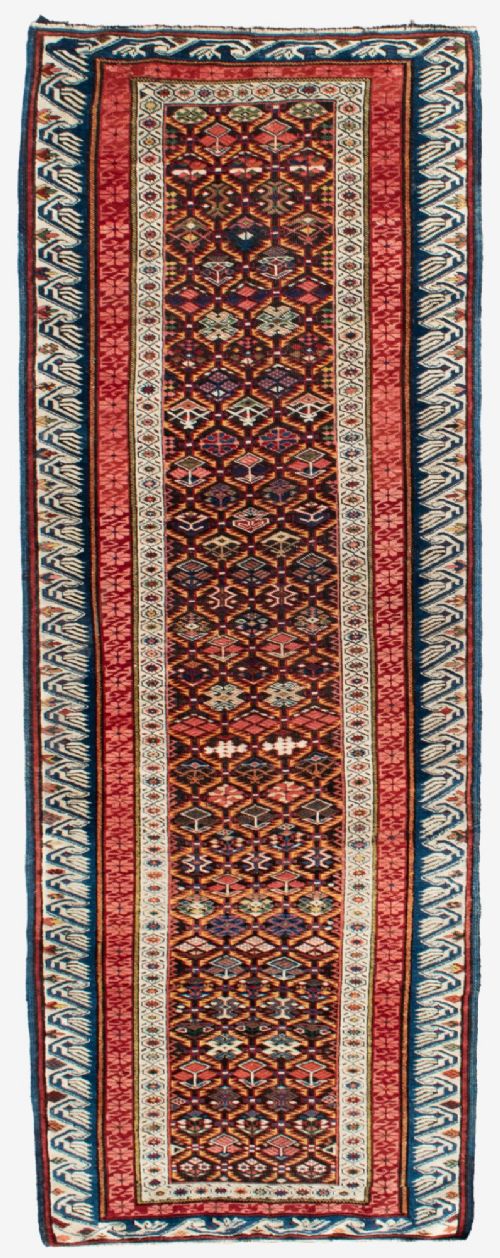
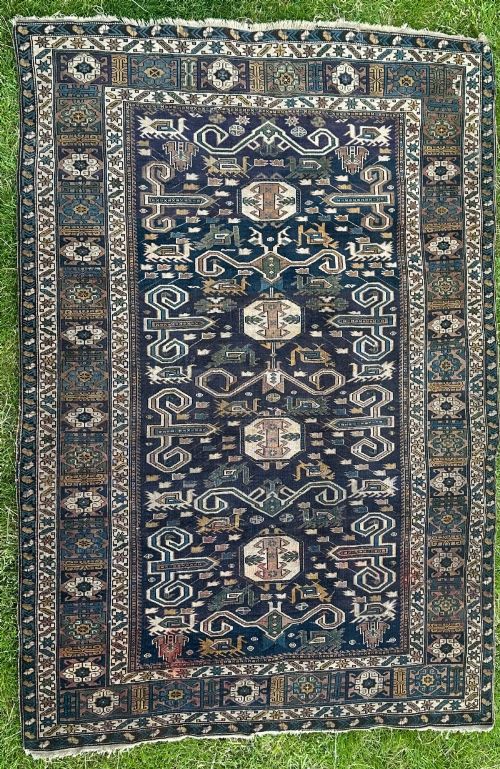
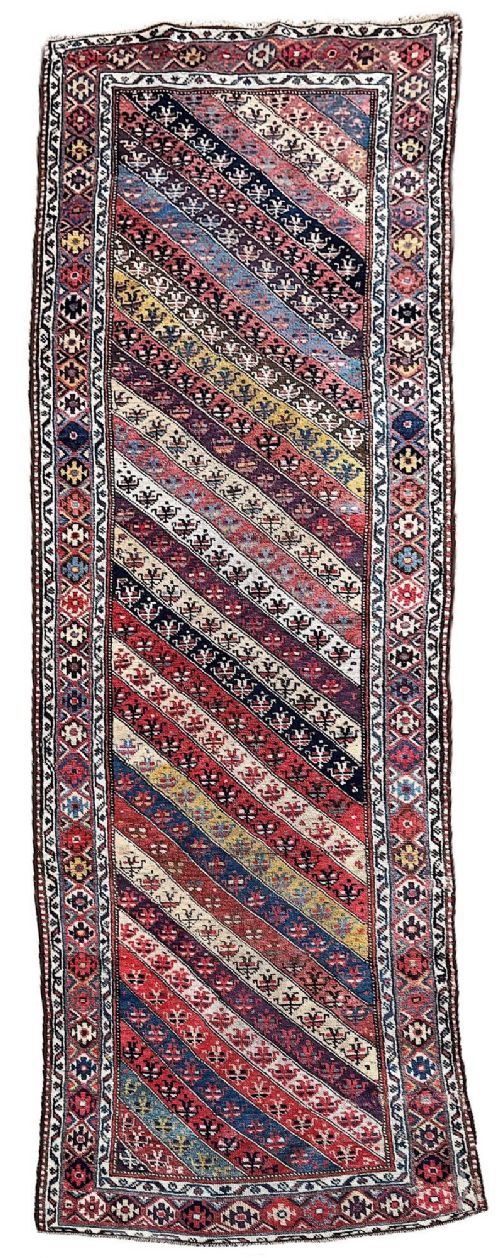
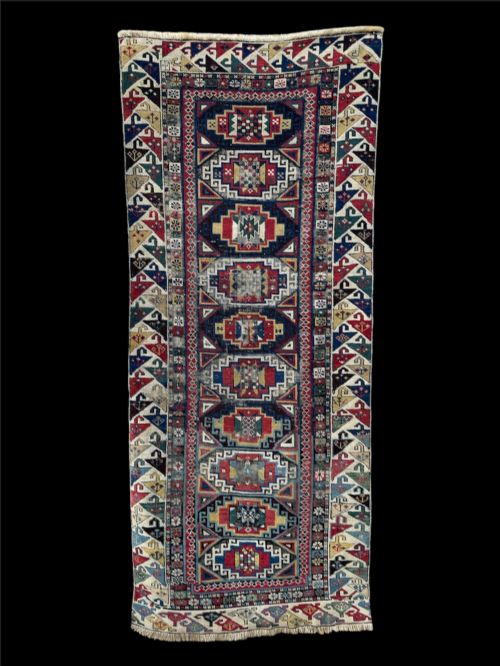


Shirvan Runner Rug
A shirvan runner rug brings the geometric discipline of the Eastern Caucasus into a narrow hallway.

Shirvan Runner Rug
A shirvan runner rug is a long, narrow floor covering originating from the Shirvan region in the Eastern Caucasus, shaped by tribal and traditional weaving practices. These pieces generally date from the late nineteenth century into the early twentieth century, spanning decades such as eighteen eighty, eighteen ninety, and nineteen hundred.
The format provides a linear span suited to corridors and narrow spaces, often categorized alongside broader runner rugs, area rugs, and flatwoven kilim structures. Workshops and weavers across the region produced both piled floor coverings and flatweaves, including related formats like saddle bags.
The design vocabulary draws on Caucasian motifs, featuring geometric medallions, star patterns, and stylised animal or floral elements arranged along the vertical axis. Pieces emerge from specific regional centres and traditions, connecting them to broader Caucasian weaving groups.
Materials and construction methods
Makers constructed these floor coverings primarily using wool and hand-spun wool for the pile and foundational elements, occasionally incorporating cotton for structure. Hand-spun fibres introduce subtle variations in texture and thickness along the length of the weave.
Colour comes from natural dyes applied to the wool, yielding soft tones as well as saturated blues, yellows, and reds that mature with age. The interaction of natural dye batches creates gentle shifts in shade across the field of the textile.
Some weavers included wandering peacocks and flaming boteh motifs, ensuring your hallway floor tells an energetic avian story.
Factors of quality and execution
Quality rests in the crispness of the geometric drawing and the precision with which motifs are resolved along a narrow format. Finer knotting density allows complex star and lattice patterns to hold their shape clearly against the background ground.
The handled handle of the wool and the stability of the foundation determine durability, while the complexity of the border arrangements separates standard regional production from distinctive workshop pieces.
The Shirvan Runner Rug Glossary
- Shirvan
- A rug-producing region in the Eastern Caucasus known for crisp geometric designs and balanced compositions. Pieces from this area typically display finely knotted wool structures.
- Runner
- A long, narrow carpet format designed for corridors, hallways, and stairs. The proportions require a balanced vertical design arrangement.
- Kilim
- A flatwoven textile produced without a pile, relying on interlocking warp and weft threads to form the pattern. These items offer a flat, durable surface.
- Natural dye
- Colorants derived from plants, insects, and minerals rather than synthetic compounds. These dyes age by softening in tone over decades.
- Boteh
- A stylized almond or paisley motif with a curved upper end, frequently seen in Caucasian weaving. It represents a seed or floral sprout in traditional symbolism.
Shirvan Runner Rug: Frequently Asked Questions
Where should I place a runner rug?
These narrow floor coverings suit corridors, hallways, and bedside spaces where standard rectangular carpets do not fit. Their elongated proportions draw the eye down a passage.
Protect the wool by placing a quality underlay beneath the textile to prevent sliding and reduce friction against hard flooring.
How do I clean an antique rug?
Gentle surface brushing and careful vacuuming without a rotating beater bar remove embedded dust from the wool pile. Avoid submerging antique textiles in water.
Consult a specialist in historical textile conservation for professional washing to protect the natural dyes and hand-spun foundations.
How do I date a Caucasian rug?
Examine the palette, materials, and structural characteristics to estimate the period of manufacture. Natural dyes and hand-spun wools generally point to nineteenth or early twentieth-century production.
Compare specific border arrangements and medallion structures with documented regional examples from eighteen eighty through nineteen ten to narrow the timeframe.
Are these rugs durable for daily use?
The tight wool construction of nineteenth-century Caucasian weaving provides natural resilience against standard foot traffic. Regular rotation distributes wear evenly along the length of the runner.
Keep pieces away from direct, strong sunlight to preserve the depth of natural dye colours over time.