

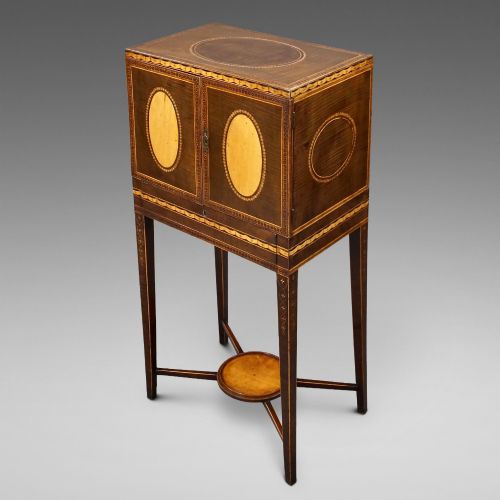
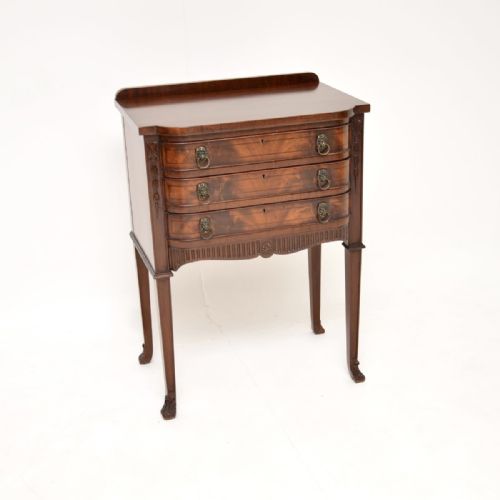
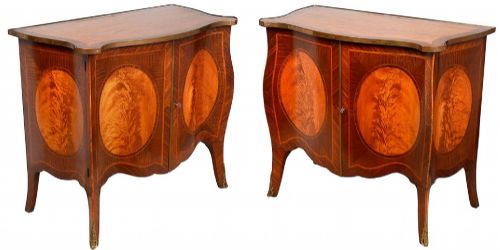
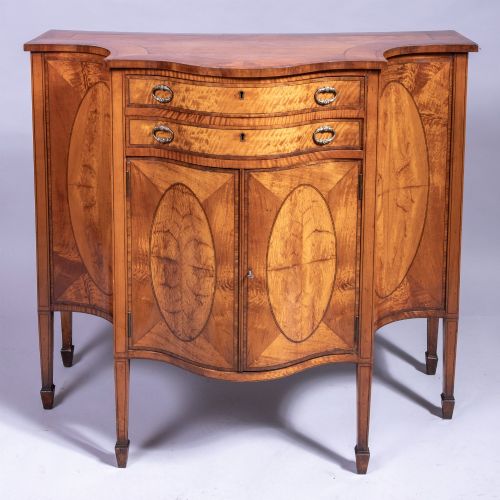

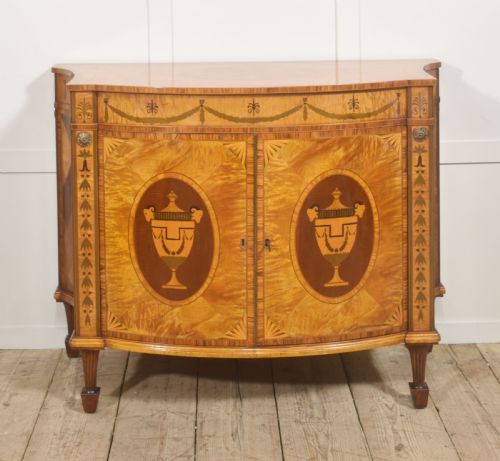


Sheraton Style Side Cupboard
These Sheraton style side cupboards bring balanced neoclassical proportions and fine marquetry into contemporary rooms.
Sheraton Style Side Cupboard
A sheraton style side cupboard offers storage with a refined silhouette, appearing across periods from the eighteenth century to the early twentieth century. Buyers encounter forms ranging from demi-lune commodes and serpentine fronted cabinets to bedside units and server tables.
The selection includes pieces spanning Georgian origins through to Edwardian revivals. Many examples adopt revival aesthetics, drawing on neoclassical design principles established in the late eighteenth century.
Makers utilised various silhouettes, including bowed fronts and flat sides, often fitted with doors enclosing shelved interiors. These cabinets function effectively in dining rooms, hallways and bedrooms as both display surfaces and practical storage.
Materials and construction
Cabinet makers relied primarily on mahogany and satinwood as primary timbers, complemented by contrasting veneers of harewood, boxwood and rosewood. These woods provided a smooth canvas for intricate decorative schemes.
Surface decoration frequently involved inlaid marquetry wood and hand-painted detailing depicting classical panels. Brass hardware added functional accents to doors and drawers, completing the refined assembly.
Current listings feature satinwood, mahogany, rosewood, harewood, boxwood and brass, spanning periods from Georgian times to the 1930s.
Evaluating craftsmanship
Distinctions in quality often rest on the precision of the marquetry and the crispness of the hand-painted detailing. Superior examples display tightly fitted veneers and seamless joins across curved serpentine or demi-lune fronts.
The choice of timber underpins the overall impact, with figured satinwood and rich mahogany demonstrating greater visual depth than simpler utility pieces. Structural integrity in the doors and internal shelving further separates standard production from finer creations.
The Sheraton Style Side Cupboard Glossary
- Demi-lune
- A half-moon shape used for the footprint of tables and commodes. This curved profile allows the cabinet to sit flush against a wall while saving floor space.
- Marquetry
- The art of applying decorative pieces of veneer to a structure to form intricate designs. Craftsmen used various coloured woods to create pictorial or geometric scenes.
- Serpentine
- A furniture front characterised by a wavy line, curving outward in the centre and inward at the sides. This shape demands high skill from the woodworker.
- Satinwood
- A light-coloured, lustrous timber native to tropical regions. It became a defining material for late eighteenth-century and revival neoclassical furniture.
- Neoclassical
- A style reviving classical Roman and Greek motifs such as urns, swags and symmetry. It heavily influenced eighteenth-century design and later revival periods.
Sheraton Style Side Cupboard: Frequently Asked Questions
How do I date a Sheraton style side cupboard?
Dating relies on examining the timber species, construction methods and secondary woods used inside the carcass. Eighteenth-century originals differ in joinery techniques from later nineteenth-century and Edwardian revival pieces.
Stylistic cues such as hand-painted panels or specific revival idioms also point to distinct decades, ranging from nineteenth-century interpretations to nineteen-thirties productions.
Where should I place a demi-lune cabinet?
A demi-lune cabinet works well in narrow hallways, entrance spaces or against flat walls in living areas. Its curved front softens room angles while offering useful surface space for lamps or decorative objects.
Because the back is straight, the unit hugs the wall securely without protruding too far into the floor space.
What is the difference between mahogany and satinwood versions?
Mahogany versions tend to offer a deeper, darker grain structure associated with traditional Georgian and later nineteenth-century furniture. They provide a sturdy, classic presence in a room.
Satinwood cabinets feature a pale, glowing yellow-gold tone that often serves as a background for elaborate marquetry and painted classical motifs, suiting lighter interior schemes.
How do I care for inlaid wood surfaces?
Inlaid surfaces require protection from direct sunlight to prevent fading of the delicate contrasting woods and painted details. Regular dusting with a soft, dry cloth keeps the polished finish intact.
Avoid placing damp items directly onto the timber, and maintain stable room humidity to prevent the fine veneers from lifting or cracking.