
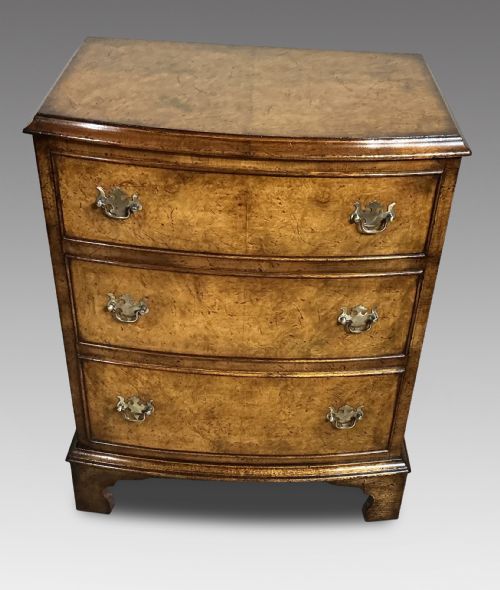
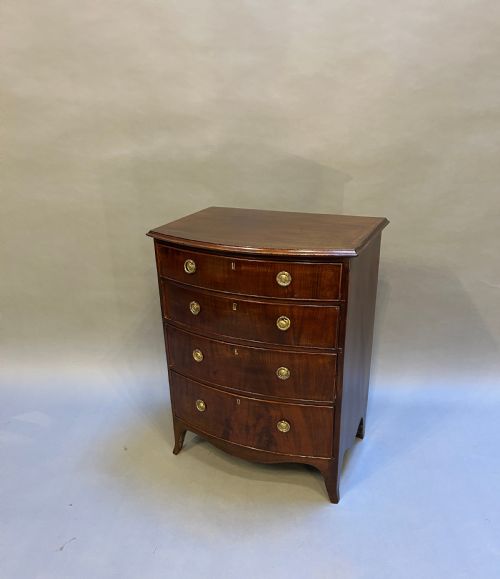


Georgian Bowfront Nightstand
A georgian bowfront nightstand brings quiet proportion and concealed bedside storage to a room, valued for its curved mahogany front.
Georgian Bowfront Nightstand
When you search for a georgian bowfront nightstand, you find compact bedroom storage defined by a gently curving front facade that softens the corner of a room. These pieces appear as bedside cabinets, small chests of drawers, cupboards and bedside tables originating from periods spanning the Georgian era through to the Edwardian and Victorian decades. The versions most commonly met on this page are mahogany bedside cupboards and small chests built with a curved profile, often housing a single door or stacked drawers.
The materials and styles recorded in the inventory range from authentic George III workmanship to later Regency and Victorian interpretations, alongside pieces dated to nineteen hundred. Makers such as Gillows represent the highest tier of cabinet-making in this form, while other examples reflect vernacular workshop production in mahogany, walnut, oak and satinwood. Buyers seek these items for their functional surface space and enclosed storage, combining domestic utility with the distinct aesthetic of a curved wooden front.
How they were made
Makers constructed the curved facade of a georgian bowfront nightstand by shaping solid timber or applying carefully matched veneers like flame mahogany and burr walnut over a sturdy secondary wood such as oak. The sweeping front required precise joinery to ensure the drawers or cupboard doors followed the contour smoothly without warping over time.
Brass hardware, including ring pulls, drop handles and occasional escutcheons, was fitted to secure the drawers and doors. Timber choice defined the visual character, utilising the deep reddish-brown grain of mahogany or the lighter patterned figures of satinwood and inlaid details.
Some nineteenth-century makers concealed commode functions inside compact bedside cabinets to maintain polite bedroom etiquette.
What varies in quality
Quality in these bedside pieces rests upon the crispness of the curved front joinery and the selection of timber figures used across the top and drawer faces. Superior examples exhibit seamless alignment where the doors or drawers meet the frame, alongside finer secondary woods and well-executed decorative inlays.
Attribution to known workshops or the presence of untouched period brassware elevates an example above standard vernacular production. Lesser pieces show heavier secondary timbers, simpler construction methods, or replacement hardware that alters the original proportion of the facade.
Gillows
The Georgian Bowfront Nightstand Glossary
- Bowfront
- A convex curving front facade common on case furniture of the period. This shape softens the rectangular silhouette of a bedside cabinet.
- Flame mahogany
- A veneer cut from timber where the grain resembles flickering flames. It provides a highly decorative surface figure on top boards and drawer fronts.
- Commode chest
- A low cabinet or chest of drawers designed for bedroom use. Many include enclosed cupboard space or multiple small drawers behind the curved front.
- Secondary wood
- The internal timber used for drawer linings, backboards and framing where it remains hidden from view. Oak and pine frequently serve this structural purpose.
Georgian Bowfront Nightstand: Frequently Asked Questions
What is a georgian bowfront nightstand used for?
These pieces function primarily as bedside tables or small storage cabinets, providing a flat top surface for a lamp and enclosed space behind doors or drawers for night-time essentials.
Their compact proportions allowed them to fit neatly beside period bed frames while keeping personal items out of sight.
How do I tell an original Georgian piece apart?
Authentic period pieces show traditional hand-cut joinery, use period-appropriate secondary timbers like oak inside the drawers, and display natural signs of age and wear on the mahogany surfaces.
Later Victorian and Edwardian revivals often utilise different interior construction methods and machine-cut elements while mimicking the earlier aesthetic.
Are these cabinets sturdy enough for daily use?
Solid mahogany and quality secondary woods provide a durable structure built to withstand regular handling over centuries of domestic life.
Careful placement away from direct heat sources helps maintain the stability of the curved veneer and timber joints.
What wood finishes appear on these nightstands?
Mahogany is the dominant timber, often enhanced by flame figures, while variations include walnut, burr walnut veneer, oak and satinwood highlights.
Each wood type offers a distinct grain pattern and colour depth that developed through traditional polishing methods.