


Hepplewhite Style Cupboard
These hepplewhite style cupboard items bring the refined neoclassical lines of the late eighteenth century into domestic spaces.
Hepplewhite Style Cupboard
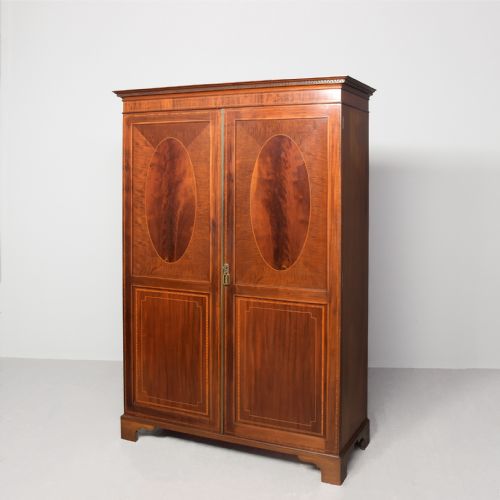
When you search for a hepplewhite style cupboard, you encounter a selection of case furniture spanning the Georgian era and later revivals. These items include sideboards, wardrobes, bedside cabinets, and display bookcases that reflect the lighter, more elegant proportions popularised during the period.
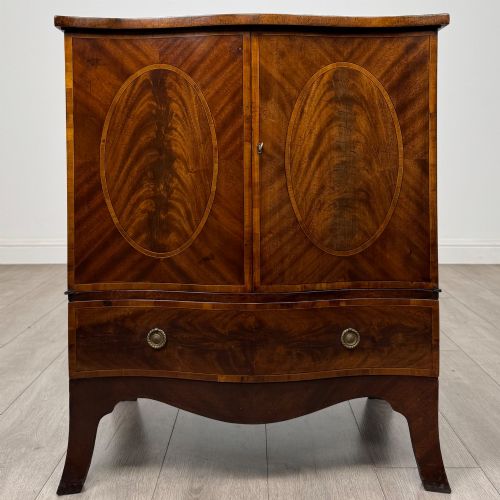
The pieces appearing on this page range from authentic Georgian originals dated around eighteen hundred down to Edwardian and twentieth-century revivals. Sideboards and side cabinets predominate, often featuring the distinctive curved fronts and tapered supports associated with the style.
Makers and manufacturers across different decades drew heavily on these neoclassical templates, producing items in mahogany with contrasting stringing. A buyer meets both eighteenth-century constructions and later interpretations that maintain the signature restraint of the design.
Materials and construction
Cabinet makers relied primarily on mahogany, frequently selecting flame mahogany veneer to achieve striking visual grain patterns across doors and drawer fronts. This timber provided a stable yet handsome carcass capable of taking fine edge details and crisp joints.
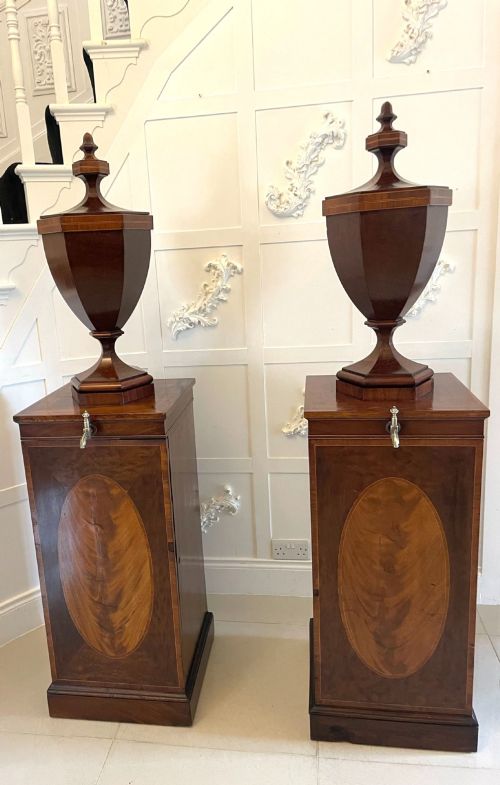
Decoration relied on delicate contrasting timber elements rather than heavy carving, utilising boxwood inlay and satinwood to create geometric stringing and classical motifs. Brass hardware, including handles and escutcheons, completed the composition on doors and pedestals.
Wine urns perched on pedestals spent centuries hiding gentlemanly drinking habits behind neoclassical decor.
Judging quality in neoclassical furniture
Quality rests upon the precision of the timber selection and the restraint shown in the inlay work. Finer pieces display book-matched flame mahogany veneers that mirror symmetrical patterns across the centre of the doors or drawers.
Structural integrity reveals itself in the joinery of the carcase and the crispness of the boxwood and satinwood stringing. Superior examples maintain sharp, clean lines on serpentine and bowfront profiles without distortion in the timber.
The Hepplewhite Style Cupboard Glossary
- Serpentine
- A curved furniture front characterised by a convex centre flanked by concave ends. This contour requires immense skill from the cabinet maker to execute cleanly in solid timber or veneer.
- Bowfront
- A convex curved front projecting outward in a continuous arc. It gained widespread favour during the Georgian period for sideboards and smaller cabinets.
- Inlay
- A technique where pieces of contrasting wood, such as boxwood or satinwood, are inserted into recesses within the primary surface to form decorative patterns. It defines the surface ornamentation of neoclassical case pieces.
- Flame mahogany veneer
- A thinly sliced section of mahogany timber taken from the fork of the tree where the branches join the trunk. This produces a fiery, undulating grain pattern prized for principal display surfaces.
- Pedestal
- A supporting column or cabinet base beneath an urn or superstructure. In dining room furniture, pedestal cupboards often housed cooling vessels or storage for glassware.
Hepplewhite Style Cupboard: Frequently Asked Questions
How do I spot a true Georgian piece?
Examine the secondary timbers used for drawer linings and carcase backs, such as oak or pine, which differ significantly from later factory-made alternatives. Construction methods like hand-cut dovetails and traditional fixings offer reliable indicators of eighteenth-century origin.
Compare the proportions and weight of the timber against known examples from the period. Revivals from the Edwardian era often employ machine-sawn elements and distinct internal labelling or modern hardware styles.
Where should I place a side cabinet?
These cabinets suit dining rooms, hallways, and drawing rooms where their slender profiles and decorative inlay can be appreciated. Their shallow depth allows them to sit comfortably against walls without dominating smaller floor spaces.
Keep them away from direct heat sources and strong sunlight to protect the mahogany veneer and delicate boxwood stringing from drying out and splitting over time.
What is the difference between serpentine and bowfront?
A bowfront follows a single outward curve from side to side, creating a smooth, rounded facade. It offers a simpler geometric profile that became standard on many regional Georgian pieces.
Serpentine fronts incorporate multiple directional curves, bending outward in the middle and inward towards the corners. This complex shape demands superior woodworking skill and generally indicates a higher tier of manufacture.
How do I care for mahogany veneer?
Dust the surfaces regularly with a soft, dry cloth to prevent abrasive particles from accumulating on the polished finish. Apply a quality beeswax periodically to nourish the wood and maintain a gentle, protective sheen.
Avoid liquid polishes containing silicone, which can penetrate porous historic finishes and damage the underlying grain. Maintain stable room humidity to prevent the veneer from lifting or cracking.