

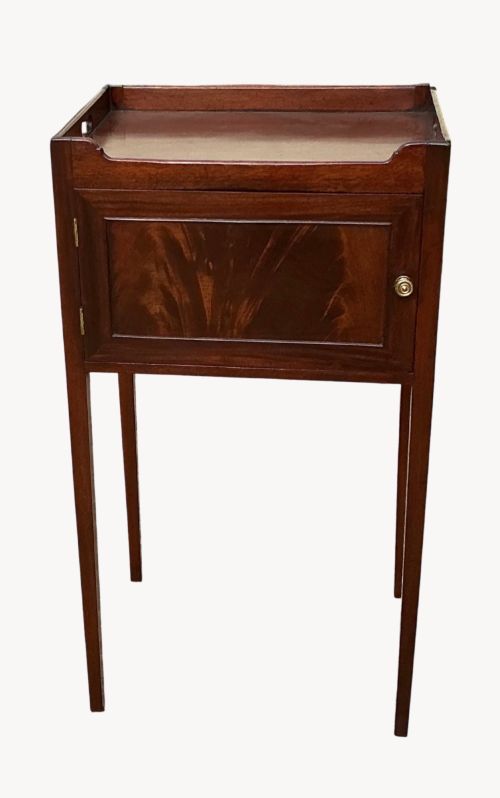


Sheraton Style Pot Cupboard
These sheraton style pot cupboard pieces combine classic mahogany and satinwood timbers with delicate inlay, offering practical bedside storage with refined period elegance.
Sheraton Style Pot Cupboard
A sheraton style pot cupboard serves as a compact bedside cabinet or table, designed to house a chamber pot or provide discreet storage beside a bed. Most examples found here date from the Edwardian era and the Sheraton Revival period, alongside occasional 18th century and Victorian pieces.
The form typically takes the shape of a bedside cabinet or bedside table, constructed in rich timbers and frequently featuring bow fronts. These items bring refined neoclassical proportions and useful surface space to a bedroom setting without dominating the room.
Makers and cabinetmakers drew heavily on the lightness and symmetry associated with the late eighteenth century, reinterpreting those design principles during the Edwardian period and the early twentieth century. Buyers encounter single cabinets as well as matched pairs.
How they were made
Cabinetmakers built these pieces using solid mahogany and satinwood carcases, often applying contrasting veneers and timbers for decorative effect. Oak frequently appears in secondary framing and drawer linings.
Surface decoration relies on marquetry inlay, ebony and boxwood stringing, alongside hand-painted detailing. Brass handles and fittings complete the construction, securing doors and drawers with traditional joinery.
Listings span four distinct centuries, led by Edwardian and 1900s Sheraton Revival interpretations alongside 18th Century and Victorian examples.
What varies in quality
Quality rests upon the crispness of the inlay and the selection of figured timber veneers. Fine examples display precise boxwood and ebony stringing that follows the curves of a bow front without distortion.
The integrity of the structural joinery and the retention of original brass hardware elevate certain pieces above standard production. Hand-painted detailing executed with genuine precision separates superior cabinetwork from simpler commercial items.
Gillows
The Sheraton Style Pot Cupboard Glossary
- Sheraton Revival
- A late nineteenth and early twentieth century design movement that emulated the lighter neoclassical furniture forms of the Georgian period. This style favoured satinwood, tapered legs, and delicate marquetry.
- Bow Front
- A convex curved cabinet front that projects outward in a smooth arc. This shape requires advanced woodworking skill to veneer and fit accurately.
- Marquetry Inlay
- The art of applying small pieces of veneer to a structure to form decorative patterns and pictures. Craftsmen used various contrasting woods to achieve pictorial depth.
- Satinwood
- A durable, lustrous hardwood with a natural golden sheen that takes a high polish. It formed the primary surface for many high-status inlaid cabinets.
- Stringing
- Thin strips of contrasting wood inlaid into grooves on a furniture surface to create delicate borders. Boxwood and ebony were common choices for this linear detail.
Sheraton Style Pot Cupboard: Frequently Asked Questions
What is a pot cupboard?
A pot cupboard is a small enclosed bedside cabinet originally designed to conceal a chamber pot behind a door. Over time, the form evolved into a general bedside table for domestic storage.
Today, these compact pieces function well as bedside tables or small lamp stands in modern bedrooms.
How do I date a Sheraton Revival piece?
Sheraton Revival furniture dates primarily from the late Victorian and Edwardian periods, typically between 1880 and 1920. Cabinet construction methods, secondary woods like oak, and standardised brass fixings help distinguish these later interpretations from original eighteenth-century work.
Examining the interior drawer linings and backboards often reveals the mechanized saw marks characteristic of industrial-era workshops.
Are these cabinets sold as pairs?
Listings include both individual bedside cabinets and matched pairs dating from the early twentieth century. Pairs are particularly sought after for placing on either side of a double bed.
Individual cabinets offer versatile standalone placement in smaller guest bedrooms or hallways.
How do I care for satinwood and mahogany?
Satinwood and mahogany benefit from regular dusting with a soft, dry cloth to prevent the accumulation of abrasive particles. Maintaining a stable indoor humidity protects delicate veneers and marquetry inlay from lifting.
Avoid placing these cabinets in direct sunlight or near heat sources, which can dry out the historic timber and finish.