
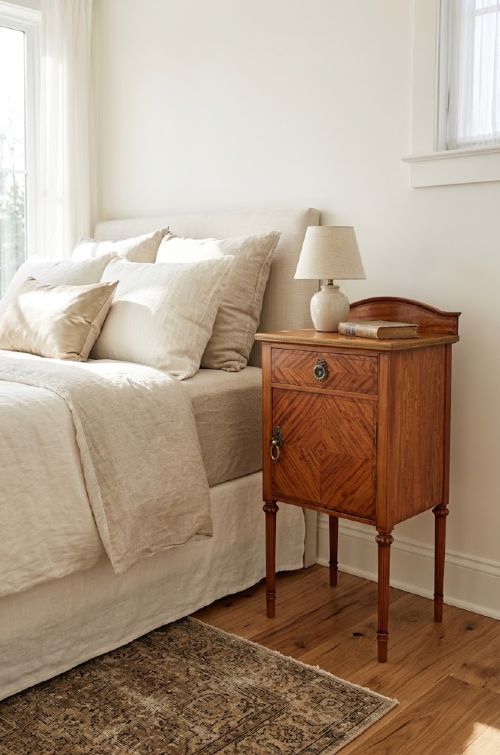

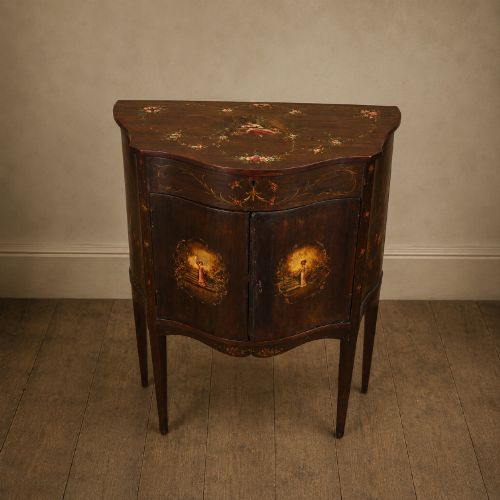


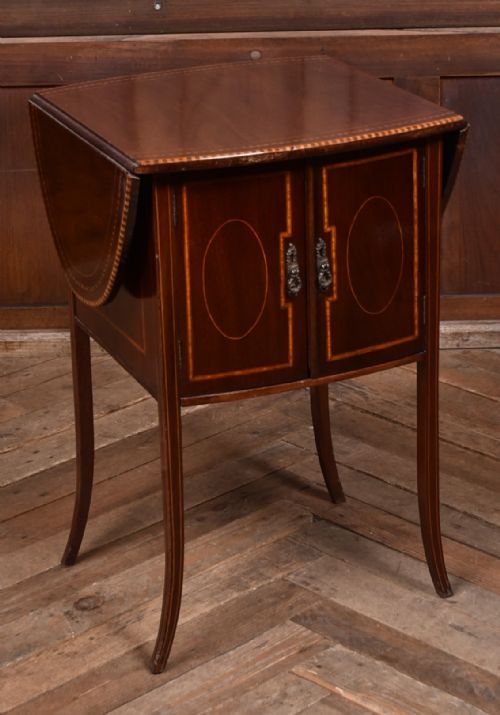


Sheraton Revival Nightstands
Sheraton revival nightstands bring neoclassical elegance to the bedroom, offering refined timber work and delicate inlay.
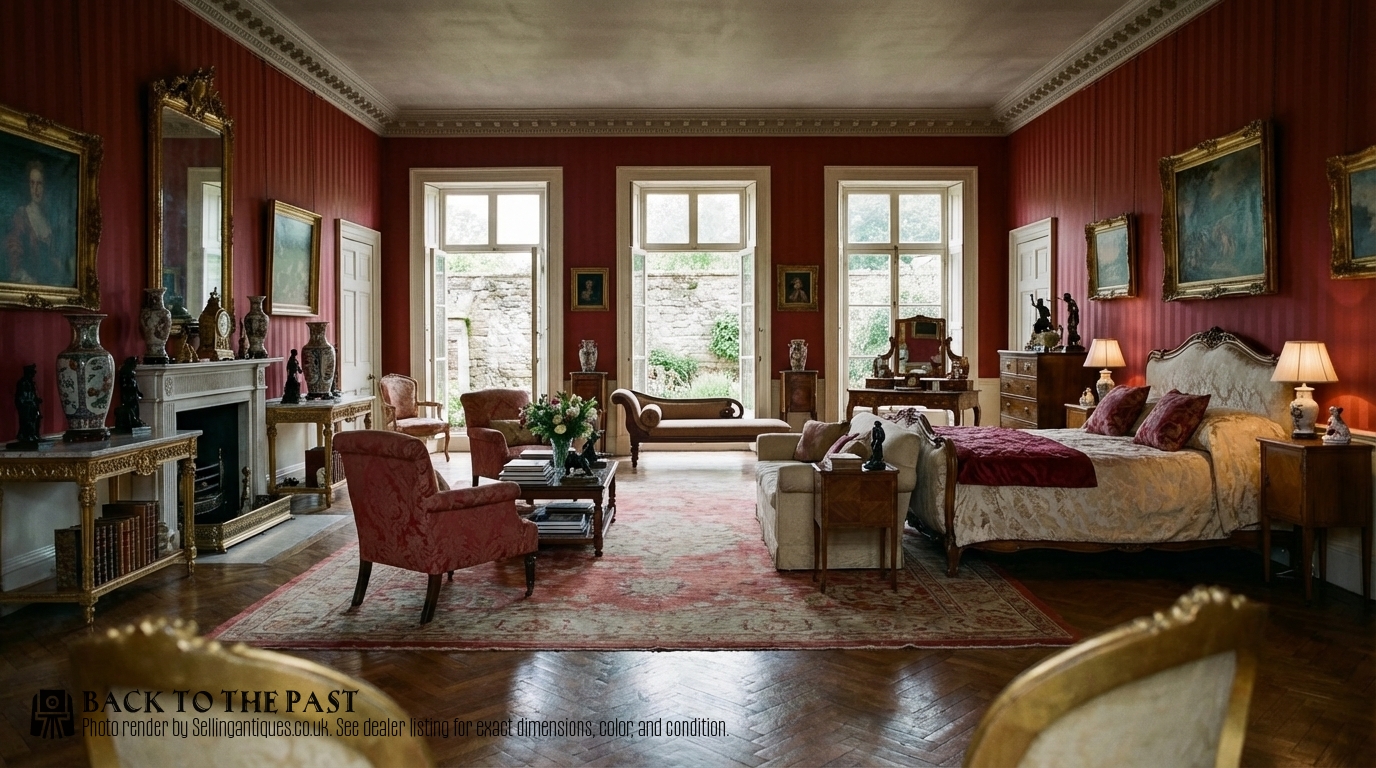
Sheraton Revival Nightstands
The pieces appearing here span Edwardian and Victorian periods, alongside nineteenth-century examples. Common forms include single bedside cupboards, bow-fronted cabinets, and matched pairs designed to stand beside a bed.
Makers of these items favoured proportions that felt light and graceful rather than heavy. Most examples on this page reflect the Edwardian interpretation of neoclassical revival styles.

How they were made
Makers utilised mahogany and satinwood as primary timbers, often enhanced by contrasting boxwood stringing and marquetry. These woods were selected for their fine grain and capacity to take a smooth polish.
Detailing frequently involved hand-painted decoration and brass hardware, such as handles and hinges. Certain pieces incorporated mirror glass or bow fronts to add visual depth to the cabinet.
Several cabinets feature bow fronts designed to catch candlelight gracefully.
What varies in quality
The refinement of the timber and the precision of the inlay set individual pieces apart. Finer examples display meticulous hand-painted detailing and carefully matched veneer grains across the panels.
Structural integrity in the joints and the crispness of the Sheraton-style motifs determine the standing of each cabinet. Subtle variations in proportions and the quality of the brass fittings distinguish workshop standards.
The Sheraton Revival Nightstands Glossary
- Satinwood
- A lustrous hardwood with a yellowish sheen, frequently used for veneering and cabinet-making during the neoclassical revival. It provides a pale, reflective surface that takes fine inlay.
- Marquetry
- The art of applying decorative veneer pieces to a structure to form geometric or pictorial designs. Craftsmen used contrasting woods like boxwood to achieve sharp definition.
- Bow front
- A convex, outward-curving front facade typical of refined case furniture. This shape softens the profile of a bedside cabinet.
- Stringing
- Thin lines of contrasting timber inlaid into the surface of furniture to create borders and panels. It defines the edges of drawers and cabinet doors.
- Edwardian
- The period spanning the reign of King Edward VII, noted for lighter furniture styles that revisited eighteenth-century aesthetics. Pieces from this era often feature delicate inlay and painted motifs.
Sheraton Revival Nightstands: Frequently Asked Questions
What is a sheraton revival nightstand?
These are bedside cabinets and cupboards made during the Victorian and Edwardian periods in the neoclassical style of the eighteenth century. They provide practical bedside storage with decorative timber finishes.
Cabinetmakers adapted earlier eighteenth-century designs to suit late Victorian and Edwardian bedrooms, focusing on elegance and proportion.
How do I date a sheraton revival nightstand?
Dating relies on observing the combination of timber, construction methods, and period characteristics such as Edwardian inlay or Victorian satinwood work. Most examples date from the late nineteenth to the early twentieth century.
Examining the interior timbers and drawer construction helps confirm the period of manufacture alongside the exterior style.
Are these nightstands found in pairs?
Pairs of bedside cabinets appear alongside individual pieces, reflecting original domestic setups where matching cupboards flanked a bed. Matched pairs are particularly sought after for symmetry in bedroom decoration.
Single cabinets also occur frequently, serving as versatile bedside tables or small side cupboards.
What woods were used for these cabinets?
Makers predominantly used mahogany and satinwood, accented with boxwood stringing and delicate marquetry. These materials provided a smooth canvas for painted details and polished finishes.
The choice of timber directly influenced the overall tone and lightness of the piece.