
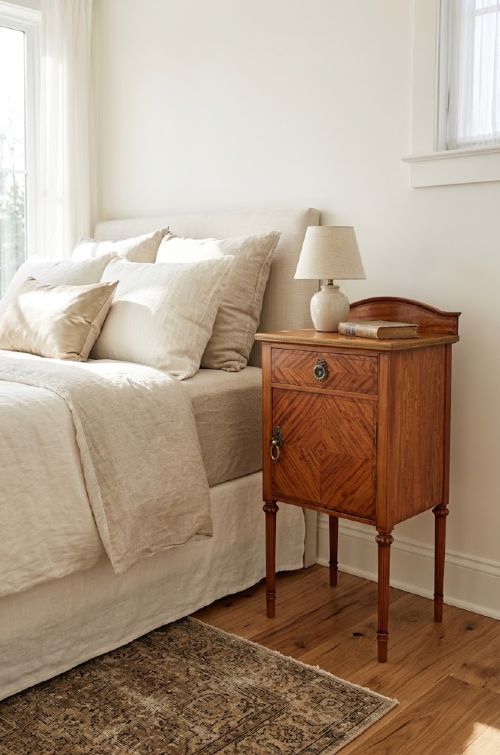

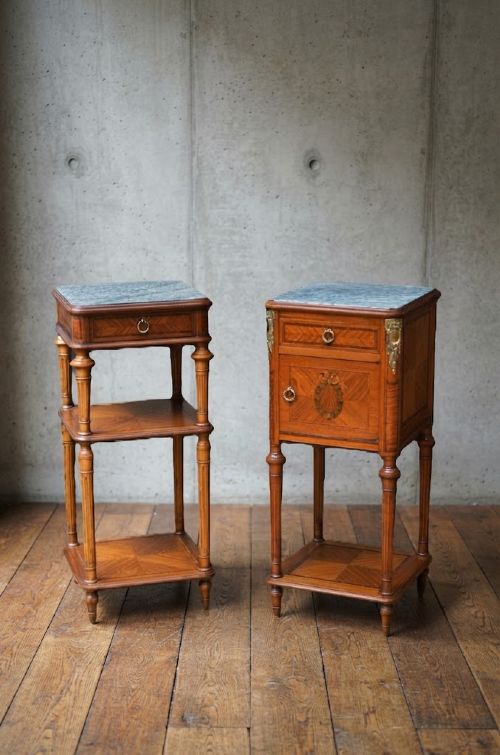
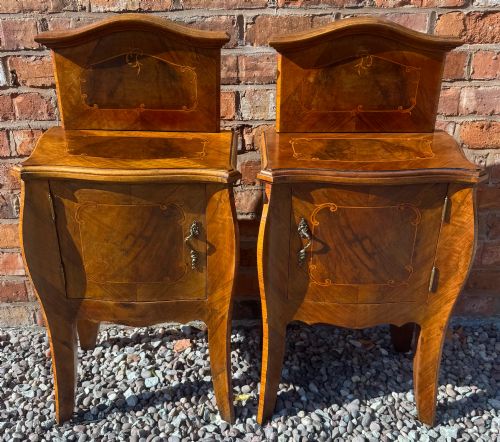


Golden Satinwood Pot Cupboard
These golden satinwood pot cupboards are refined bedside cabinets crafted from lustrous timbers, offering practical storage with a distinct period elegance.
Golden Satinwood Pot Cupboard
A golden satinwood pot cupboard is a compact bedside cabinet designed to hold a chamber pot or serve as a nightstand. Buyers searching this phrase will find pieces spanning the nineteenth century through the Edwardian era, predominantly in Victorian and Sheraton Revival styles.
The version most commonly met on this page is the single or paired bedside cabinet featuring a cupboard door, frequently accompanied by inlaid decoration or a shaped bow front. Originating mostly from English workshops, these items served refined bedrooms as functional and decorative necessities.
Materials and construction
Construction relies heavily on satinwood and satin birch, selected for their luminous grain and pale golden tone. Cabinetmakers enhanced these primary timbers with contrasting ebony inlay and intricate marquetry detailing.
Many examples incorporate practical upgrades such as fitted marble tops and cast brass hardware. Joinery techniques from the Victorian and Edwardian periods ensure sturdy carcase construction while allowing delicate decorative veneers to take centre stage.
Materials range from solid satinwood and satin birch to contrasting ebony inlay, marble surfaces, and hand-painted detailing.
Distinctions in quality
Quality in these pieces is dictated by the precision of the marquetry inlay and the choice of primary timber figures. Superior examples display carefully matched satinwood veneers and crisp, balanced brass fittings rather than plain surfaces.
The presence of fine detailing such as hand-painted decorations or shaped bow fronts separates standard utilitarian cupboards from masterworks of the Sheraton Revival or Louis styles. Structural integrity in the door hinges and the soundness of marble tops also mark the upper tier.
Gillows
The Golden Satinwood Pot Cupboard Glossary
- Satinwood
- A durable tropical timber known for its distinctive golden sheen and smooth texture. It forms the primary visual appeal of these cabinets.
- Bow front
- A convex curved front facade characteristic of refined nineteenth-century case furniture. This shape softens the corners of a bedroom interior.
- Marquetry inlay
- Decorative patterns formed by fitting contrasting veneers into prepared recesses in the wood. It demonstrates high levels of cabinetmaker skill.
- Sheraton Revival
- A late nineteenth and early twentieth-century design movement inspired by eighteenth-century neoclassical furniture forms. It favours light proportions and classical motifs.
Golden Satinwood Pot Cupboard: Frequently Asked Questions
What is a golden satinwood pot cupboard used for today?
These cabinets serve admirably as bedside tables or small storage units in contemporary bedrooms. Their compact proportions allow them to fit easily beside modern bed frames while concealing everyday items.
They also function effectively as lamp tables in living spaces or hallways. The fitted marble tops on certain models provide a durable surface for drinks or decorative objects.
How do I care for antique satinwood furniture?
Maintain satinwood surfaces by dusting regularly with a soft, dry cloth to prevent abrasive particle buildup. Avoid placing the wood in direct sunlight or near heat sources to protect the delicate golden tone and prevent veneer cracking.
Apply a quality natural wax polish occasionally to nourish the timber and preserve its sheen. Keep marble tops wiped clean with a damp cloth and mild soap.
How can I tell a Victorian piece from an Edwardian one?
Victorian examples often display heavier proportions and deeper colour tones with traditional mahogany or ebony stringing. Construction during this era prioritised robust utility alongside decorative marquetry.
Edwardian pieces, particularly those in the Sheraton Revival style, lean towards lighter proportions and airier neoclassical motifs. They frequently exhibit refined satinwood veneers with minimal, crisp inlay work.
Are these cupboards always found as pairs?
While matching pairs frequently appear from the Edwardian and late nineteenth-century periods, many survive as single items. Single cabinets are equally traditional as they were often purchased individually for smaller guest rooms.
Pairs command particular attention for symmetrical bedroom placement. Single cupboards offer versatile accent storage in tighter residential spaces.