

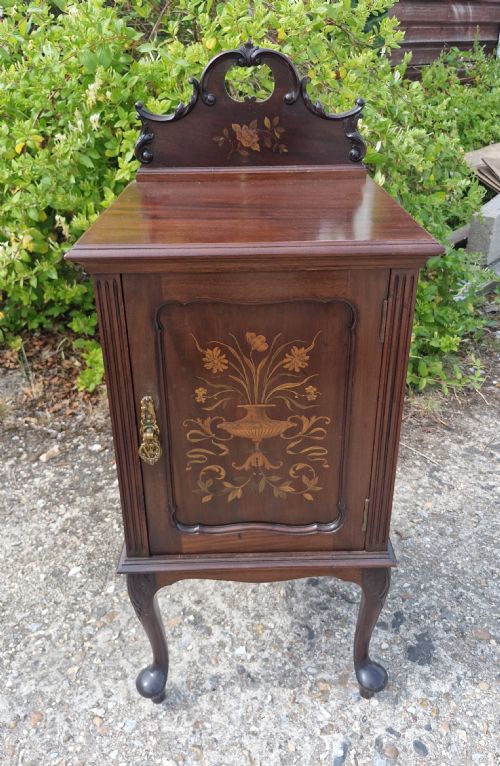

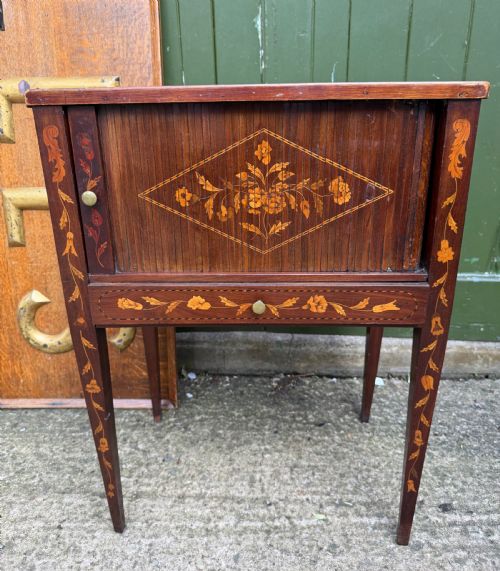


Inlaid Mahogany Pot Cupboard
An inlaid mahogany pot cupboard brings compact storage and fine timber grain to a bedside with understated utility.
Inlaid Mahogany Pot Cupboard
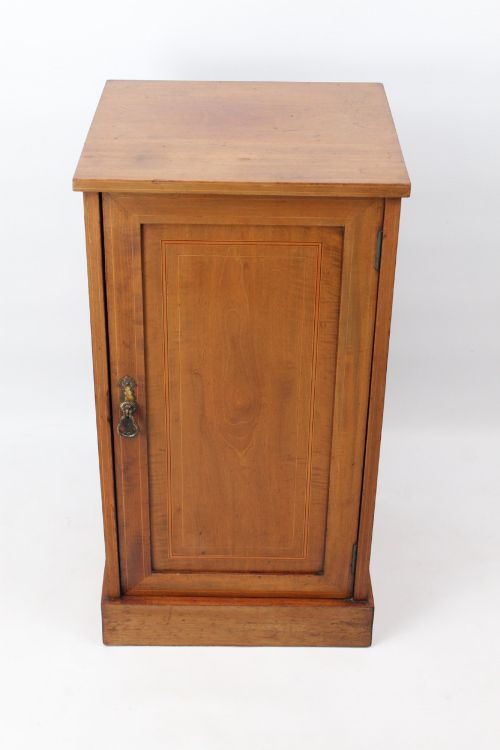
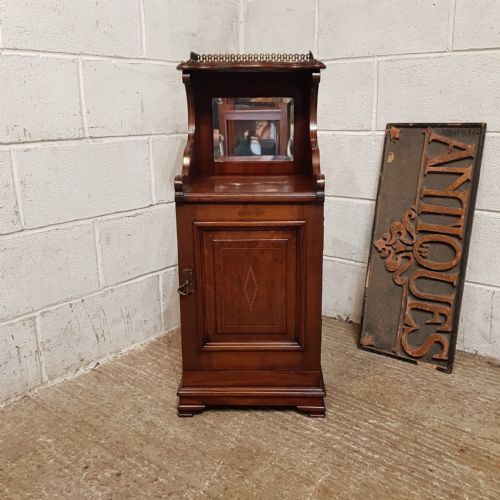
When searching for an inlaid mahogany pot cupboard, buyers encounter bedside pieces spanning from the 18th Century Georgian period through to Edwardian iterations. These items function primarily as bedside cabinets, night stands, and small side storage units. The selection on this page leans heavily towards Edwardian examples alongside Georgian and Victorian pieces.
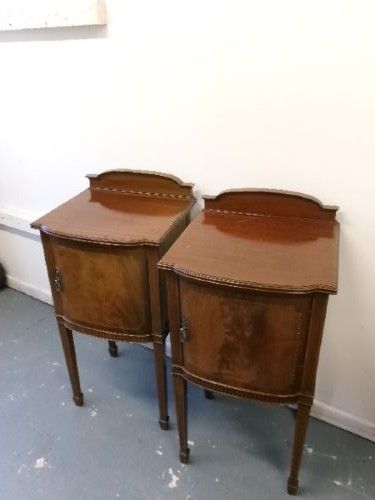
The forms range from straight-fronted bedside cabinets to bow-fronted designs and Dutch floral marquetry cupboard variants. Makers historically constructed these as practical bedroom furniture to house chamber pots or personal items. Surviving examples retain this compact footprint, making them adaptable for modern bedrooms as small tables or cabinets.
Timber construction and decorative technique
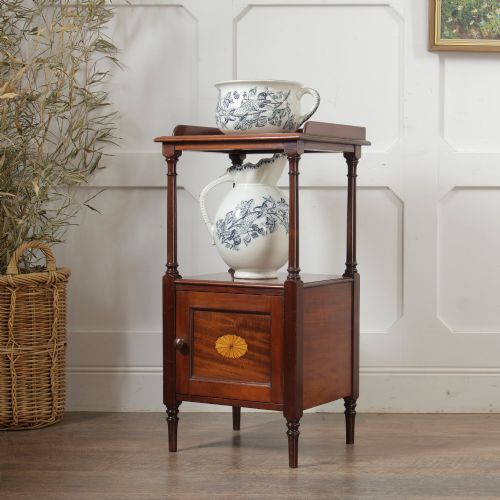
Cabinet makers built these pieces using solid mahogany and mahogany veneers, often incorporating contrasting woods for detail. Workshops utilised boxwood and satinwood inlay to create delicate lines, geometric borders, and floral motifs along the doors and top surfaces. Marquetry inlay appears on select Dutch and Edwardian pieces, adding pictorial complexity to the timber background.
The archive includes Dutch marquetry alongside Sheraton Revival bedside cabinets and washstand variants.
Distinctions in construction and design
Quality in an inlaid mahogany pot cupboard rests on the crispness of the cabinet work and the fidelity of the timber selection. Pieces displaying finely figured flame mahogany or intricate boxwood and satinwood inlay stand apart from simpler utilitarian versions. The precision of the marquetry and the retention of original brass fittings indicate higher workshop standards.
Proportion and structural integrity define the upper tier of these cabinets. Finer pieces demonstrate careful attention to dovetail joinery in the drawers and harmonious grain matching across the panels. Lesser examples show simpler construction without decorative banding or contrasting stringing.
Maple and Co·Edwards Roberts·Gillows Lancaster
The Inlaid Mahogany Pot Cupboard Glossary
- Marquetry
- Decorative woodwork where pieces of veneer are fitted into a ground material to form designs. This technique creates floral or pictorial patterns on cabinet doors.
- Satinwood
- A durable, yellow-toned timber utilised for contrasting inlay and stringing. It provides bright visual accents against dark mahogany surfaces.
- Pot cupboard
- A small bedside cabinet originally designed to enclose a chamber pot. These pieces now serve commonly as compact nightstands.
- Stringing
- Thin lines of contrasting wood inlaid into channels cut into the primary timber. This linear detail defines the edges of panels and tops.
Inlaid Mahogany Pot Cupboard: Frequently Asked Questions
What is a pot cupboard used for today?
Modern interiors utilise these compact cabinets primarily as bedside tables for lamps, books, and small personal items. Their enclosed storage keeps bedroom surfaces tidy while maintaining a small footprint.
The internal shelving and door design also suit use in narrow hallways or sitting rooms as supplementary display stands or small storage units.
How do I distinguish a Georgian piece from an Edwardian one?
Georgian cabinets often display heavier proportions, rich flame mahogany grain, and restrained stringing typical of the 18th Century and early 19th Century. Construction details like hand-cut dovetails provide structural clues.
Edwardian Sheraton Revival pieces generally feature lighter framing, more symmetrical satinwood boxwood inlay, and brighter surface finishes associated with the early 1900s revival style.
Are these cabinets usually found as pairs?
Many Edwardian and 19th Century cabinets survive as matched pairs intended to flank a bed. Single pieces also appear frequently from various periods.
Pairs usually command higher interest from collectors looking to furnish a bedroom symmetrically with matching timber grain and inlay work.
What maintenance do mahogany cabinets require?
Maintenance involves gentle cleaning with a soft cloth and occasional application of appropriate furniture wax to nourish the mahogany timber. Avoiding direct sunlight preserves the rich colour of the wood.
Keeping the cabinets away from extreme temperature shifts prevents timber movement and protects delicate boxwood and satinwood inlay.