


Sheraton Style Dressing Table
A sheraton style dressing table brings refined classical geometry and delicate inlay into a bedroom, offering a practical surface with lighter proportions than heavier antique forms.
Sheraton Style Dressing Table
A sheraton style dressing table draws on late eighteenth-century classical design principles, favouring straight tapered legs, subtle curves, and balanced proportions. When browsing for a sheraton style dressing table, pieces from the Edwardian era and the Sheraton Revival movement appear most frequently alongside authentic Georgian examples.
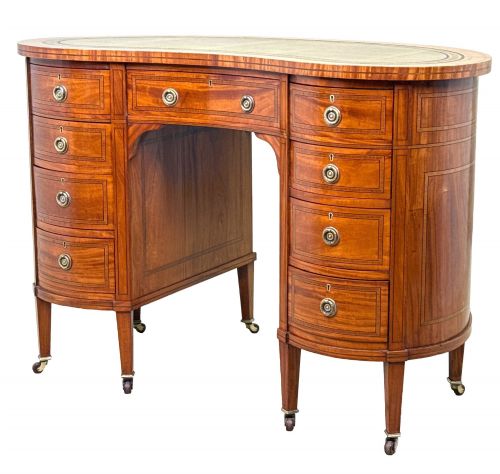
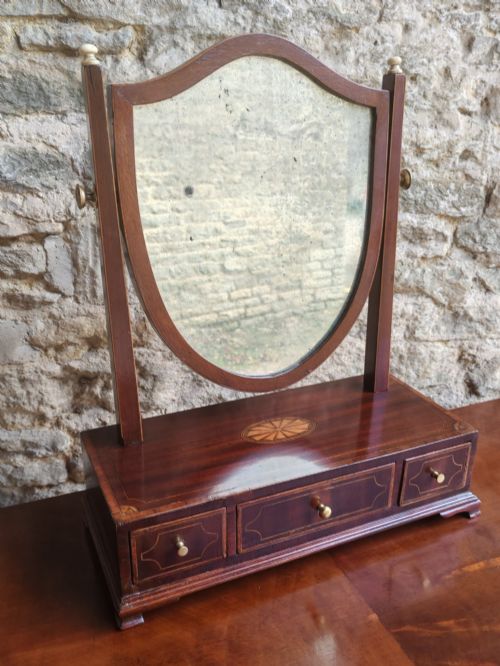
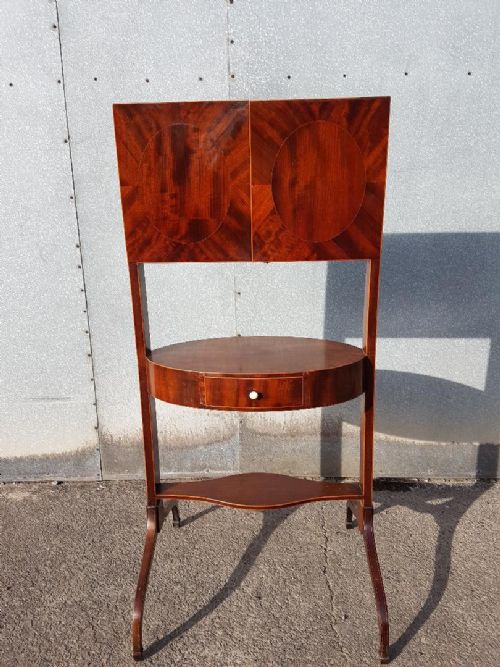
The selection ranges from kidney-shaped desks and sideboards with integrated mirrors to dedicated dressing tables featuring hand-painted satinwood panels and brass hardware. Alongside these primary forms, related items such as toilet mirrors and writing desks reflect the same vocabulary of classical revivalism.
Materials and construction methods
Cabinetmakers relied on dense timbers like mahogany and smooth satinwood as primary surfaces, often enhanced by contrasting boxwood inlay and delicate marquetry. Drawer linings and secondary woods demonstrate traditional joinery techniques appropriate to both eighteenth-century workshops and later revival periods.
Surface decoration frequently includes hand-painted details, brass handles, and glass components such as shield-shaped toilet mirrors or marble tabletops. Crossbanding and stringing define the edges, framing the grain of the timber with meticulous geometric precision.
Several ladies' writing tables retain hidden compartments designed for secret correspondence and miniature portraits.
Judging the quality of execution
Quality rests upon the crispness of the inlay and the selection of figured timber, where well-matched mahogany or satinwood grain elevates a piece beyond standard production. Finer examples display harmonious proportions, sharp hand-painted motifs, and substantial brass fittings that integrate seamlessly into the design.
The sophistication of the superstructure, the grace of the serpentine or kidney-shaped curves, and the integrity of the secondary woods distinguish superior workshops from ordinary commercial output.
Edwards & Roberts·Maple & Co.·Shoolbred of London·Heal & Son
The Sheraton Style Dressing Table Glossary
- Satinwood
- A lustrous, fine-grained exotic timber native to India and Sri Lanka, prized for its pale yellow colour and golden sheen. It serves as the primary veneer for many neoclassical and revival pieces.
- Marquetry
- The art of forming decorative patterns using thin veneers of different woods, shell, or ivory applied to a carcase. It requires precise cutting and fitting to achieve pictorial or geometric designs.
- Crossbanding
- A strip of veneer applied to the border of a tabletop or drawer front with the grain running perpendicular to the central panel. This technique creates a contrasting frame that highlights the main timber.
- Inlay
- A method of ornamenting a surface by embedding pieces of contrasting materials, such as boxwood or ebony, flush into depressions carved into the wood. It provides sharp linear definition to legs and drawer fronts.
- Superstructure
- An upper framework attached to a desk or table, typically containing small drawers, compartments, or a pivoting mirror. It adds vertical complexity and storage to lower writing surfaces.
Sheraton Style Dressing Table: Frequently Asked Questions
How do I identify a revival piece?
Revival pieces dating from the Edwardian period or around nineteen hundred often combine eighteenth-century neoclassical forms with machine-sawn internal timbers and brighter modern lacquers.
Examining the drawer construction and the ageing of the secondary woods helps distinguish these later interpretations from genuine Georgian production.
What woods were used?
Mahogany and satinwood form the foundation of these pieces, frequently accented with boxwood inlay, kingwood, and rosewood.
Secondary timbers like oak and pine appear inside drawer boxes and carcases depending on the workshop and period of manufacture.
Are mirrors original?
Mirrors on dressing tables and toilet stands were frequently replaced or resilvered over centuries of domestic use due to foxing and degradation of the original backing.
Original glass often shows minor distortions, slight pitting, and secure mounting within shaped wooden frames that match the primary timber.
How should I care for satinwood?
Satinwood requires protection from direct sunlight and excessive moisture to prevent the pale timber from darkening or the delicate painted decorations from fading.
Applying microcrystalline wax periodically preserves the polish and protects the surface from routine environmental wear.