






Sheraton Revival Centre Table
These Sheraton Revival centre table examples bring graceful eighteenth-century elegance into Victorian and Edwardian rooms with fine timber and delicate marquetry.
Sheraton Revival Centre Table
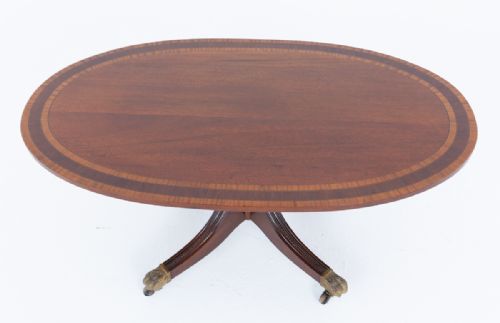
A Sheraton Revival centre table represents a deliberate nineteenth and early twentieth-century return to the lighter forms popularised by Thomas Sheraton a century before. These pieces function as freestanding room centrepieces rather than wall-bound furniture, designed to be viewed from every angle in a principal reception space.
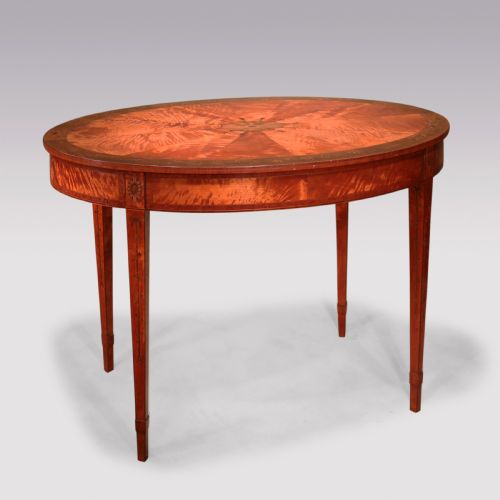
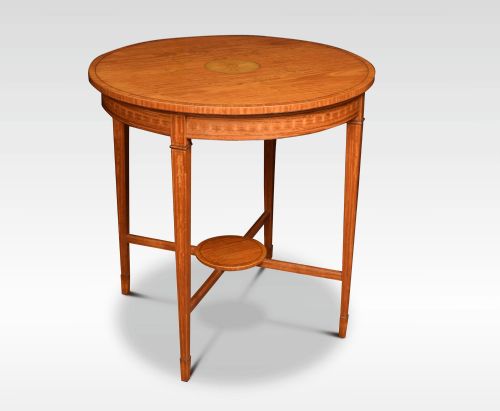
Buyers browsing this selection encounter circular, oval, octagonal, and two-tier occasional tables dating from the late nineteenth century through the Edwardian period to nineteen twenty. Mahogany and satinwood dominate the forms, frequently enriched with contrasting boxwood stringing and classical painted or inlaid motifs.
Materials and construction
Cabinetmakers built these frames primarily from mahogany and satinwood, occasionally introducing rosewood for darker contrast. Surface decoration relies heavily on precise inlay and boxwood stringing, alongside delicate hand-painted floral or classical garlands.
Brass fittings appear sparingly on castors or mounts, while tiered variations utilise slender turned or tapered legs to maintain visual lightness despite solid timber construction.
Several tables feature hidden lower tiers just large enough for a stray volume of poetry or an afternoon teacup.
Assessing quality
The distinction between standard examples and the finest pieces rests upon the precision of the timber figure and the complexity of the marquetry. Superior items display meticulously figured satinwood veneers and crisp, sharply defined boxwood inlay rather than rudimentary painted substitutes.
Structural refinement also separates grades, with better pieces exhibiting balanced proportions, elegant tapering supports, and retained stability across multi-tiered or unconventional octagonal and oval formats.
The Sheraton Revival Centre Table Glossary
- Sheraton Revival
- A late nineteenth and early twentieth-century style reviving the neoclassical furniture designs associated with George Hepplewhite and Thomas Sheraton. It favours light proportions, tapered legs, and subtle marquetry.
- Satinwood
- A pale, lustrous hardwood prized for its golden sheen and smooth grain. It serves as a primary veneer surface for high-status Edwardian occasional tables.
- Stringing
- A narrow strip of contrasting wood inlaid into the surface veneer to form delicate geometric borders. Boxwood is frequently utilised for this purpose against dark mahogany.
- Marquetry
- Decorative patterns formed by fitting together small pieces of veneer into wooden panels. It distinguishes finer tables through pictorial floral or classical motifs.
- Occasional table
- A small, movable table designed for specific, intermittent uses within a principal reception room. Examples in this category often feature two tiers for display.
Sheraton Revival Centre Table: Frequently Asked Questions
What is a Sheraton Revival centre table?
These pieces are freestanding nineteenth and early twentieth-century tables inspired by eighteenth-century neoclassical designs. They utilise lighter timbers and delicate inlays rather than heavy Victorian mass.
They serve as decorative room centrepieces, often holding lamps, books, or floral arrangements while standing visibly away from walls.
How do I date a centre table?
Dating relies on combining stylistic clues with material evidence across Victorian and Edwardian periods. Late nineteenth-century examples often feature deeper mahogany tones, while nineteen-hundred items lean towards brighter satinwood.
Construction methods and secondary woods inside drawers or underneath tiers also help narrow down the decade of manufacture.
Where should I place a centre table?
These tables belong in open spaces where their finished surfaces and inlaid details remain visible from all sides. A drawing room, large hallway, or principal sitting room suits them best.
Because they function as focal points, keeping the surrounding floor space clear allows the proportions and tapered legs to show to advantage.
Are these tables sturdy enough for daily use?
Most examples utilise solid mahogany or satinwood frames built to withstand normal domestic placement. Two-tier and occasional variations provide stable surfaces for everyday items like lamps and books.
Care should be taken with veneered surfaces to avoid excessive moisture and direct heat sources that might affect the timber.