



Sheraton Pot Cupboard
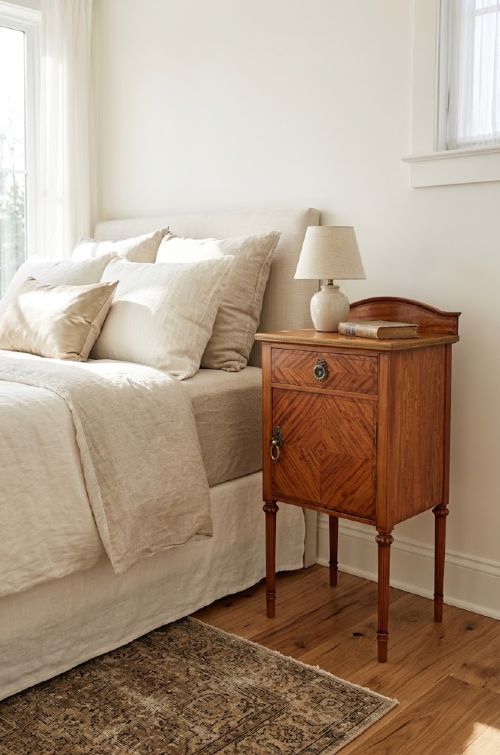
A Sheraton pot cupboard brings refined Georgian and revival lines right to the bedside.
Sheraton Pot Cupboard
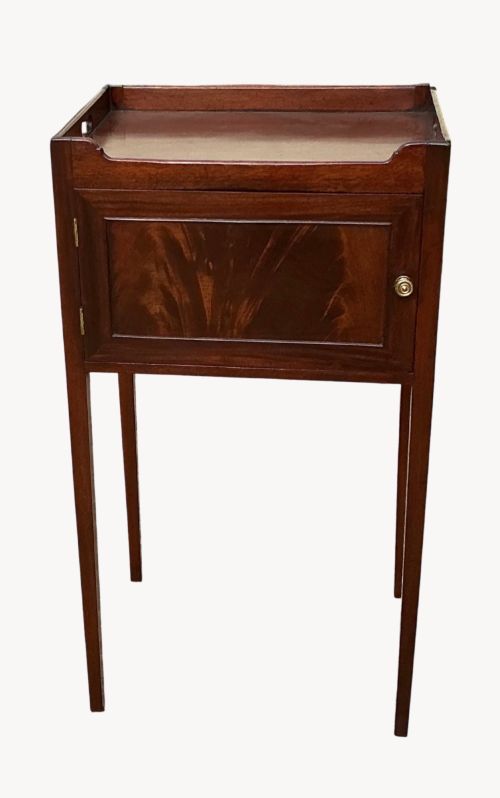
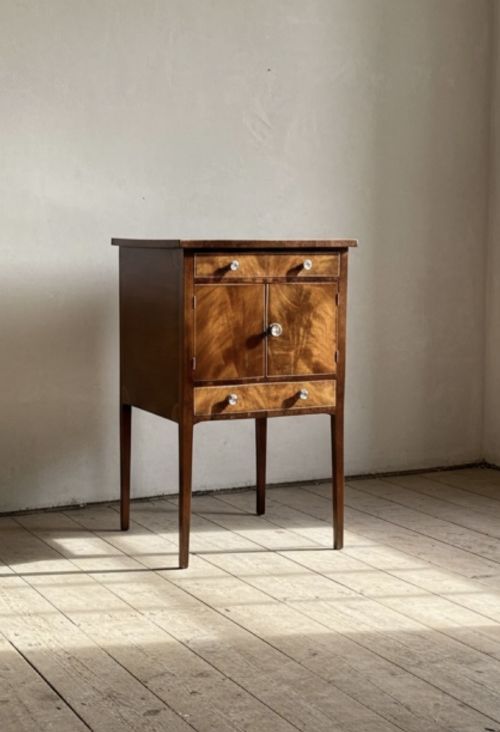
A sheraton pot cupboard serves as a compact bedside cabinet or nightstand, originally designed to conceal a chamber pot behind a panelled door. The pieces found here span the eighteenth century, the nineteenth century, and the Edwardian period, capturing both original Georgian craftsmanship and later revival movements.
Most examples adopt rectilinear or bow-fronted forms in mahogany and satinwood, often standing on slender tapering legs. Buyers encounter matched pairs alongside single cabinets, varying from simple bedside cupboards to more elaborate marquetry chests and commodes.
Materials and construction methods
Cabinetmakers utilised solid mahogany and flame mahogany veneer, frequently pairing them with contrasting satinwood for door panels and top surfaces. Details relied on precise woodworking techniques such as boxwood and ebony inlay, alongside delicate hand-painted ornamentation.
Hardware typically involved cast brass handles and hinges that complemented the polished timber surfaces. Structural integrity depended on tight joinery and stable secondary timbers hidden within the bedside carcase.
These polite little cupboards spent their mornings hiding chamber pots and their evenings holding a candle.
Evaluating craftsmanship and condition
Quality rests in the crispness of the stringing, the alignment of the veneers, and the selection of figured timber for the main surfaces. Finer cabinets display harmonious proportions and balanced inlay work rather than heavy or crowded ornamentation.
The integrity of the internal carcass and the original pairing of any matched sets dictate the standing of a piece. Subtle details, such as well-fitted doors and sound timber movement, separate standard utilitarian items from superior examples.
Gillows
The Sheraton Pot Cupboard Glossary
- Bow-front
- A convex curved front contour popular on eighteenth and nineteenth-century case furniture. This shape softens the corners of the bedside cabinet and showcases figured timber veneers.
- Marquetry
- Decorative woodwork where pieces of veneer are fitted into a ground material to form pictorial or geometric designs. Craftsmen used contrasting woods like boxwood and ebony to create crisp botanical or linear motifs.
- Sheraton Revival
- A late nineteenth and early twentieth-century design movement inspired by the neoclassical furniture of Thomas Sheraton. These pieces emulate lighter proportions, satinwood finishes, and delicate inlay.
- Stringing
- Thin lines of contrasting wood inlaid into grooves on table tops and cabinet fronts. It frames panels and accentuates the geometric lines of the furniture.
- Commode
- A term historically applied to various enclosed decorative cabinets and washstands with doors or drawers. In this context, it often describes an upscale bedside night stand.
Sheraton Pot Cupboard: Frequently Asked Questions
What is a sheraton pot cupboard?
A sheraton pot cupboard is a small enclosed bedside cabinet or nightstand dating from the Georgian era through to the Edwardian revival period. They were built to house a chamber pot behind a single door, keeping bedroom essentials neatly out of sight.
Today, buyers use them as bedside tables or side cabinets in compact spaces. Their enclosed storage makes them practical for modern bedrooms where surface area is limited.
How do I tell original Georgian from revival pieces?
Original eighteenth-century pieces display period construction methods, timber oxidation, and hand-cut joinery that differs from later manufacturing. Revival pieces from the Edwardian era often utilise machine-cut elements while faithfully copying the lighter neoclassical aesthetic.
Examining the secondary timbers, backboards, and interior drawer construction helps clarify the true age of the cabinet. Comparing the patination of the wood across different sections also reveals whether alterations or repairs have occurred over time.
Are pairs difficult to find?
Matched pairs of bedside cabinets appear less frequently than single items because most were originally manufactured individually or separated over centuries. When pairs do turn up, they often date from the Edwardian Sheraton revival period rather than the eighteenth century.
Buyers seeking symmetry in a bedroom should look specifically for designated pairs rather than attempting to match two separate single cabinets. Even within pairs, subtle variations in timber grain remind us that each piece was finished by hand.
How should I care for satinwood and mahogany?
Protect antique timber surfaces by keeping cabinets away from direct sunlight and maintaining stable room humidity. Gentle dusting with a soft cloth preserves the polish without stripping the aged finish.
Avoid placing damp items directly onto satinwood or mahogany veneers to prevent water rings and lifting. Occasional application of a suitable wax nourishment helps maintain the lustre of the timber.