
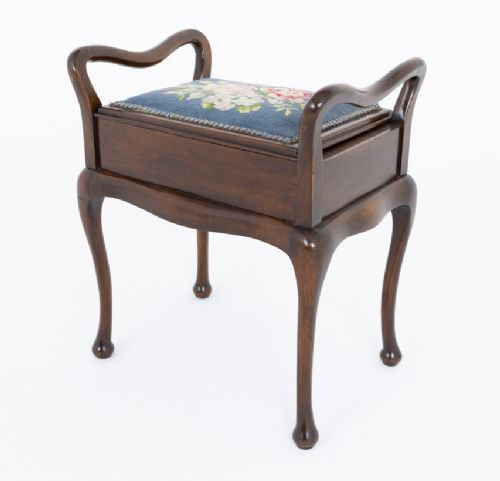


Sheet Music Storage Seat
These pieces for sheet music storage seat requirements combine practical storage with comfortable seating, offering an elegant solution for keeping scores organised beside the piano.
Sheet Music Storage Seat
A sheet music storage seat is a dedicated furniture form designed primarily for pianists, combining a seated bench with internal compartments for musical scores. Most examples encountered here belong to the Edwardian and Victorian periods, manifesting predominantly as mahogany piano stools or duet stools.
The construction typically incorporates hinged lids or fall-front mechanisms that open to reveal interior shelving or storage space specifically scaled for sheet music. Stylistic variations span simple Edwardian mahogany designs to pieces featuring Sheraton Revival boxwood inlay and Jacobean Revival oak constructions.
Materials and construction
Makers relied heavily on solid mahogany and walnut for the primary framework, often accentuating the timber with delicate boxwood inlay. Brass hinges and handles provide the functional hardware required for the opening mechanisms.
Upholstery forms an essential component of the design, utilising fabrics such as velvet and tapestry over padded seats. These textile elements complement the polished timber frames while ensuring comfort during prolonged practice sessions.
Current selections span the Victorian, Edwardian, and Jacobean Revival periods, constructed primarily in mahogany, walnut, and oak.
Assessing quality and craftsmanship
Superior examples distinguish themselves through the precision of their boxwood inlay and the selection of figured mahogany or walnut timbers. The smoothness of the mechanical action on lift-up lids and fall-front panels indicates the underlying standard of joinery.
The refinement of the upholstery work and the durability of the internal compartments separate standard utilitarian pieces from more sophisticated decorative commissions. Finer versions maintain crisp carving and balanced proportions that reflect the prevailing Edwardian and Victorian aesthetic standards.
The Sheet Music Storage Seat Glossary
- Duet stool
- An elongated piano stool designed to accommodate two players simultaneously. These wider seats often feature more substantial internal storage capacity for larger collections of shared sheet music.
- Fall-front
- A hinged front panel that drops downward to provide easy access to internal compartments. This mechanism allows players to retrieve scores without lifting the upholstered seat itself.
- Sheraton Revival
- A late nineteenth and early twentieth-century design style drawing inspiration from the neoclassical furniture of George Sheraton. Pieces in this manner frequently display symmetrical boxwood inlay and refined tapered legs.
- Boxwood inlay
- A decorative technique where contrasting light-coloured boxwood is inserted into recesses carved within a darker primary timber. It creates crisp geometric or floral borders typical of Edwardian cabinetmaking.
Sheet Music Storage Seat: Frequently Asked Questions
What is a sheet music storage seat used for?
These pieces serve a dual purpose as both a functional piano bench and a discrete cabinet for organising sheet music. The internal compartments keep scores flat and protected from dust near the instrument.
Historically, they sat beside upright and grand pianos in domestic parlours, ensuring the musician had immediate access to their repertoire during practice or performance.
How do I date a sheet music storage seat?
Dating relies heavily on observing the timber choices, decorative motifs, and overall structural style. Pieces from the Victorian era often feature heavier walnut construction and darker finishes, whereas Edwardian examples frequently showcase brighter mahogany paired with delicate boxwood inlay.
Hardware details, such as the style of brass hinges and the type of upholstery fabric, also offer reliable clues to the decade of manufacture.
Are these seats comfortable for daily piano practice?
Most variants provide adequate padding through traditional upholstery methods, often utilising durable tapestry or velvet surfaces. They were engineered specifically to support correct posture at the keyboard over extended periods.
Buyers intending daily use can easily refresh the internal padding or top fabric while preserving the antique timber frame.